
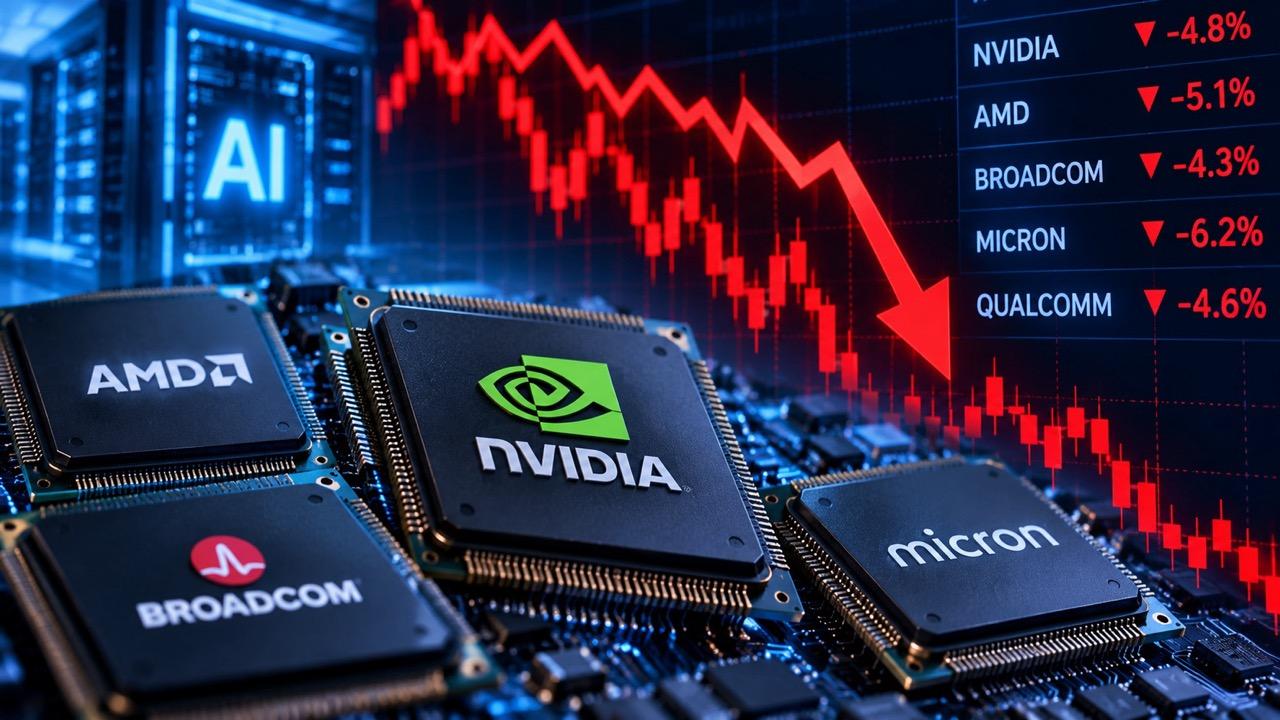
Semiconductor stocks have tumbled in October as rising bond yields, mounting AI infrastructure costs and questions about future returns prompt investors to reassess the artificial intelligence trade. The selloff has hit major chipmakers and raised concerns about whether the debt-financed expansion of AI infrastructure can deliver sufficient profits.
The retreat marks a shift in sentiment after chipmakers benefited from heavy spending on AI data centers, advanced processors and high-bandwidth memory. Reuters reported on October 15 that US semiconductor stocks were on course to lose roughly $2 trillion in market value during the selloff, with the Philadelphia Semiconductor Index down more than 3% that day.
The decline has affected companies across the AI supply chain, including Nvidia Corp. (NASDAQ: NVDA), Broadcom Inc. (NASDAQ: AVGO), Micron Technology Inc. (NASDAQ: MU) and major Asian chipmakers. Their exposure differs, but their valuations have benefited from expectations that demand for AI computing will continue to expand.
The recent losses do not establish that demand for AI chips is collapsing. Instead, investors are weighing whether the pace of infrastructure investment can be sustained as financing costs rise and companies face greater pressure to demonstrate returns on their spending.
Why Semiconductor Stocks Are Falling as AI Financing Costs Rise
The latest selloff reflects growing concern that the cost of financing AI infrastructure could outpace the returns generated by the technology. Higher Treasury yields increase the cost of capital, making expensive projects less attractive and putting pressure on valuations that assume years of strong growth.
Reuters reported on October 13 that the Philadelphia Semiconductor Index was heading toward a sixth consecutive daily decline, while South Korean chipmakers Samsung Electronics and SK Hynix faced heavy selling. The broader retreat followed months of strong gains driven by expectations of sustained demand for AI processors and memory chips.
The pressure has also extended beyond semiconductor manufacturers. Shares of CoreWeave, an AI cloud infrastructure provider with substantial debt, have fallen as investors question whether the revenue generated by new data centers will be sufficient to cover financing and operating costs. CoreWeave's bonds have also come under pressure, with yields rising to around 15% on a bond issued earlier in the year.
That matters for chipmakers because their growth depends partly on continued spending by cloud providers and other technology companies. If infrastructure operators face higher borrowing costs or struggle to secure financing, some projects could be delayed, potentially affecting future orders for processors, memory and networking equipment.
Investors are also reassessing the relationship between AI spending and profitability. Major technology companies have committed substantial sums to data centers, chips and computing infrastructure, but the financial benefits may take time to materialize. Reuters reported on October 16 that five major AI infrastructure spenders could collectively increase capital expenditure to approximately $1.2 trillion next year, based on Goldman Sachs estimates.
The scale of those investments creates an increasingly important test for the industry: whether revenue and operating profits can grow fast enough to justify the cost of building and maintaining AI infrastructure.
The International Monetary Fund has also warned that an AI-driven market correction could have wider financial consequences if investors' expectations for the technology prove too optimistic. That warning does not predict an imminent collapse, but it highlights the potential for a reassessment of AI valuations to affect markets beyond technology.
Is the AI Trade Losing Momentum or Entering a New Phase?
The recent decline suggests investors are becoming more selective about AI-related stocks rather than abandoning the technology altogether. Semiconductor companies remain central to AI development, but valuations increasingly depend on earnings growth, customer demand, and the returns generated by infrastructure spending.
Market participants have pointed to profit-taking, crowded positions and rising interest-rate expectations as additional factors behind the selloff. The recent decline in semiconductor stocks has followed a strong rally, leaving some investors more sensitive to disappointing news or changes in the outlook for AI investment.
Upcoming earnings reports could help determine whether the pullback reflects a temporary adjustment in market positioning or a more significant reassessment of demand. Results from semiconductor equipment makers such as Lam Research Corp. (NASDAQ: LRCX) and Texas Instruments Inc. (NASDAQ: TXN), alongside updates from major technology companies, should provide further information about spending plans and demand across the supply chain.
Investors will also watch Nvidia and other leading chip suppliers for evidence that demand remains strong enough to support current valuations. Orders, revenue growth, margins and management guidance will be important indicators, particularly if companies continue expanding their AI infrastructure budgets despite higher financing costs.
The distinction between short-term share-price declines and deteriorating business fundamentals remains important. A stock can fall sharply even when sales are growing if investors decide that its valuation already reflects years of future growth. Conversely, sustained weakness in customer spending or reduced earnings forecasts would provide stronger evidence that the underlying outlook is changing.
For readers following investment markets and technology stocks, the next phase of the AI trade will likely depend on whether companies can turn heavy spending into measurable financial returns.
For now, October's semiconductor selloff signals a more demanding environment for AI investments. Investors are no longer focused solely on how quickly the industry can expand computing capacity; they are increasingly asking how that expansion will be financed and when it will generate sufficient returns.
The AI trade has not necessarily run its course, but the market is beginning to distinguish between companies with durable demand and sustainable economics and those whose growth depends heavily on continued access to cheap capital.