

Michael Burry, famous for shorting the U.S. housing market in 2008 and making over $700 million for Scion Asset Management, has remained one of the most prominent investors in the stock market. Now, his stock buys are back in focus in 2026 after the investor behind “The Big Short” used public disclosures and posts to outline a new batch of buys, from Chinese e-commerce to sports betting and consumer names.
The SEC filing shows that Michael Burry has not been buying for momentum. Rather, he has been buying into drawdowns, valuation resets, and policy overhangs, arguing that market pessimism has pushed several businesses below what he sees as their long-term earning power. This report is a Wealthier Today guide to every stock Burry publicly disclosed buying in 2026, the price he said he paid, and how each has performed since that entry, based on recent market data and his own commentary.
What Stocks Michael Burry Bought In 2026 And Why
In Q1 2026, Scion Asset Management’s 13F filing showed a major shift toward a smaller, more concentrated basket, including new positions in MercadoLibre, Adobe, PayPal, and Lululemon. By June 30, 2025, the filing showed Scion had also held names such as Alibaba, JD.com, Estee Lauder, Regeneron, UnitedHealth, and VF Corp.
The largest disclosed value in the filing was UnitedHealth at about $116.6 million, followed by Regeneron at $112.9 million, and Lululemon at $106.9 million. Meta Platforms came in at $73.8 million, while Estée Lauder totaled $52.5 million across common shares and call options.
Then, in July 2026, Burry revealed on his Substack that he bought Flutter Entertainment, DraftKings, and more JD.com, describing Flutter at about $107 a share, DraftKings in the low-$26 range, and JD.com at $27.58. Reuters reported that Michael Burry framed the bets as a response to what he sees as regulatory pressure on prediction markets, which could hurt sports-betting operators less than investors currently expect if taxes and regulation rise on those event-contract products.
With Flutter and DraftKings, Burry is betting that prediction-market competition will eventually be regulated more like gambling, not less. Reuters reported that he called the current setup a loophole because event contracts can be offered nationwide under CFTC oversight while avoiding state gaming taxes. That is the central risk/reward debate for both names.
The JD.com stock buy fits a different thesis. Burry said he expects Hong Kong and Chinese stocks to benefit as enthusiasm in AI and memory chips rotates away from South Korea and Japan. Michael Burry appears to think investor capital could move back toward lagging Chinese large caps if the next big market trade loses steam.
For MercadoLibre, the appeal for Michael Burry is simpler. The stock sold off sharply after earnings, and Burry said he was able to buy in the “1,600s.” That matters because MercadoLibre is still the dominant e-commerce and fintech platform across much of Latin America, and large-quality franchises often look expensive until a temporary pullback gives investors a better entry point.
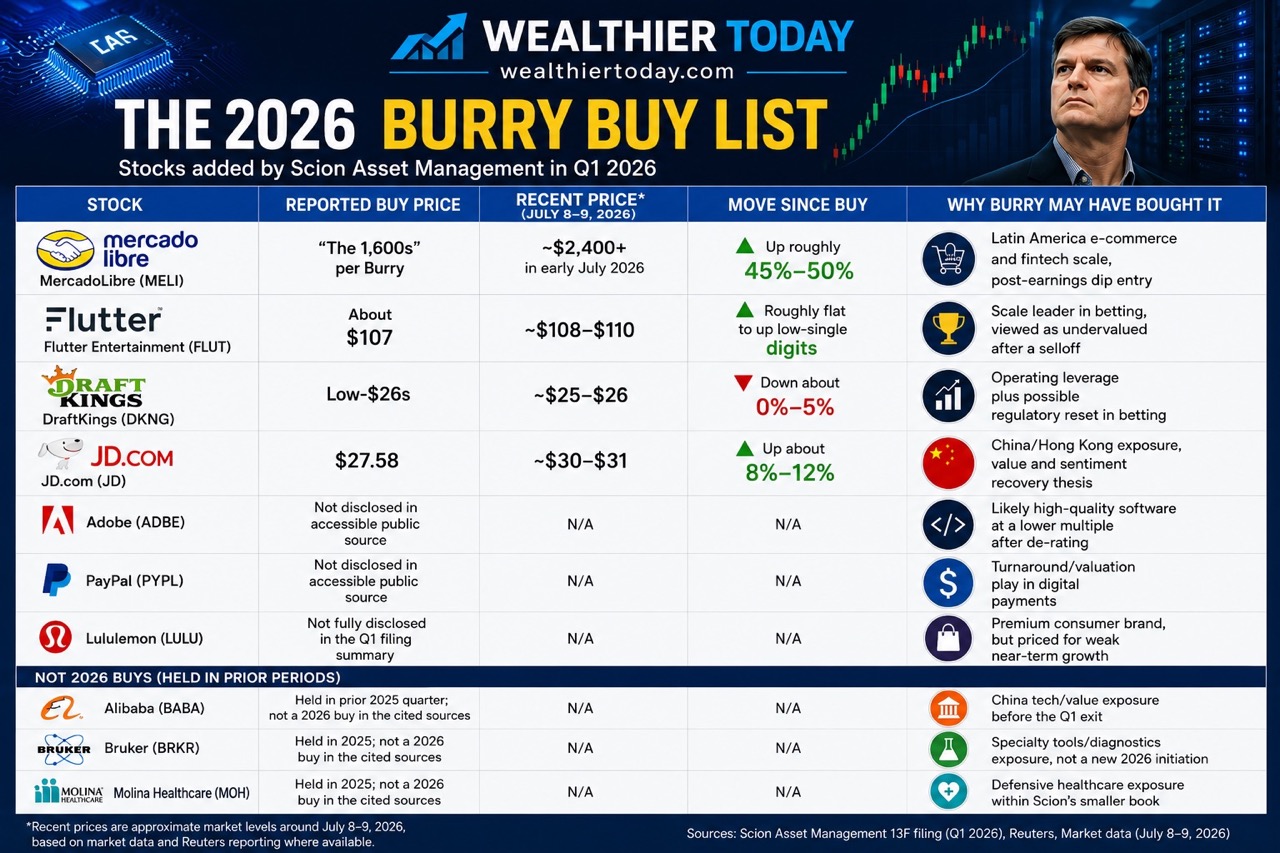
Adobe, PayPal, and Lululemon remain the least transparent names in the available public sources, but the broader setup is consistent and moves toward quality businesses, softer sentiment, and a price that the market has pushed down faster than earnings power may warrant.
Setting Up Another Big Short Behind The Trades?
The numbers help explain why these Michael Burry stock buys stand out. Flutter was described by Reuters as down about 50% for the year at the time of its purchase, while DraftKings had fallen about 21%. Meanwhile, JD.com was bought at $27.58, a price that suggests Burry wanted exposure before any re-rating in Chinese equities.
These moves, one could say, represent the classic Michael Burry who looks for a stock whose price already reflects the worst-case story, and then asks whether the company can still compound cash flow, expand margins, or benefit from a regulatory shift. The millionaire investor has also said he expects betting markets to be pulled deeper into regulation and taxation, which would narrow the competitive edge of lightly regulated rivals.
From a portfolio construction standpoint, Michael Burry’s buys also show concentration. His disclosed holdings are typically few in number, and the 2026 move into multiple battered names suggests he prefers a handful of high-conviction ideas over broad diversification.