
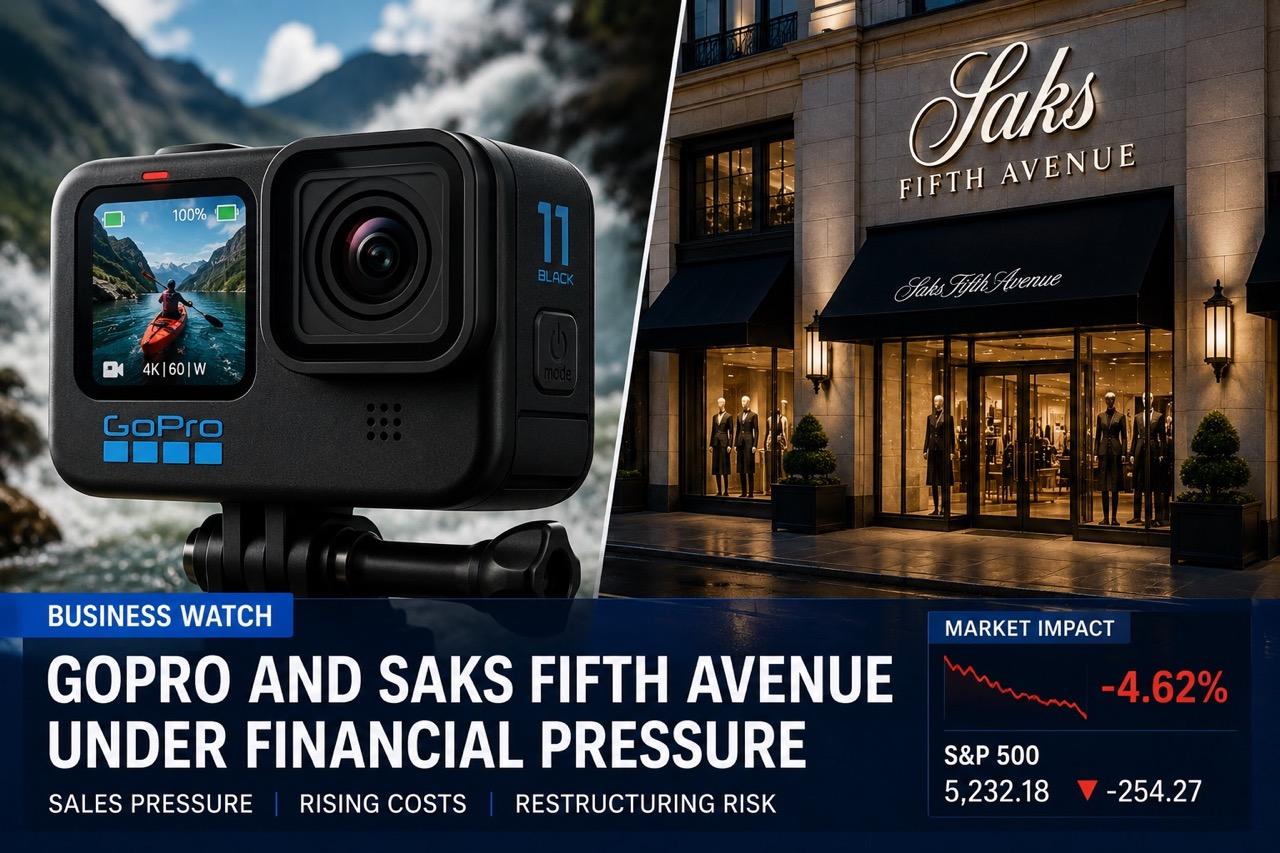
In 2026, bankruptcy and financial trouble are no longer limited to small distressed firms. They are now showing up in the filings and court battles of better-known brands such as GoPro and Saks Global. When liquidity shrinks, debt maturities tighten, and costs rise faster than sales, the risk of a turnaround can turn into a race against the calendar, no matter how big the company is.
GoPro Bankruptcy Risk Is Rising At The Wrong Time
GoPro, the action-camera maker once synonymous with adventure video, has warned that it may need to “significantly reduce, restructure, cease operations, or seek protection under the Federal bankruptcy laws” if it cannot secure new financing or complete a strategic transaction, according to its SEC filing and company disclosures filed in early June 2026. Saks Global, meanwhile, has already moved through Chapter 11 bankruptcy and won court approval on June 5, 2026, for a restructuring plan that would leave it smaller, more leveraged to senior lenders, and much more dependent on consistent vendor support.
GoPro’s warning landed after a brutal stretch in which the company said first-quarter 2026 revenue fell 26% year over year to $99.1 million. At the same time, adjusted EBITDA was negative $50 million, and cash and equivalents were down to $40.7 million at March 31, 2026, from $49.7 million at the end of 2025, according to its SEC filings. The company also disclosed an aggregate principal debt balance of $99.9 million at quarter-end.
The bigger problem for the camera maker, however, is margin pressure. GoPro told investors that memory component prices spiked as much as 80% to 115% in late March 2026, while suppliers indicated production cuts that reduced forecasted sales volumes. The company also flagged a $24.5 million non-cancelable purchase commitment tied to those components. This simply means that weaker demand and higher input costs are hitting the company at the same time, which is exactly the kind of combination that can force a company to seek refinancing, asset sales, or a court-led reset.
As a result, GoPro’s board authorized strategic alternatives, including a possible sale or merger, and the company engaged outside advisors to explore defense and aerospace opportunities for its imaging technology. But those moves may simply help to buy GoPro some time, but they do not guarantee survival.
For context, a “going concern” warning does not mean a company is automatically entering bankruptcy. It means management and auditors believe there is substantial doubt about the company’s ability to meet obligations over the next 12 months. In GoPro’s case, that warning is especially meaningful because the company also said it may not comply with future minimum liquidity, EBITDA, and asset-coverage covenants, creating a cross-default risk if lenders choose to act.
Financial Distress Can Quickly Become A Court Process
Saks Global is another example that offers a different but equally important example of how financial trouble can escalate toward bankruptcy. On January 13, 2026, Reuters reported that the luxury retailer filed for Chapter 11 protection with about $3.4 billion in debt after its Neiman Marcus takeover strained cash flow and vendor relationships. By June 5, 2026, Reuters reported again that a U.S. bankruptcy judge approved the company’s restructuring plan, paving the way for a smaller company with lower debt and new lender control.
The numbers show how deep the reset is for Saks Global. Senior lenders will reportedly provide $1 billion in new funding through the bankruptcy case and another $500 million after exit. The company is also expected to emerge with about 49 luxury retail locations, including 33 Neiman Marcus stores, 15 Saks Fifth Avenue stores, and Bergdorf Goodman. Its equity is set to be wiped out under the plan, and junior creditors, owed roughly $1.5 billion, would likely recover little without a litigation trust funded with $20 million.
For Saks Global, the Chapter 11 bankruptcy case appears to be a way to shed debt, rebuild vendor trust, and right-size its store footprint. But it also reflects how fast a leverage-heavy retail strategy can break when sales soften, and suppliers stop shipping inventory on favorable terms.
The luxury sector is particularly sensitive to this kind of stress because brands, inventory, and customer confidence are tightly linked. Once vendors lose confidence, the problem becomes self-reinforcing: less inventory means fewer sales, which leads to more cash pressure, which makes vendors even more cautious. This dynamic is why distressed companies often seek court protection only after months of slower warning signs. By the time the filing arrives, the business may still be operating. But it is usually operating under heavy constraints.