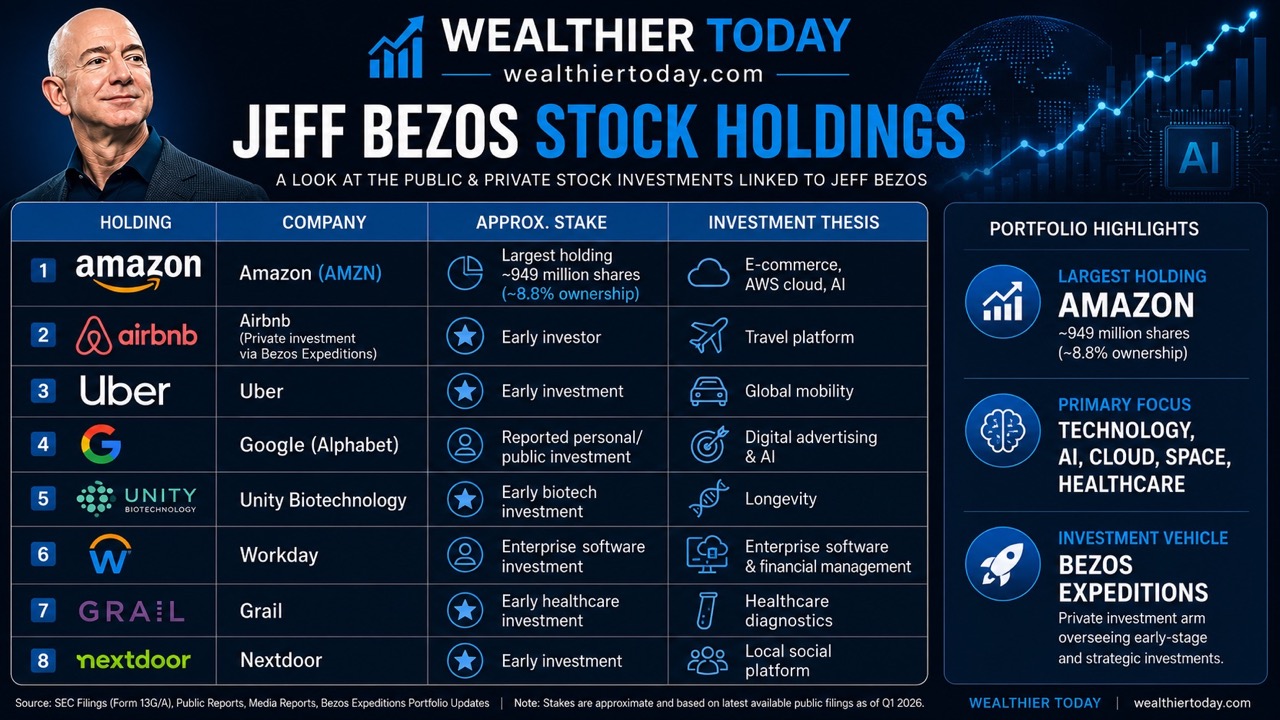
When it comes to stocks, Jeff Bezos’ holdings have become nearly synonymous with long-term wealth creation. The Amazon founder built one of the world's largest fortunes through a concentrated investment strategy that has delivered massive gains across technology, e-commerce, artificial intelligence, and digital platforms.
Unlike Warren Buffett, who manages a highly diversified portfolio through Berkshire Hathaway, Jeff Bezos has generally favored a small number of high-conviction investments. Most of his wealth remains tied to Amazon, but his venture arm, Bezos Expeditions, has backed several companies that later became household names.
Below is a look at some of the most notable stocks and equity investments associated with Jeff Bezos, how they have performed, and why the billionaire entrepreneur invested in them.
Jeff Bezos' Biggest Stocks And How They Have Performed
Amazon (NASDAQ: AMZN)
Investment Date: Founded in 1994 and publicly listed in 1997 IPO Price: $18 per share ($0.075 adjusted for stock splits) Recent Price: Around $220 per share Approximate Gain: More than 290,000%
No investment defines Jeff Bezos more than Amazon. The company started as an online bookstore and expanded into cloud computing, logistics, advertising, streaming, and artificial intelligence. To put into perspective how much the company has grown, an investor who purchased $10,000 worth of Amazon shares at its IPO and held them would now have an investment worth well over $30 million.
The value proposition was straightforward but ambitious, and it was to build an online retail ecosystem with relentless customer focus and long-term investment. Today, Amazon's cloud division, AWS, remains one of the company's biggest profit drivers, while AI services and advertising have become additional growth engines.
The clearest confirmed purchase on record is Bezos’ June 2023 buy of one Amazon share at $114.77, first reported by Bloomberg on June 9, 2023. Bloomberg described it as the first Amazon share purchase in records going back to 2002, a striking fact given that Bezos remains Amazon’s largest individual shareholder.
Since then, Bezos has been much more active on the sell side. Reuters reported on July 1, 2025, that he sold 3.3 million Amazon shares for about $736.7 million in late June 2025 after adopting a 10b5-1 trading plan in March. SEC filings show additional sales on July 3, 2025, and July 8-9, 2025, with weighted average prices around $223.73 to $224.02 per share. Those filings showed his remaining holdings still above 901.9 million shares after the July transactions.
Airbnb (NASDAQ: ABNB)
Investment Date: Early private funding rounds around 2011 Estimated Entry Valuation: Approximately $1 billion Current Market Capitalization: More than $80 billion Approximate Gain: Over 7,900%
Jeff Bezos invested in Airbnb through Bezos Expeditions when home sharing was still an emerging industry. The investment thesis centered on platform economics. Airbnb owned little physical inventory yet had the ability to connect millions of travelers with hosts worldwide. The company eventually became one of Silicon Valley's most successful public offerings.
Uber Technologies (NYSE: UBER)
Investment Date: Around 2011 Estimated Investment: $37 million Estimated Share Price Equivalent: Roughly $30 per share on a split-adjusted basis Recent Price: Approximately $95 per share Approximate Gain: More than 200%
Among the most successful stocks in the Bezos portfolio has been Uber. The investment reflected confidence in platform businesses capable of disrupting large traditional industries. Uber now generates billions in annual revenue and has expanded beyond ride-hailing into food delivery and freight services.
Jeff Bezos Favors High-Growth Stocks
Google (NASDAQ: GOOGL)
Investment Date: Pre-IPO investment through Google backers Estimated Entry Price: Approximately $0.85 split-adjusted Recent Price: Around $190 Approximate Gain: More than 22,000%
Google became another major winner for Jeff Bezos over the years. The company's dominance in search, advertising, cloud computing, and artificial intelligence has made it one of the world's largest technology firms. Like Amazon, Google benefits from powerful network effects and significant scale advantages.
Unity Software (NYSE: U)
Investment Date: Early private investment rounds Current Performance: Shares remain below their post-IPO highs Approximate Change: Down significantly from peak levels
Interestingly, not all of Jeff Bezos' stocks have been winners. Unity's technology powers thousands of games and real-time 3D applications, but the company has faced profitability challenges and slower growth. Still, the investment highlights Bezos' willingness to back technologies with long-term disruption potential.
Workday (NASDAQ: WDAY)
Investment Date: Early funding rounds Recent Performance: Shares have generated substantial gains since their IPO
Workday provides cloud-based software for human resources and financial management. The company benefited from the migration of enterprise software to the cloud and remains a leader in digital business management solutions.
Perplexity AI
Investment Date: Private funding rounds Current Status: Privately held Estimated Valuation: Tens of billions of dollars
Artificial intelligence (AI) represents one of the newest areas of interest for Jeff Bezos, and Perplexity AI is developing conversational search technologies that could challenge traditional search models. The investment reflects a broader belief that AI could reshape information discovery and productivity. The broader lesson from Jeff Bezos and his stock portfolio is that concentration can create enormous wealth when investors correctly identify transformative businesses. Unlike many billionaire investors who hold dozens of positions, Jeff Bezos has generally focused on companies with massive addressable markets, scalable business models, and technological advantages.
His investments also reveal a preference for platform companies capable of generating network effects and long-term competitive moats. Not every investment has been successful. Some stocks have underperformed or remain private bets whose outcomes are uncertain. However, Amazon, Google, Airbnb, and Uber demonstrate why the Bezos approach has been extraordinarily effective.