
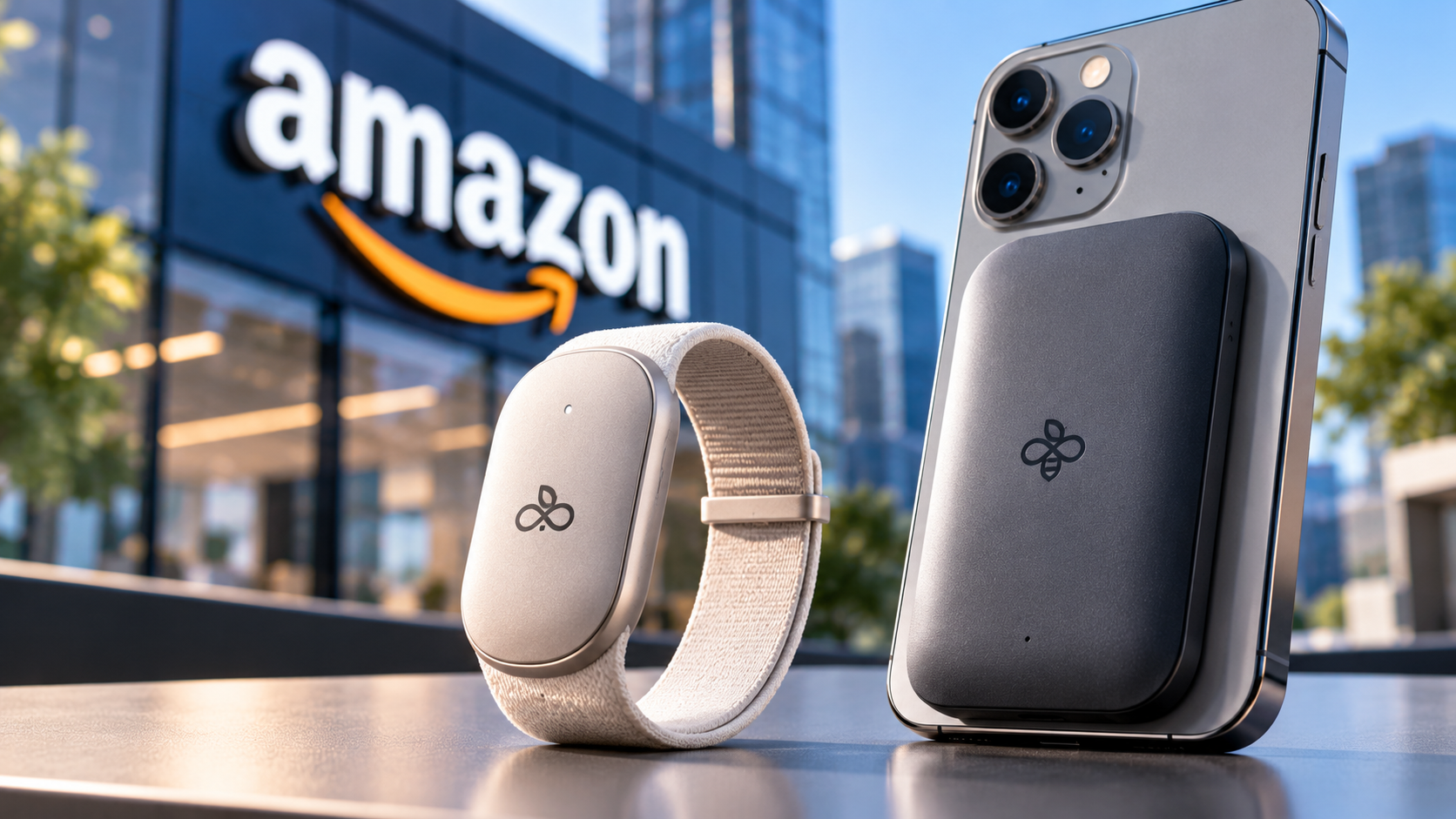
- Amazon has expanded its Bee AI wearable lineup with a redesigned wristband and a smartphone-mounted device, adding a paid subscription that unlocks expanded conversation summaries, personal assistance and integrations with Amazon services.
Amazon.com Inc. (NASDAQ: AMZN) introduced two new devices from its Bee wearable business on October 15, expanding its push into consumer AI beyond smart speakers and voice assistants. The lineup includes the $74.99 Bee Frontier, an updated wearable that can be worn as a wristband or clipped onto clothing, and the $99.99 Bee Eclipse, a card-shaped device designed to attach magnetically to the back of a smartphone.
The company also introduced Bee Pro, a subscription priced at $11.99 per month that provides additional features for users who want more from the service. The devices are designed to capture conversations and turn them into summaries, transcripts, reminders and actionable tasks.
Users can connect Bee with services such as Gmail, Google Calendar, Outlook and Apple HealthKit, allowing the AI assistant to use selected information to help draft emails, prepare calendar invitations and organize commitments.
The launch gives Amazon another way to bring AI into consumers' daily routines. Rather than requiring users to open an app and type a request, Bee operates in the background, helping users retrieve information from conversations and follow up on tasks.
Bee Frontier and Eclipse Add New Hardware Options
The Bee Frontier is an updated version of the company's earlier wearable. It features dual microphones, a recording indicator light, water resistance and a claimed battery life of approximately seven days on a charge. Its redesigned recording button is intended to make it easier for users to control when the device captures conversations.
The Bee Eclipse takes a different approach. Its credit-card-style design attaches to a smartphone, providing an alternative for people who do not want to wear a wristband or clip-on device. Amazon's new hardware lineup gives Bee two form factors aimed at different usage preferences, with the Eclipse offering a claimed battery life of up to 21 days.
Both products are built around the same basic proposition: using AI to preserve information from everyday conversations and turn it into useful reminders and tasks. The devices compete in a growing category that includes AI note-taking products and personal assistants designed to operate with minimal manual input.
Amazon acquired Bee in 2025 as it expanded its consumer AI ambitions. The startup had developed a wearable designed to listen to daily conversations and generate summaries and reminders. Since joining Amazon, Bee has added capabilities such as voice notes, daily insights and connections to email and calendar services, as described in the company's official overview of Bee's development.
The launch also fits into Amazon's broader effort to expand AI across its consumer products and services. Its work on AI-powered shopping and consumer services reflects a strategy that combines existing customer relationships with new AI features, although Bee's contribution to revenue has not been disclosed.
Bee Pro Subscription Adds Expanded AI Features
Amazon's Bee service will continue to offer a free tier, which includes conversation summaries, recaps and 14 days of memory. Bee Pro, priced at $11.99 per month, adds expanded capabilities, including unlimited summaries, daily memories, a personal assistant and compatibility with Amazon services and Alexa Plus.
The subscription creates a recurring-revenue opportunity alongside hardware sales. It also gives Amazon a way to charge for more intensive use of its AI assistant while retaining a free option for customers who need only basic summaries and memory features.
The paid plan's value will depend on whether users find the additional features useful enough to justify a monthly fee. AI wearables face a practical challenge: consumers must be comfortable allowing a device to process information from conversations throughout the day, and the resulting summaries and reminders must be accurate enough to become part of their routines.
Privacy will therefore remain central to Bee's adoption. Amazon says Bee processes conversations in real time and does not retain audio recordings, while its privacy architecture is designed to restrict access to users' transcripts and summaries. Customers should review the service's privacy and data-protection information to understand how information is handled and what controls are available.
The products also raise broader questions about recording conversations in workplaces, public settings and social situations. Users may need to consider local consent rules and whether other people know when a device is capturing audio, even when the wearable includes a recording indicator.
Amazon has not disclosed sales forecasts or expected revenue from the new devices and Bee Pro. The launch adds another product category to its AI portfolio, but its commercial impact will depend on customer adoption, subscription retention and how effectively Bee differentiates itself from smartphone-based AI assistants and competing wearable products.