
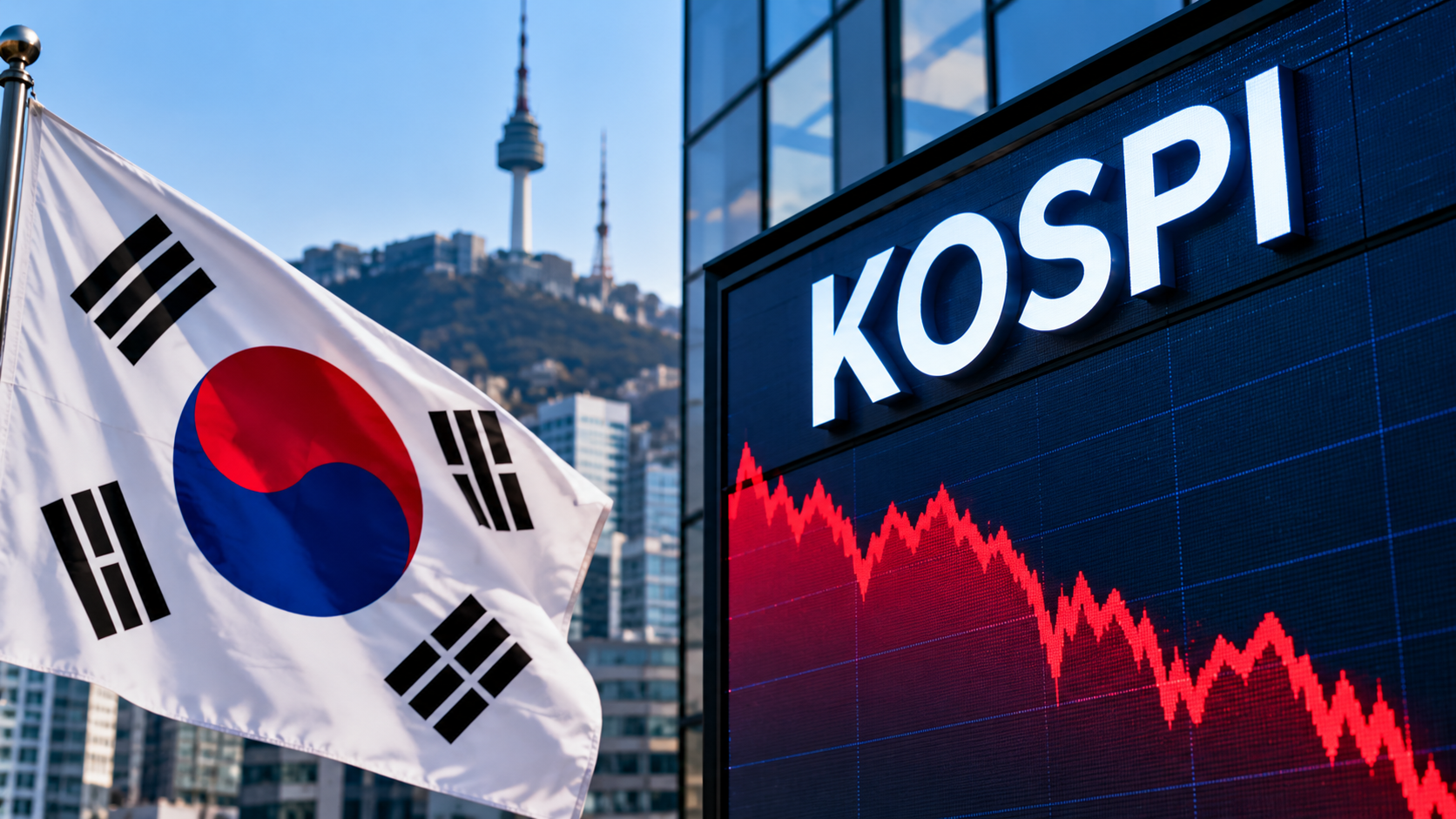
- South Korea's benchmark KOSPI index plunged to its lowest closing level in six months on Thursday as a sharp sell-off in semiconductor shares and concerns over US interest rates triggered a temporary trading halt.
South Korea's KOSPI index fell 454.59 points, or 7.57%, to close at 5,554.22 on October 15, extending its losing streak to seven consecutive sessions. The index reached an intraday low of 5,450.81 after opening sharply lower. Its closing level was the weakest since April 7, as investors reduced exposure to technology stocks amid renewed concerns about the returns from artificial intelligence investment and the outlook for borrowing costs.
The sell-off triggered a market-wide circuit breaker that halted trading for 20 minutes after losses exceeded the exchange's threshold. The Korea Exchange also activated a separate mechanism to temporarily suspend program selling earlier in the session, according to Yonhap's market report.
The decline followed losses on Wall Street, where hotter-than-expected US inflation data intensified concerns that the Federal Reserve could keep interest rates higher for longer or consider another increase. Those expectations weighed on technology shares, which are particularly sensitive to changes in financing costs and the valuations investors assign to future earnings.
Samsung and SK Hynix Lead the KOSPI Sell-Off
Semiconductor stocks accounted for much of Thursday's decline. Samsung Electronics fell 9.48% to 210,000 won, while SK Hynix dropped 11.06% to 1.26 million won. Both companies are major suppliers of memory chips used in servers and other computing systems supporting AI development.
The losses followed a 4.3% decline in the Philadelphia Semiconductor Index overnight, reflecting broader pressure on chipmakers as investors reassessed the sustainability of AI-related spending.
The sharp move also followed a series of declines in Asian technology shares. South Korea's market had already faced pressure from concerns about growing competition in memory chips, including advances by Chinese manufacturers. Those worries have added to uncertainty about whether the industry's rapid expansion will translate into profits sufficient to justify current valuations.
Chip stocks and Chinese semiconductor competition have seen growing pressure on investors to assess both demand for AI hardware and the possibility of greater competition among suppliers.
Other major South Korean stocks also fell. LG Energy Solution declined 4.6%, while Hyundai Motor lost 5.7%. Across the market, decliners significantly outnumbered advancing shares, showing that the sell-off extended beyond chipmakers.
Foreign investors were net sellers of South Korean shares worth approximately 3.62 trillion won, or about $2.68 billion. The selling added to the pressure on local equities as international investors reassessed exposure to the region's technology-heavy market.
Inflation and AI Spending Concerns Pressure Asian Markets
The KOSPI decline came after US consumer prices rose 0.6% in September, the largest monthly increase since April. Inflation data strengthened concerns that inflation could remain persistent and complicate the Federal Reserve's interest-rate decisions.
Higher interest rates can weigh on technology valuations by increasing the discount rate applied to future earnings and raising financing costs for companies investing in infrastructure. For AI-related businesses, the concern is particularly relevant because data centers, advanced processors and supporting infrastructure require substantial capital expenditure.
Investors are also questioning whether the scale of AI infrastructure investment will produce adequate financial returns. That debate has become more prominent as technology companies continue spending heavily on computing capacity while markets look for evidence that AI demand can support sustainable revenue and profit growth.
The concerns have coincided with a wider reassessment of semiconductor valuations. Although demand for advanced chips remains an important industry driver, investors are increasingly weighing that demand against competition, capital spending requirements and the possibility that expectations have risen too far.
The Korean won weakened to around 1,344.6 per US dollar on Thursday. South Korean financial authorities held an emergency meeting to review market conditions and pledged to respond proactively to support market stability and protect investors.
The sell-off was not confined to South Korea. Japan's Nikkei 225 fell 4.9%, while Taiwan's Taiex declined 3.4%. The regional losses reflected a broader retreat from technology shares after inflation concerns and doubts about AI investment returns pressured global markets.
For investors tracking the KOSPI index, the next focus will be whether semiconductor shares stabilize and whether upcoming economic data alter expectations for US monetary policy. The latest decline highlights the market's sensitivity to global technology valuations, but further trading and earnings developments will be needed to determine whether the sell-off marks a temporary correction or a more sustained shift in sentiment.