

- A new National Debt Relief survey shows debt is influencing how younger Americans approach spending, relationships, financial advice, and major life decisions.
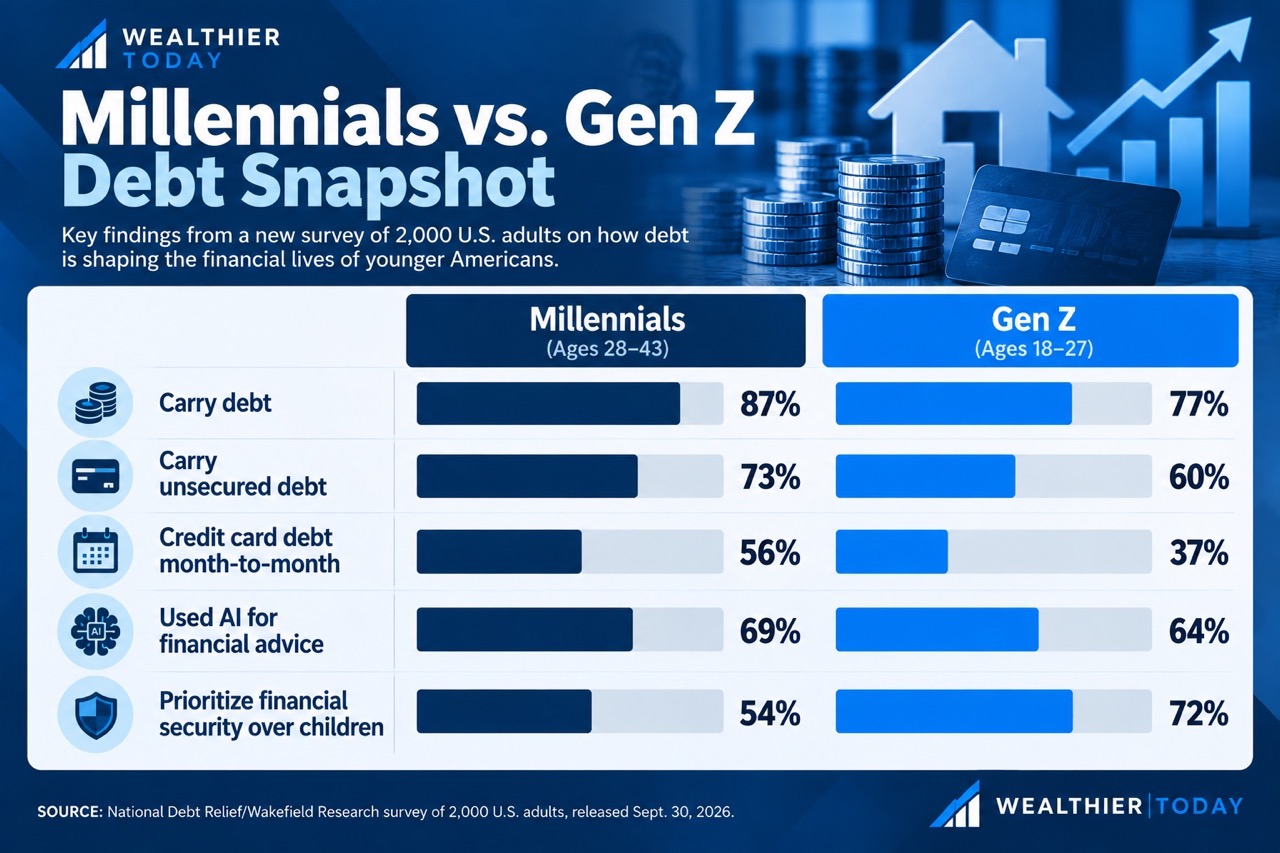
Debt is widespread among younger US adults, with 87% of millennials and 77% of Gen Z respondents saying they currently carry debt, according to a new survey released Sept. 30 by National Debt Relief. The National Debt Relief survey found that unsecured debt was particularly common, affecting 73% of millennials and 60% of Gen Z respondents. Credit cards were the most frequently cited source of unsecured debt.
The findings offer a snapshot of how debt is affecting younger Americans beyond monthly payments. Respondents also reported changing attitudes toward financial security, relationships, spending, and the use of artificial intelligence for money-related questions.
The survey was conducted by Wakefield Research for National Debt Relief among 2,000 US adults. The sample included 550 millennials, while Gen Z was oversampled to 500 respondents. Because the research was commissioned by a debt-relief company, its findings should be viewed as survey data rather than a measure of total household debt across the US population.
Credit Card Debt and Rising Costs Put Pressure on Younger Adults
Credit card debt was the most common form of unsecured borrowing identified in the survey. Among respondents with credit card debt, 56% of millennials said they carry balances from month to month, compared with 37% of Gen Z respondents.
The survey also points to affordability pressures as an important part of the picture. Millennials cited economic factors and unexpected expenses equally, at 49%, as the most common causes of their debt during the previous year. Among Gen Z respondents, unexpected expenses were the leading cause, cited by 40%.
Everyday spending also featured prominently. About 71% of millennials and 69% of Gen Z respondents with debt said convenience purchases such as subscriptions, food delivery and social-media shopping had contributed to their balances. The survey found that 72% of millennials and 64% of Gen Z respondents had purchased something they felt they deserved even though they could not afford it at the time.
Those findings come against a broader backdrop of elevated US household borrowing. The Federal Reserve Bank of New York reported that total household debt stood at $18.77 trillion at the end of the second quarter of 2026. Credit card balances reached $1.263 trillion, while student debt totaled $1.651 trillion.
The Federal Reserve's 2025 household survey provides additional context. It found that 16% of US adults had outstanding student loans, rising to 25% among adults ages 18 to 29 and 22% among those ages 30 to 44. The Fed also reported that average credit card balances increased by more than 35% among respondents who said they were finding it difficult to get by. Federal Reserve
For younger households trying to manage multiple balances, strategies for paying off debt can therefore involve more than simply reducing discretionary spending.
Debt Is Changing Financial Advice, Relationships and Future Plans
One of the more notable findings involves how younger Americans seek financial guidance. The survey found that 69% of millennials and 64% of Gen Z respondents had used AI for advice about a financial challenge. More than half also said they would feel more comfortable discussing financial struggles with AI than with people closest to them.
AI was not, however, the most trusted source of financial information. Traditional financial resources ranked first for 59% of millennials and 69% of Gen Z respondents, compared with 22% and 16%, respectively, for AI.
The survey also found a connection between debt and attitudes toward relationships. Nearly half of millennials, 49%, ranked the amount of debt a potential partner carries among the top three things they would want to know, while 40% of Gen Z respondents placed a partner's debt among their top three considerations.
Financial security also appeared to influence views about having children. Some 72% of Gen Z respondents said people should prioritize financial security even if that means not having children, compared with 54% of millennials.
The findings extend beyond traditional borrowing. Among respondents who regularly participated in activities such as sports betting, casino gambling, fantasy sports, prediction markets, day trading or lotteries, 65% of Gen Z and 49% of millennials said they had participated in such activities in an attempt to pay off debt.
That result does not establish that debt is causing gambling or other financial risk-taking, but it shows how respondents themselves describe the relationship between financial pressure and those activities. The survey also found that 46% of millennials and 33% of Gen Z respondents did not view a debt-free life as realistic.
For households dealing with persistent balances, budgeting and managing cash flow can become an important part of the financial picture, particularly when unexpected expenses are contributing to new borrowing. Other credit and debt strategies can also vary depending on interest rates, loan types and repayment terms.
The broader data suggest that younger Americans' debt experience is not limited to a single category of borrowing. Credit cards, student loans, auto financing, and other obligations are affecting household finances at the same time that younger consumers are changing how they seek financial information and evaluate long-term financial security.