
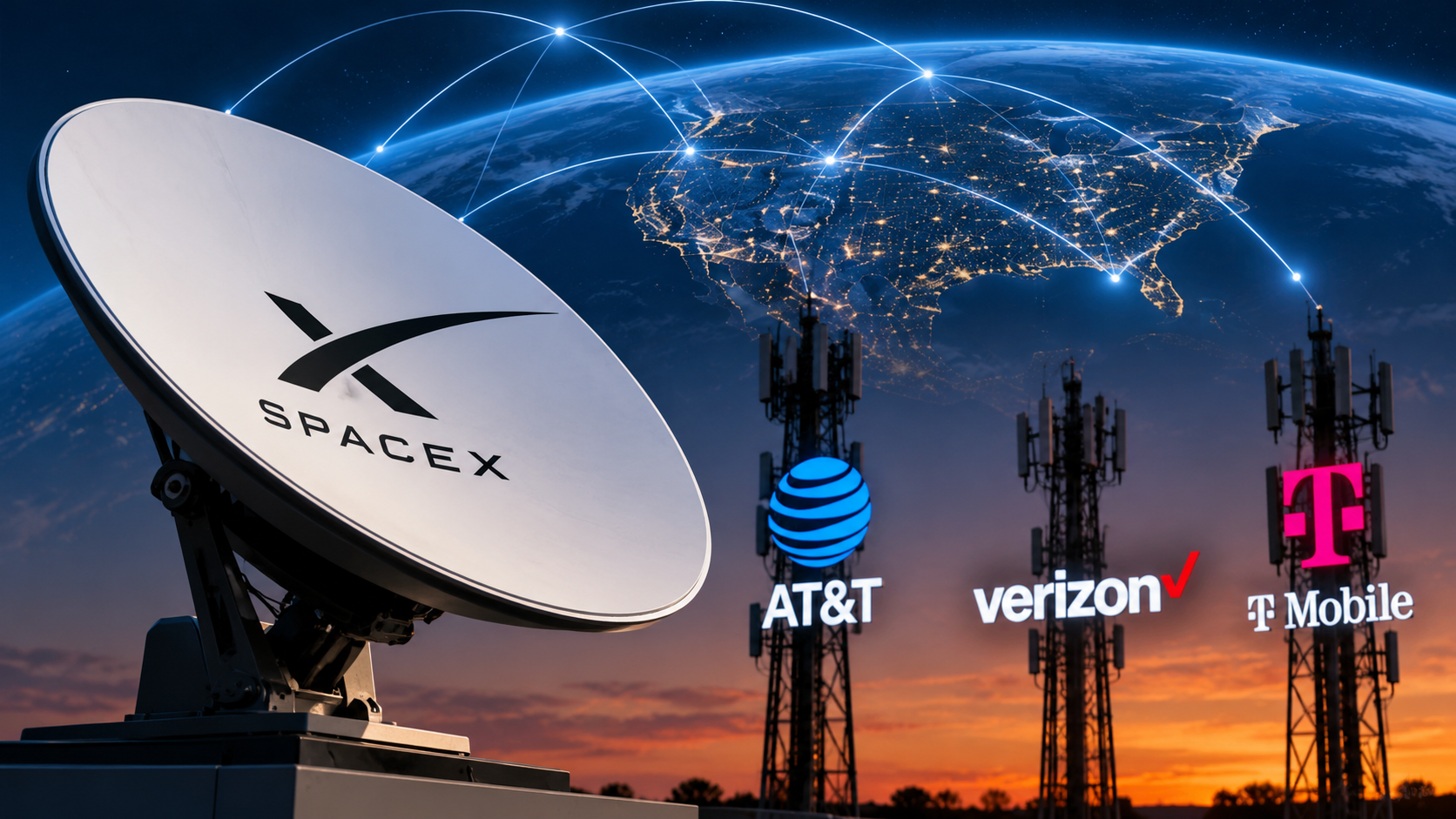
- SpaceX's agreement to acquire nationwide wireless spectrum licenses is intensifying competition concerns for US telecom companies, as the Starlink operator moves closer to offering mobile connectivity that could challenge established carriers.
SpaceX (NASDAQ: SPCX) agreed to acquire Grain Management's nationwide portfolio of 800 MHz spectrum licenses on October 8, adding a critical component to its plan to expand Starlink Mobile beyond satellite connectivity. The transaction remains subject to approval from the Federal Communications Commission (FCC), according to Grain Management's announcement.
The agreement covers up to 14 MHz of paired low-band spectrum. Reuters reported that the transaction was valued at approximately $8 billion, although the companies did not disclose the financial terms in their public announcement.
The acquisition represents a significant step in SpaceX's effort to enter the US wireless market. Its implications extend to AT&T Inc. (NYSE: T), Verizon Communications Inc. (NYSE: VZ) and T-Mobile US Inc. (NASDAQ: TMUS), whose shares fell sharply on October 9 as investors assessed the potential threat from Starlink Mobile.
According to Wealthier Today's report, AT&T shares fell 9.8%, Verizon declined 8.8% and T-Mobile dropped 13.3% on Friday. The reaction reflected concerns about future competition rather than evidence that the carriers' existing subscriber bases or earnings had already been materially affected.
How SpaceX's Spectrum Acquisition Could Change Wireless Competition
Low-band spectrum is valuable because its radio signals can travel long distances and penetrate buildings and other obstacles more effectively than higher-frequency signals. These characteristics make it useful for extending mobile coverage across wide geographic areas, including locations where traditional cellular networks have limited reach.
SpaceX has been developing Starlink Mobile around satellite-to-device connectivity using spectrum in the 2 GHz band. Adding 800 MHz spectrum could help the company combine satellite transmissions with terrestrial infrastructure, potentially improving coverage in areas where satellite signals struggle to reach users indoors.
The company has said the acquisition provides a key missing component for its mobile ambitions. Its planned network would combine satellite connectivity with ground-based radios and antennas, creating a hybrid system designed to reach standard mobile devices.
The FCC has also approved SpaceX's application to deploy a second-generation Starlink Mobile constellation involving 15,000 satellites optimized for the company's planned service. However, the spectrum transfer itself still requires regulatory approval, and SpaceX must build and operate the infrastructure needed to deliver reliable service.
The distinction is important for established carriers. Spectrum licenses provide access to radio frequencies, but they do not automatically create a nationwide network with the capacity, reliability and indoor coverage consumers expect from conventional mobile providers.
Verizon has argued that acquiring spectrum alone is insufficient to compete without the necessary network infrastructure. T-Mobile executives have also highlighted the difficulty of delivering a consistent indoor experience, where terrestrial networks retain an advantage.
The new licenses could nevertheless give SpaceX greater flexibility to expand beyond remote-area connectivity. Existing mobile handsets generally support the 800 MHz band, potentially reducing the need for customers to purchase specialized devices, although actual compatibility will depend on network implementation and regulatory requirements.
The development also follows efforts by the three major carriers to expand satellite connectivity. AT&T, T-Mobile and Verizon have been pursuing arrangements intended to address coverage gaps, illustrating how satellite services are becoming an increasingly important part of the broader wireless market.
What the Deal Means for AT&T, Verizon and T-Mobile Stocks
The immediate stock-market reaction suggests investors are reassessing the long-term competitive landscape. If SpaceX develops a credible mobile service with broad coverage and attractive pricing, established carriers could face additional pressure on subscriber growth, pricing power and customer retention.
However, the transaction does not immediately change the carriers' operating positions. SpaceX still needs regulatory clearance for the spectrum transfer, infrastructure deployment and a commercially viable service offering. Its ability to compete in major cities and deliver consistent performance at scale remains to be demonstrated.
AT&T, Verizon and T-Mobile also have substantial existing networks, established customer relationships and broad retail distribution. These assets could help them defend their positions even if satellite-based mobile services become more competitive.
The financial impact will depend on how SpaceX prices its offering, whether it bundles mobile connectivity with Starlink broadband and how quickly it can attract customers. A service focused primarily on remote areas could complement existing networks, while a more comprehensive nationwide product would pose a more direct competitive challenge.
Investors will also need to distinguish between short-term share-price reactions and changes in company fundamentals. The sharp declines on October 9 indicate concern about potential future competition, but they do not establish how much revenue or profit the traditional carriers could ultimately lose.
For telecom investors, the next milestones will be FCC approval, SpaceX's infrastructure plans and further details about Starlink Mobile's launch timeline and commercial strategy. SpaceX executives have indicated that the company aims to launch its mobile service business in late 2027.
The spectrum acquisition brings SpaceX closer to competing directly with established wireless carriers, but the commercial consequences will depend on execution. For AT&T, Verizon and T-Mobile, the immediate challenge is not a confirmed loss of customers, but the possibility that a well-funded satellite operator could become a more formidable competitor in the years ahead.