
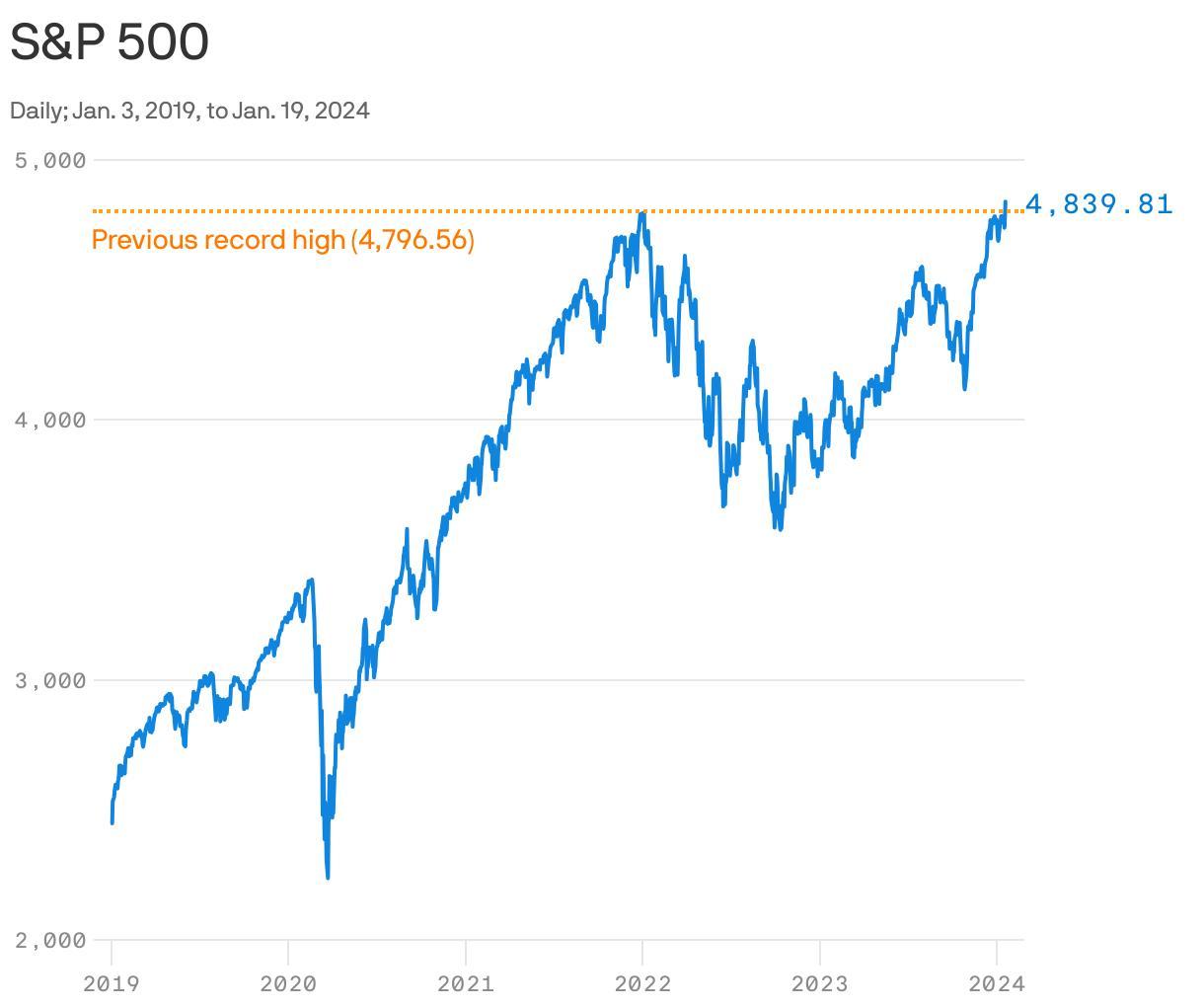
- The S&P 500 is approaching record territory as investors prepare for another earnings season, with strong profit forecasts supporting stocks even as rising Treasury yields and heavy exposure to artificial intelligence create risks for valuations.
The S&P 500 gained 0.6% to close at 7,811.54 on Friday, October 9, finishing the week 1.2% higher and leaving the benchmark near its record level. The Nasdaq Composite also rose 0.6%, while the Dow Jones Industrial Average advanced 0.8%.
Corporate earnings are central to the rally. Analysts expect S&P 500 companies to report strong third-quarter profit growth, led by technology businesses benefiting from demand for AI infrastructure. But investors are weighing those expectations against higher financing costs, inflation uncertainty, and questions about how much future growth is already reflected in share prices.
The current bull market has gained approximately 117% since its October 2022 low. That performance has been supported by corporate profits and investment in AI, although the rally's reliance on a relatively small group of large technology companies has increased concerns about market concentration.
Strong Earnings Forecasts Support the S&P 500 Rally
Analysts expect S&P 500 earnings to grow approximately 31% year over year in the third quarter, with AI-related companies accounting for a substantial share of the increase. Technology companies are expected to contribute heavily to that growth. Semiconductor earnings are projected to rise sharply as businesses continue investing in AI computing capacity, while higher oil prices are supporting earnings expectations for energy producers.
FactSet data also show that analysts raised their aggregate third-quarter earnings-per-share estimate by 1.4% between June 30 and September 30, bringing the forecast to $89.84 from $88.64. That contrasts with the typical pattern of estimates declining during a quarter, according to FactSet's earnings analysis.
The strength of those forecasts helps explain why the market has continued to advance despite higher Treasury yields. When companies generate faster earnings growth, investors may be willing to pay more for their shares because the underlying profits can support valuations.
Nvidia Corp. (NASDAQ: NVDA), Alphabet Inc. (NASDAQ: GOOGL) and Meta Platforms Inc. (NASDAQ: META) are among the large companies closely watched for signs that AI spending is translating into revenue and earnings. Their results and guidance could influence broader sentiment because major technology companies account for a substantial portion of the index's market value.
However, the market's dependence on AI-related spending creates a potential vulnerability. If companies reduce infrastructure budgets or fail to generate expected returns from their investments, earnings forecasts could weaken. Investors will also be watching whether growth spreads beyond technology into sectors such as industrials, financials and consumer businesses.
The recent Nasdaq rally led by Nvidia illustrates how optimism about AI earnings has supported major indexes despite pressure from the bond market.
Rising Treasury Yields Put Stock Valuations to the Test
The 10-year US Treasury yield reached approximately 5.24% on Friday, according to the Associated Press, increasing the competition between equities and fixed-income investments. Higher yields can also raise borrowing costs for companies and reduce the present value of future earnings.
The relationship is particularly important for growth stocks, whose valuations often depend on profits expected years into the future. When investors demand a higher return, those future cash flows become less valuable in present-day terms, all else being equal.
Yet higher yields have not prevented stocks from approaching record levels. One reason is that earnings expectations remain strong. Another is that valuations have moderated from earlier peaks, even as share prices have advanced.
Reuters reported on October 1 that the S&P 500's forward price-to-earnings ratio had fallen to 19.2 from 22 at the start of the year and a peak of 23.5 in October 2025, according to LSEG Datastream. That placed the market's valuation below its recent high despite the index's strong performance.
A lower multiple can provide some support if earnings continue to rise, but it does not guarantee that stocks are cheap. If profits disappoint or interest rates increase further, investors could demand lower valuations.
The risk is also uneven across the market. Companies with strong balance sheets and reliable cash generation may be better positioned to manage higher financing costs than businesses that depend heavily on borrowing. Investors concerned about rising Treasury yields and stock valuations should consider both the price paid for a company's shares and its ability to sustain earnings growth.
Market concentration presents another challenge. When a handful of large companies account for a substantial share of index performance, weakness in those stocks can have an outsized effect on the broader market. The growing concentration of gains in major technology stocks has raised questions about whether the rally is broad enough to withstand setbacks in AI-related shares.
The coming earnings reports will help determine whether corporate performance can support current prices. Investors will be looking beyond headline profit growth to revenue, profit margins, forward guidance and companies' plans for capital spending.
The S&P 500's proximity to a record high reflects confidence in corporate earnings, but that confidence will need to be reinforced by results. If companies deliver the expected growth, valuations may remain supported despite higher yields. If earnings momentum weakens while financing costs remain elevated, the market could become more vulnerable to a pullback.