
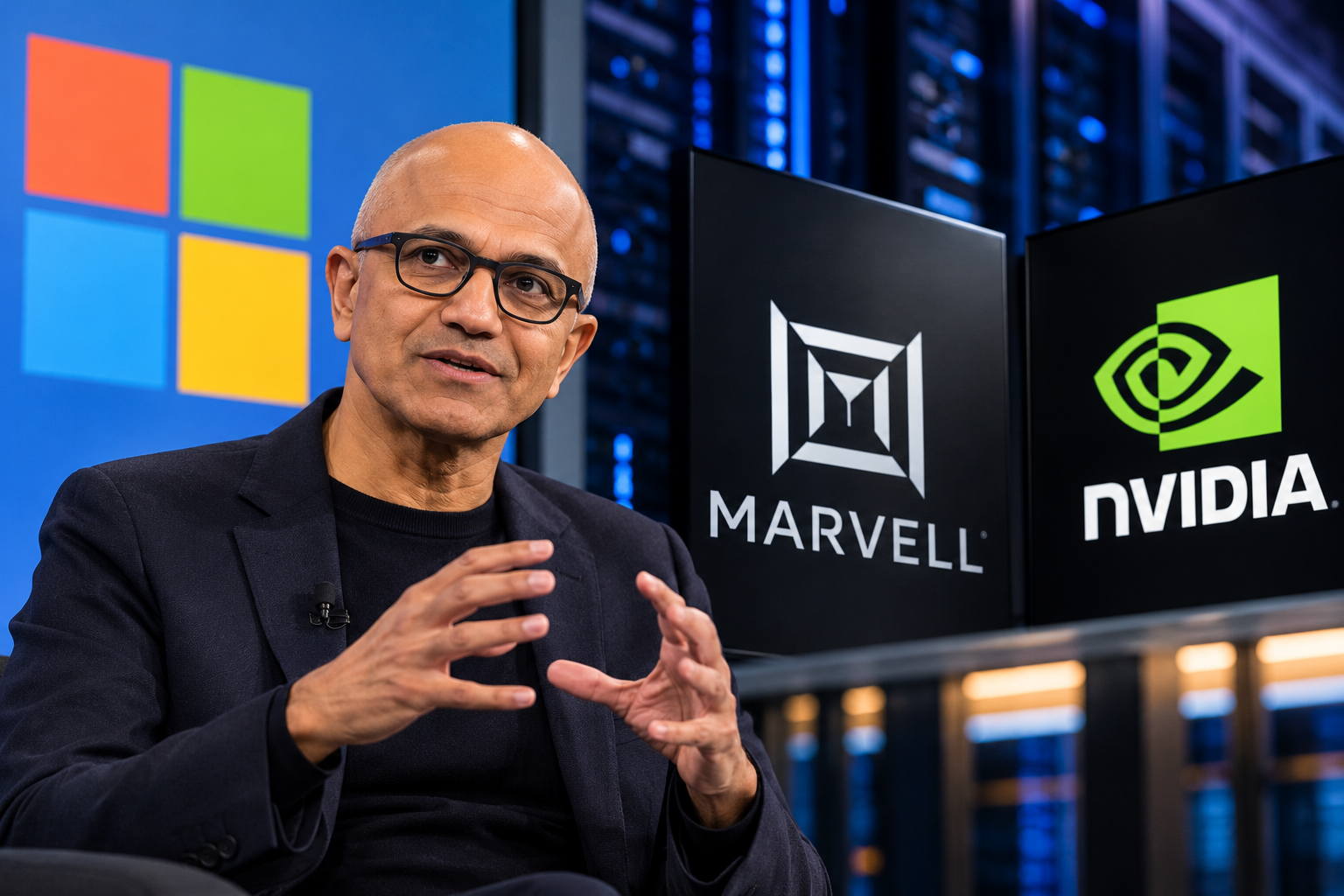
- Microsoft CEO Satya Nadella’s plan to scale the company’s in-house Maia AI chips from 2027 could create a major opportunity for Marvell Technology (NASDAQ: MRVL), a semiconductor designer involved in custom silicon, while intensifying competition for Nvidia (NASDAQ: NVDA) in parts of the AI computing market.
Microsoft’s next phase of artificial intelligence infrastructure could create a significant opportunity for Marvell Technology as the software giant prepares to expand its custom-designed processors across its cloud and AI operations.
In an October 16 report, Yahoo Finance highlighted why Nadella’s AI chip plans could benefit Marvell and challenge Nvidia. The discussion followed Microsoft’s announcement of Maia 300, its third-generation custom AI accelerator, and plans to expand deployment of the Maia family beginning in 2027.
Nadella said Microsoft intends to scale Maia to multi-gigawatt deployments, making the chip family its primary inference system for its own products and services. Inference is the process through which a trained AI model generates responses or performs tasks, and it represents a growing source of computing demand as businesses adopt AI tools.
Microsoft said it could deploy more than one million Maia 300 chips in 2027 to support its internal AI services. The company’s broader investment in custom silicon reflects an effort to improve computing efficiency, manage infrastructure costs and reduce dependence on processors purchased from outside suppliers.
In its report on Microsoft’s Maia 300 plans, Reuters reported that Microsoft expects the new chip to deliver about 40% more useful computing per megawatt than leading GPU-based systems. That figure is Microsoft’s own comparison, and the company did not identify the systems used as benchmarks.
The expansion could create new business for Marvell, which works on custom semiconductor solutions for large technology companies. However, the financial impact will depend on actual production volumes, customer demand and how much of Microsoft’s infrastructure spending translates into revenue for its chip partners.
Why Marvell Could Benefit From Microsoft’s Maia 300
Marvell’s potential advantage lies in its participation in the market for application-specific integrated circuits and other custom semiconductor solutions. Large cloud providers increasingly want processors tailored to their own AI workloads rather than relying exclusively on general-purpose GPUs.
Microsoft’s Maia strategy could support that shift. If its custom chips handle a larger share of AI inference, the company may need more of the supporting silicon and networking technology required to build and connect its systems.
The opportunity is not limited to Microsoft. Marvell has also pursued custom-chip work with other major technology companies, including Google. Its growth prospects therefore depend on whether it can secure additional projects and deliver chips that meet customers’ performance, power and cost requirements.
A recent analysis of the semiconductor stocks positioned to benefit from AI infrastructure spending examined how demand is spreading across chip designers, manufacturers and networking suppliers. Marvell’s custom silicon business places it within that wider investment theme.
Still, a larger market opportunity does not guarantee stronger stock performance. Investors need to assess how much business Marvell wins, the profitability of those projects and the valuation already reflected in its share price.
Nvidia Faces More Competition From Its Biggest Customers
Microsoft’s move highlights a broader change in the AI chip market: some of Nvidia’s largest customers are developing their own processors to reduce costs and gain greater control over computing infrastructure.
Nvidia remains a major supplier of AI accelerators and computing systems used for model training and inference. Its hardware is supported by an established software ecosystem and broad compatibility with AI development tools, which can make it difficult for customers to replace across all workloads.
Custom processors offer a different advantage. They can be designed around specific tasks, potentially improving efficiency when deployed at sufficient scale. Microsoft’s initial Maia expansion is focused on its own products and services, rather than replacing every GPU used by Azure customers or making Maia available for all third-party workloads.
As Axios reported in its coverage of the AI chip competition, major technology companies are increasingly treating custom silicon as a way to gain more control over performance, cost and supply. The trend puts some of Nvidia’s biggest customers in the position of developing alternatives to products they continue to purchase.
The shift does not mean Nvidia’s business will necessarily contract. Demand for AI computing is expanding, and Nvidia can continue selling GPUs to customers whose workloads require flexibility or who prefer its existing hardware and software tools.
Wealthier Today’s analysis of Nvidia’s valuation and growth outlook explores why competition is only one factor in the company’s investment case. Future returns also depend on earnings growth, margins and the price investors pay for those earnings.
How Microsoft’s AI Chip Strategy Could Affect Costs
Microsoft is investing heavily in data centers to support its AI products and Azure cloud services. The company has indicated that its capital expenditure for 2026 could exceed $175 billion, underscoring the financial scale of its infrastructure buildout.
Custom chips could help Microsoft improve the economics of running AI services, particularly when workloads are predictable enough to benefit from specialized hardware. More efficient inference could allow the company to process additional requests using a given amount of power or infrastructure capacity.
However, the savings are not automatic. Custom-chip development requires engineering resources, manufacturing capacity, advanced packaging, memory and networking infrastructure. Microsoft must also ensure its systems can support the AI models and software used by its customers.
The commercial outcome will depend on whether performance gains translate into lower operating costs, stronger margins, more competitive pricing or additional AI services. As MarketWatch’s analysis of Microsoft’s cost-saving ambitions noted, improved computing efficiency does not automatically determine how much financial benefit shareholders ultimately receive.
For Microsoft investors, the key question is whether AI infrastructure spending produces enough additional revenue and profit to justify the investment. Wealthier Today’s coverage of Microsoft’s AI-driven stock outlook examines the relationship between AI expansion, capital spending and potential shareholder returns.
What Investors Should Watch in 2027
The next stage of Microsoft’s Maia strategy will be measured by execution rather than announcements alone. Investors should watch whether the company delivers on its deployment plans, how quickly Maia chips move into production workloads and whether Microsoft reports meaningful improvements in infrastructure economics.
For Marvell, evidence of additional orders and rising custom silicon revenue would help establish whether the Microsoft opportunity is translating into commercial results. Its ability to win business from other cloud providers will also influence the longer-term outlook.
For Nvidia, investors will be watching whether demand for its GPUs continues to grow as cloud companies develop competing processors. The expansion of custom silicon could put pressure on its share of selected workloads, but it may also coexist with a growing market for AI computing overall.
There are risks for all three companies. Chip production can be constrained by manufacturing and advanced-packaging capacity, while changes in AI demand or delays in data-center construction can affect revenue expectations. Custom processors must also demonstrate that their performance and cost advantages are sufficient to justify adoption.
Is Marvell Better Positioned Than Nvidia?
Marvell could benefit disproportionately if custom AI accelerators become a larger part of data-center investment and it captures more design contracts. Nvidia, meanwhile, remains exposed to the broader market for accelerated computing and serves customers across the AI ecosystem.
The companies therefore represent different investment opportunities. Marvell’s prospects depend partly on the growth and profitability of its custom-chip and networking businesses. Nvidia’s outlook depends on continued demand for its GPUs and systems, its competitive advantages and its ability to sustain earnings growth as customers diversify their chip supply.
Nadella’s announcement signals that Microsoft intends to rely more heavily on its own processors for internal AI workloads. It does not establish that Marvell has overtaken Nvidia or that Microsoft will stop buying Nvidia hardware.
Bottom line: Microsoft’s planned Maia 300 expansion could be an important growth opportunity for Marvell Technology while adding to competitive pressure on Nvidia in selected AI workloads. Whether that translates into superior stock performance will depend on execution, revenue growth, margins and valuation—not the chip announcement alone.