
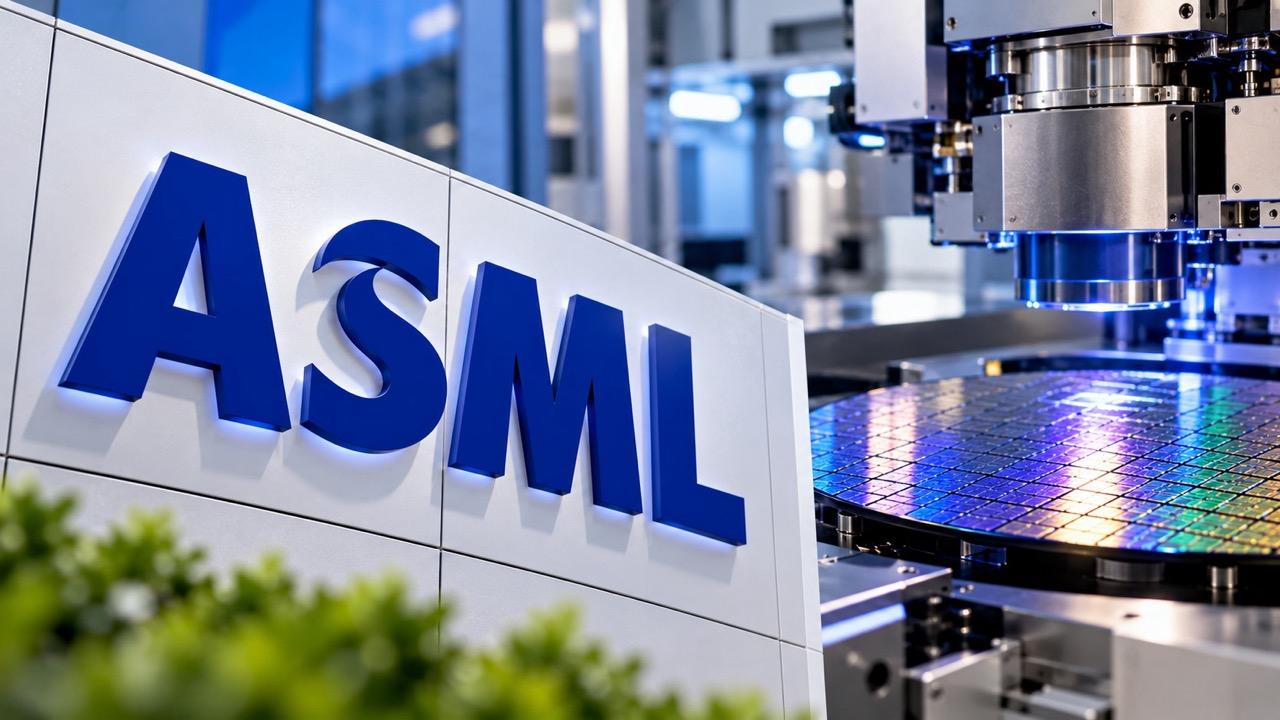
- ASML raised its full-year sales outlook after record third-quarter revenue and profit, saying customer demand for chipmaking equipment is now strong enough that planned supply for 2027 and 2028 may fall short.
ASML Holding NV (NASDAQ: ASML) reported record third-quarter sales and higher profit on Wednesday as artificial intelligence investment drives demand for advanced semiconductor manufacturing equipment. The Dutch company said customers are seeking more capacity than it currently plans to supply, and some are discussing orders as far ahead as 2030, according to CNBC’s report on ASML’s earnings and capacity outlook.
The results strengthen the case that spending on AI infrastructure is supporting demand beyond chip designers and data-center operators. ASML supplies the lithography systems used by semiconductor manufacturers to print intricate circuit patterns onto silicon wafers, making its orders an important indicator of investment plans across the chip industry.
ASML Q3 Earnings Beat as 2026 Revenue Forecast Rises
ASML reported third-quarter net sales of €11.66 billion and net income of €4.96 billion, according to its official earnings release. Sales rose from €9.33 billion in the second quarter, while net income increased from €2.92 billion. Gross margin reached 57.5%, above the company’s previous-quarter level of 54%.
The company expects fourth-quarter net sales of €14.2 billion to €15.2 billion, with gross margin around 57%. Its full-year 2026 sales forecast is now €44 billion to €45 billion, with gross margin around 56%.
ASML’s outlook reflects stronger demand for its equipment and services as chipmakers expand manufacturing capacity. Its installed-base management business, which includes services and productivity upgrades for equipment already operating in customer facilities, generated €3.29 billion in third-quarter sales, above the €2.76 billion reported in the second quarter.
The company also sold 113 new lithography systems during the quarter, compared with 86 in the previous three months. The figures point to a higher delivery pace, although the company’s longer-term outlook suggests that increasing production may not be enough to meet all expected demand.
ASML’s position is particularly important in advanced chip manufacturing because it is the only supplier of extreme ultraviolet, or EUV, lithography systems. These machines are used to manufacture leading-edge semiconductors, including processors and other chips needed for demanding AI workloads. Its customers include major chipmakers such as Taiwan Semiconductor Manufacturing Co. (NYSE: TSM), Samsung Electronics and Intel Corp. (NASDAQ: INTC).
The demand outlook also provides context for recent investor focus on semiconductor earnings and AI-related profits. Strong equipment orders can indicate that manufacturers expect continued demand for chips, but they do not guarantee that every part of the AI supply chain will deliver the same growth or profitability.
AI Demand Creates a Capacity Challenge Through 2028 and Beyond
ASML said customers have continued to raise their short- and medium-term equipment demand forecasts, driven primarily by their expectations for the scale and duration of AI investment. Based on those discussions and its order momentum, the company now expects its currently planned supply for both 2027 and 2028 to fall short of customer demand.
Management is examining options to expand 2028 capacity beyond a previously communicated increase of 30%. The company has not yet announced a new capacity target, so the potential scale and timing of any additional expansion remain uncertain.
Interest in orders for 2029 and 2030 offers a longer view of customer planning. Such discussions indicate that some chipmakers are looking beyond immediate production needs, though expressions of interest are not the same as confirmed orders or completed sales.
The supply constraint could affect how quickly semiconductor manufacturers can add advanced production capacity. Lithography systems are complex industrial equipment, and expanding output requires planning, suppliers and manufacturing resources. ASML’s results therefore offer a window into the equipment bottlenecks that may shape the pace of the broader AI infrastructure buildout.
For investors, the report adds to a growing body of evidence that AI-related spending is supporting semiconductor demand. TSMC’s recent revenue performance tied to AI chip demand is another important measure of activity further along the supply chain. But ASML’s outlook also highlights a distinction: strong demand does not automatically translate into immediate deliveries when production capacity is constrained.
The next indicators to watch include ASML’s fourth-quarter sales, progress on its proposed capacity expansion, and whether customers turn their longer-term discussions into firm orders. Investors will also be looking for signs that demand remains broad across advanced logic and memory rather than concentrated in a narrower group of projects.
ASML’s latest results show that AI investment is translating into substantial equipment demand today, while customer discussions point to potential demand several years ahead. Whether that momentum continues will depend on chipmakers’ investment plans, the pace of capacity additions and the durability of spending on AI infrastructure.