
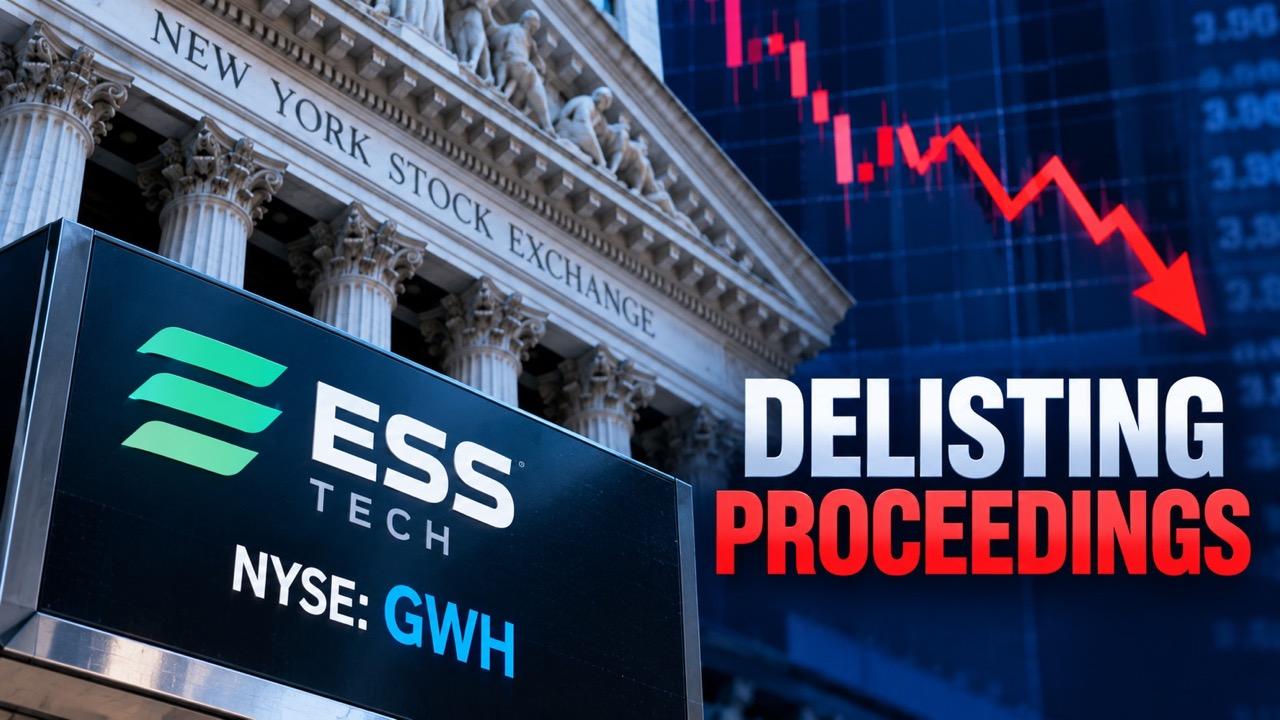
- The New York Stock Exchange has suspended ESS Tech shares and begun delisting proceedings after the battery-storage company failed to meet a continued-listing market-capitalization requirement.
ESS Tech Inc. (NYSE: GWH) faces removal from the New York Stock Exchange after NYSE Regulation determined that the energy-storage company no longer meets the exchange's continued-listing standards.
The NYSE's delisting notice said ESS Tech had fallen below the requirement to maintain an average global market capitalization of at least $15 million over 30 consecutive trading days. Trading in GWH shares was suspended immediately.
The latest action follows an earlier Sept. 24 determination that ESS Tech had failed to demonstrate that it had regained compliance with Section 802.01B of the NYSE Listed Company Manual before the expiration of its maximum compliance period.
ESS Tech has the right to ask a committee of the NYSE board to review the determinations. The exchange said it will apply to the Securities and Exchange Commission to delist the common stock after completing the applicable procedures, including any appeal by the company.
The process therefore does not mean that GWH has already been permanently removed from the public markets. The suspension and delisting proceedings are separate steps in the NYSE process.
Why ESS Tech Lost Its NYSE Listing Compliance
The latest listing problem follows several months of pressure on ESS Tech's stock and financial position. The company received a separate NYSE deficiency notice in June after its shares traded below the exchange's $1 minimum average closing-price requirement for 30 consecutive trading days. ESS Tech said at the time that it intended to pursue measures to regain compliance.
The company subsequently proposed a reverse stock split of between 1-for-8 and 1-for-30. Shareholders are scheduled to consider the proposal at a special meeting on Oct. 16.
According to the company's SEC proxy filing, the board would select the final ratio within that range if shareholders approve the proposal. A reverse split would reduce the number of shares outstanding but would not, by itself, change the aggregate value of shareholders' holdings immediately after the transaction.
The proposal was designed in part to address the earlier $1 share-price deficiency. The latest market-capitalization issue is a separate NYSE requirement.
ESS Tech's financial statements also show why maintaining access to public capital has become important for the company.
In its second-quarter filing, ESS reported only $73,000 of total revenue for the three months ended June 30, compared with $2.36 million a year earlier. For the first six months of 2026, revenue was $201,000 versus $2.96 million in the comparable 2025 period.
The company recorded a $31.5 million net loss during the first six months of 2026 and used $22.4 million of cash in operating activities. It had $10.8 million in unrestricted cash and cash equivalents at June 30.
ESS warned in its filing that its ability to continue as a going concern depends on obtaining additional debt or equity financing in the near term, alongside its ability to eventually generate profitable operations.
ESS Tech Is Still Pursuing Battery-Storage Growth
The listing problems come while ESS Tech is attempting to reposition its business around long-duration energy storage and sodium-ion battery technology. The company develops non-lithium energy-storage systems using iron-flow and sodium-ion technologies for utility, commercial and industrial applications. Its second-quarter financial results highlighted development of its Bridge modular sodium-ion system and several early-stage commercial opportunities.
ESS said in August that it had signed a letter of intent with Juniper Energy for more than 500 megawatt-hours of sodium-ion energy storage, including a planned 80 MWh California utility project. It also announced a non-binding letter of intent for a strategic business combination with a private energy-sector company that implied an expected combined enterprise value of $515 million at signing.
Those initiatives remain separate from the NYSE listing process. The exchange's action concerns the company's compliance with listing standards rather than the technical performance or commercial potential of its battery systems.
The company is also seeking shareholder approval for the issuance of shares associated with warrants from a recent financing. Its proxy materials state that the proposed reverse split and warrant-share approval are connected to its efforts to satisfy NYSE requirements and maintain its listing.
For existing GWH shareholders, the immediate issue is therefore the trading suspension and the outcome of the NYSE review process. A successful appeal could affect the timing and eventual outcome of the delisting proceedings, while shareholder approval of the proposed reverse split could address the separate share-price requirement.
None of those measures guarantees that ESS Tech will remain listed. The company must still navigate its financing needs, operating losses and limited revenue while attempting to commercialize its energy-storage products. The SEC filings show that ESS remains in an early stage of commercial development, with substantial cash requirements relative to its current revenue base.
The NYSE action therefore marks a significant development for GWH, but it is not the end of ESS Tech's corporate or operating activities. The company remains subject to SEC reporting requirements while the delisting process and shareholder votes proceed.