
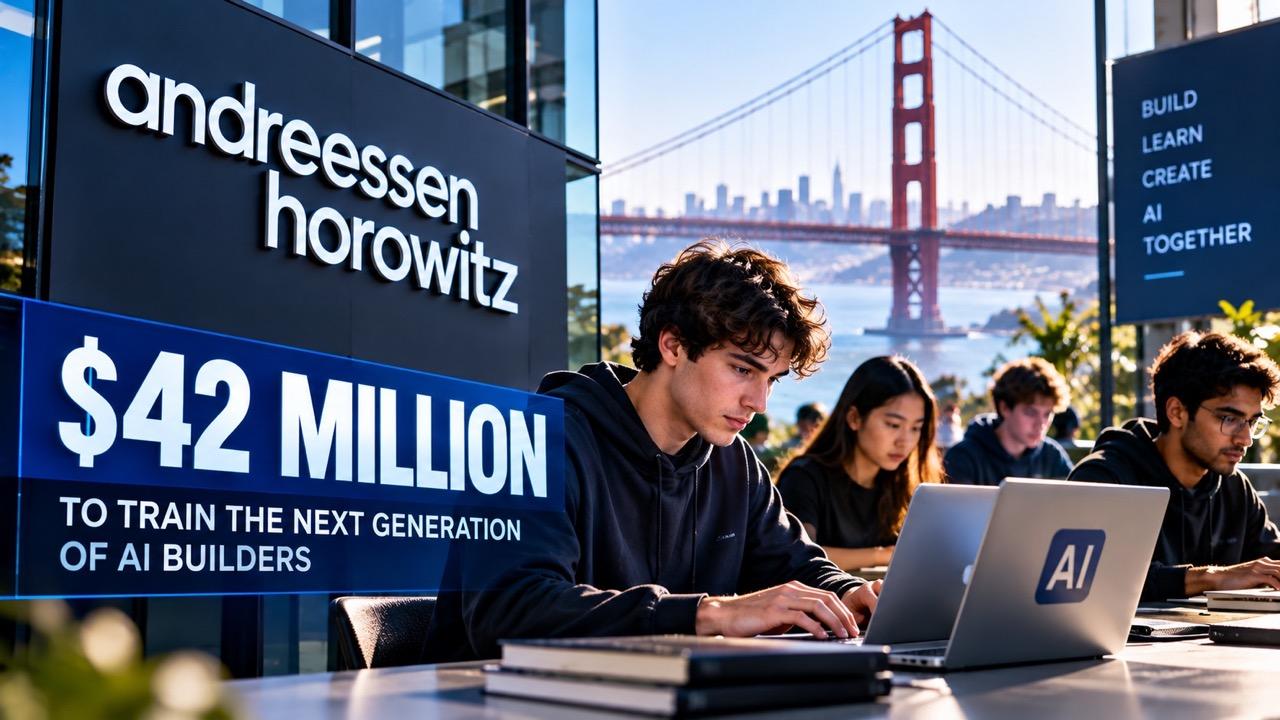
- Andreessen Horowitz is backing a tuition-free San Francisco academy that will give about 50 young builders an alternative to the traditional college path, with AI projects and real-world technology experience at the center of the program.
Andreessen Horowitz is leading a $42 million funding round for the Horowitz Andreessen Academy, a new for-profit school in San Francisco designed to train young people for an economy increasingly shaped by artificial intelligence.
The academy plans to bring in its first class of roughly 50 students in September 2027 for a one-year, tuition-free fellowship. The program is aimed primarily at recent high school graduates, although the academy also says students who have spent one or two years at an elite university can apply.
The funding comes as AI changes the skills technology companies are seeking and increases demand for people who can build AI products, software and businesses. The academy is positioning itself around practical work rather than a conventional university curriculum.
AI Projects Replace Traditional College Coursework
Students will spend much of the program working on projects rather than completing traditional homework, tests and problem sets. The curriculum includes subjects such as AI systems design, startup mechanics, fundraising, sales, and storytelling.
The academy is being led by Gagan Biyani, co-founder of Udemy and Maven. Its network includes major technology companies such as Anthropic, Coinbase, Google, Meta Platforms Inc. (NASDAQ: META), NVIDIA Corp. (NASDAQ: NVDA), OpenAI, Palantir Technologies Inc. (NASDAQ: PLTR), Replit and Stripe.
Each student will receive more than $50,000 in computing credits and technology resources, along with a $5,000 budget for travel and exploration. Students will also have access to mentors, guest lecturers, and technology companies connected to the academy.
The program is part of a broader shift in how AI companies and investors are approaching talent development. As AI infrastructure spending continues to expand, the competition is increasingly extending beyond chips and data centers to the people developing applications and businesses around the technology.
The academy is also emphasizing proof of work during admissions, with applicants evaluated heavily on what they have built, shipped, or accomplished rather than relying solely on traditional academic credentials.
Academy Plans Longer Program After Tuition-Free Fellowship
The initial fellowship is intended to function as a one-year alternative or gap year for students who might otherwise begin college. The academy does not currently award a traditional college degree.
Andreessen Horowitz has said the academy is a separate for-profit company that it incubated rather than a conventional university operated directly by the venture firm. The school intends to seek regulatory approval for a two-year program beginning in fall 2028.
That future program would be different from the initial tuition-free fellowship. The academy has said tuition for the two-year program is expected to be comparable to an elite private university.
The model puts the academy directly into the growing debate over how education should adapt as AI changes entry-level technology work. The approach also reflects the investment community's increasing focus on the businesses and infrastructure that can support the next stage of AI adoption, beyond the companies developing the underlying models.
For now, the first 50 students will get a tuition-free year focused on building projects, learning from technology operators, and gaining direct exposure to the Silicon Valley startup ecosystem.