
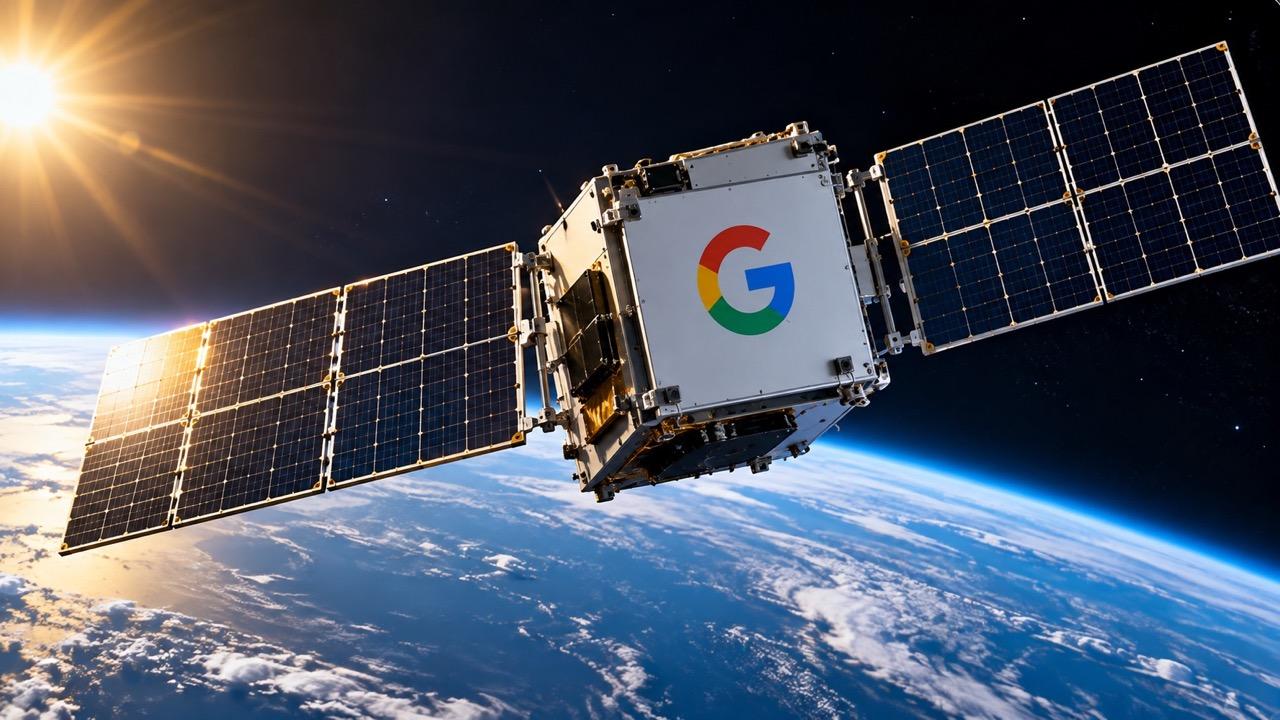
- Google is preparing to launch the first in-orbit test of Project Suncatcher on October 1, putting four Tensor Processing Units aboard a satellite to test whether AI computing can eventually move beyond Earth’s power, cooling, and infrastructure constraints.
Alphabet Inc. (NASDAQ: GOOGL) is taking its Project Suncatcher research program from laboratory testing to space next week as Google prepares to launch a prototype satellite designed to test AI hardware in low Earth orbit.
The refrigerator-sized satellite, developed with Planet Labs PBC (NYSE: PL), is scheduled to fly aboard SpaceX’s Transporter-18 rideshare mission on October 1. The spacecraft will carry four Google Tensor Processing Units, or TPUs, and test how they perform under radiation, launch vibration, and the thermal conditions of space.
The mission is an important milestone for Google's orbital data center concept, but it is not a commercial space-based data center. Google describes Suncatcher as a long-term research effort aimed at determining whether interconnected, solar-powered satellites could eventually provide large-scale machine-learning infrastructure.
That distinction creates an important SEO and investor angle: the October launch is primarily an engineering test, while the much larger question is whether orbital computing can eventually become an economically viable alternative to terrestrial AI infrastructure.
What Is Google Project Suncatcher Testing in Space?
The first Suncatcher satellite is deliberately small. It will carry four TPUs and roughly 1 kilowatt of solar power, according to reporting from Ars Technica and Yahoo Finance. The chips will run Gemini models, but the system will operate in short bursts of about 15 minutes because of the limits of its experimental cooling system.
Cooling is one of the most significant differences between an AI data center on Earth and one in orbit. Terrestrial data centers can use air or liquid systems to move heat away from processors. In space, there is no atmosphere to carry heat away. Google's prototype instead uses heat pipes and radiators to transfer thermal energy from the TPUs and release it into space.
Google says it has already tested the system in thermal-vacuum conditions on Earth, with the upcoming mission providing an opportunity to see how the hardware performs in an actual orbit. Radiation is another concern. High-energy particles can damage electronics or cause errors in computing operations. Google has therefore conducted radiation testing on its TPUs before the launch.
The company is also testing whether conventional Google AI hardware can survive the mechanical stresses of reaching orbit. The launch environment subjects equipment to vibration and high acceleration, creating another challenge for chips designed primarily for terrestrial data centers.
The first mission is therefore less about delivering useful AI capacity and more about answering a basic question: can Google's AI hardware reliably operate in space?
Why Google Wants AI Data Centers in Orbit
The longer-term Suncatcher concept is much larger than the October test.
Google's 2025 research proposed a network of solar-powered satellites operating in low Earth orbit and linked by high-speed optical communications. In an appropriate orbit, solar panels could generate substantially more power than comparable panels on Earth while receiving sunlight for much longer periods. Google has said panels could be up to eight times more productive in the right orbital conditions.
The potential attraction is straightforward. AI data centers on Earth require enormous amounts of electricity, land, cooling capacity, and grid infrastructure. Google is already among the companies investing heavily in AI infrastructure, while other technology companies are confronting similar constraints. But moving computation into orbit introduces a different set of problems.
Google's research calls for future satellites to communicate using high-bandwidth optical links. The company plans a separate two-satellite communications test in 2027. Those satellites would need to maintain extremely precise positioning while transferring large amounts of data between one another.
Economics may ultimately be the biggest hurdle. Launch costs, satellite replacement, radiation protection, communications, maintenance, and hardware obsolescence all have to be considered alongside the cost of electricity.
Research from JLL also suggests orbital computing may initially make more sense for workloads that can tolerate latency, such as AI training, batch processing and simulations, rather than real-time applications.
That leaves Google with a long development path. The October 1 launch can provide valuable engineering data, but it does not establish that orbital AI is ready to compete with terrestrial data centers.
For Alphabet investors, the near-term financial impact is therefore limited. The more important question is whether Suncatcher can eventually become a credible answer to one of AI's biggest infrastructure problems: finding enough power and computing capacity to support continued growth.
Google's October test is the first step in answering that question.