
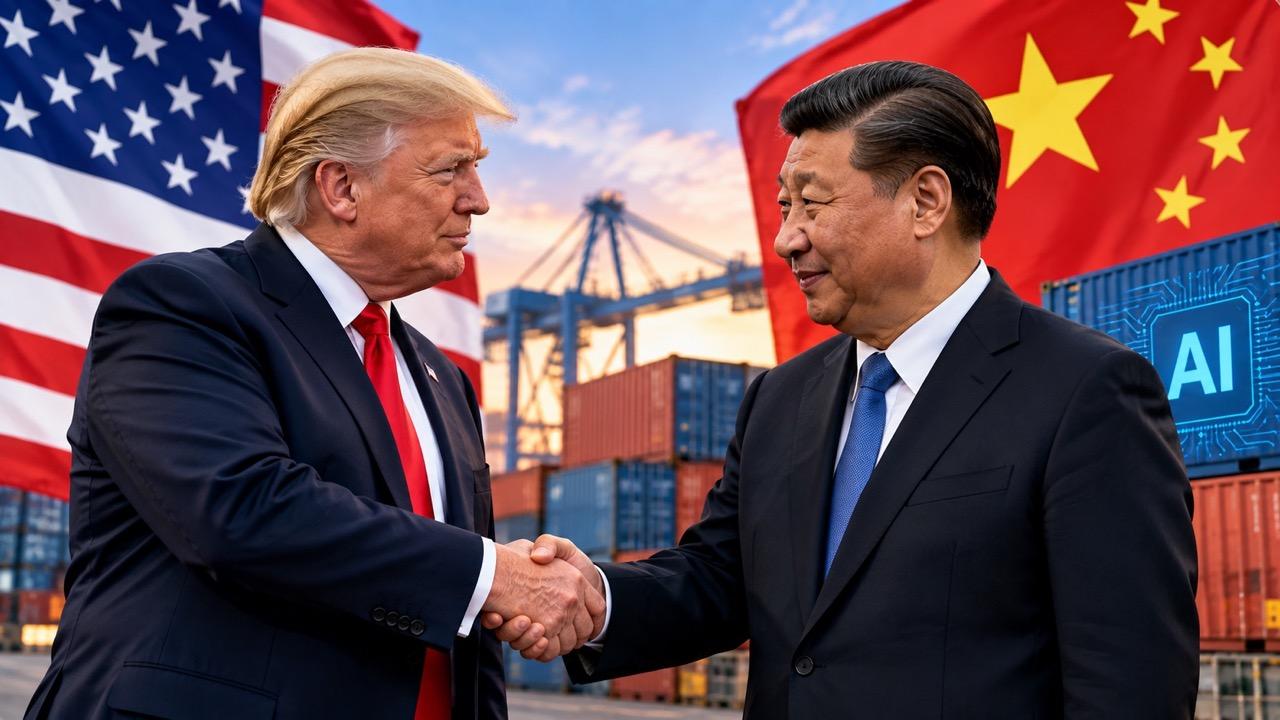
- China and the US have agreed to reciprocal tariff reductions covering $30 billion in trade and will establish a new artificial intelligence dialogue, adding fresh economic and technology agreements after President Xi Jinping’s Washington visit.
China and the US have reached an eight-point consensus that includes a $30 billion reciprocal tariff-reduction arrangement, a new trade council and formal talks on artificial intelligence, according to China’s Ministry of Foreign Affairs and a Reuters report published Sept. 26.
The agreement follows Xi’s three-day US visit and comes as Washington and Beijing try to extend a fragile trade truce while managing disputes over tariffs, technology, AI and critical supply chains.
The two governments had already agreed to extend the existing trade truce by two months, pushing its expiration from Nov. 10 to Jan. 10, US Treasury Secretary Scott Bessent said earlier this week. The latest arrangement therefore adds specific areas of cooperation without resolving every major dispute between the world's two largest economies.
What Does the $30 Billion US-China Tariff Agreement Cover?
The $30 billion tariff arrangement is not a broad removal of tariffs across all US-China trade. China’s Ministry of Commerce said earlier this year that the framework would cover products of roughly equivalent value on each side, with selected goods potentially receiving most-favored-nation tariff rates or lower rates. The ministry said the framework was intended to cover non-sensitive products.
The US and China had been working on the framework for months. In July, Beijing sought input from companies, business groups and local governments on the proposed tariff reductions, indicating that the details had not yet been fully finalized.
US Trade Representative Jamieson Greer said Friday that the two countries had reached agreement on exempting some goods from future trade disputes. He said US agricultural products and medical devices could be included, while Chinese consumer goods and other non-sensitive products could receive preferential treatment. Details of the arrangement are expected to be released Monday, Greer said.
The economic stakes remain substantial. The US Trade Representative estimates that US goods and services trade with China totaled $494.6 billion in 2025, including $414.6 billion in goods trade. US imports from China were $308.7 billion, compared with $106 billion of US goods exports to China.
That means the $30 billion framework represents only a portion of bilateral commerce, making implementation and the eventual product list more important than the headline figure alone.
US-China AI Talks Add a New Technology Channel
Artificial intelligence is the other major development from the summit. China and the US agreed to establish a dialogue covering the risks and benefits of AI, with the next round of discussions scheduled for November, Reuters reported. The two sides also agreed to create a communication channel for AI-related incidents.
The mechanism builds on discussions that had taken place before the summit. Earlier this month, Bessent proposed an AI safety notification system focused on national-security-level incidents, while US officials said advanced AI chips and semiconductor manufacturing equipment were not part of those particular discussions.
That distinction remains important because AI is simultaneously an area of potential cooperation and one of the most sensitive parts of the US-China technology relationship.
Washington has imposed restrictions on China's access to certain advanced computing technologies, while Beijing has sought greater access to AI hardware and other technologies needed to develop its domestic industry. The latest dialogue does not indicate that those export-control disputes have been resolved.