
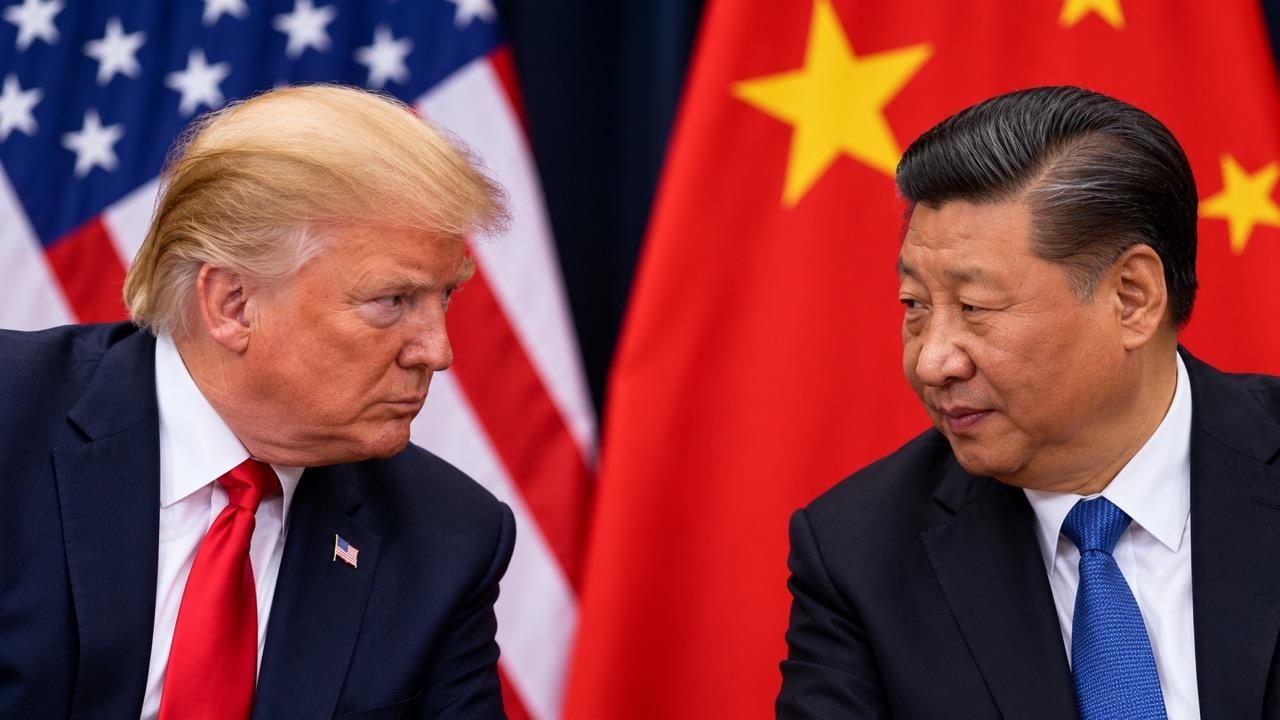
- Donald Trump and Xi Jinping have begun talks at the White House, with trade, artificial intelligence, semiconductor restrictions and Taiwan among the issues shaping the US-China relationship.
US President Donald Trump welcomed Chinese President Xi Jinping to the White House on Thursday for a state visit that brings the world's two largest economies together while disagreements over trade and technology remain unresolved.
The meeting is Xi's first state visit to Washington in more than a decade and the leaders' third in-person meeting in less than a year. The White House scheduled a formal arrival ceremony followed by talks and a state dinner.
Bloomberg reported that the visit is intended to keep relations between Washington and Beijing on track despite continuing disputes over artificial intelligence, trade and Taiwan. The economic stakes are significant for US companies because the relationship affects tariffs, semiconductor exports, critical minerals, manufacturing and access to the Chinese market.
The two countries have already agreed to extend their existing trade truce by two months, moving the expiration date from Nov. 10 to Jan. 10, according to Treasury Secretary Scott Bessent. The extension reduces the immediate risk of another broad escalation in tariffs, but it does not resolve the underlying trade disputes.
AI and Semiconductor Restrictions Are Central to the Trump-Xi Talks
Artificial intelligence has become one of the most important areas of US-China competition. Washington has restricted China's access to some advanced AI chips and related technologies, while Beijing has objected to US efforts to limit its access to critical technology. The two countries are also competing for leadership in AI development, data centers and advanced computing.
Trump said Thursday that he does not expect the summit to produce new AI guardrails. In a social media post, he said artificial intelligence would be an important discussion topic but indicated that he wanted the issue left largely where it stands. At the same time, US officials have discussed creating a mechanism for Washington and Beijing to communicate about AI incidents that could threaten national security.
Treasury Secretary Scott Bessent said the US has proposed a notification system that would allow the two governments to alert one another about serious AI-related incidents. Secretary of State Marco Rubio has separately described the concept as potentially similar to a Cold War-era communications channel intended to prevent dangerous incidents from escalating.
The potential mechanism illustrates the distinction between AI cooperation and AI competition. The US and China can have an interest in preventing an AI-related incident from escalating while continuing to compete over chips, models, and technological capabilities.
Semiconductor policy remains particularly important for companies such as NVIDIA Corporation (NASDAQ: NVDA) and Advanced Micro Devices Inc. (NASDAQ: AMD), whose ability to sell advanced processors into China has been affected by US export rules.
Recent congressional proposals would also strengthen controls over advanced AI chips and require additional safeguards around the location and use of exported processors.
What the Trump-Xi Meeting Means for Trade, Markets and US Companies
Trade remains the most immediate economic issue. The two governments are discussing the future of their tariff truce as businesses continue to operate under a complicated mix of tariffs, export controls and other restrictions. Reuters reported that the current extension gives negotiators additional time to work on agriculture, non-tariff barriers and other unresolved issues.
Critical minerals and rare earths are another important part of the relationship because China remains a major supplier of materials used in electronics, electric vehicles and advanced manufacturing. The issue has become intertwined with the broader technology competition.
The guest list for Thursday's state dinner also highlights the commercial importance of the relationship. Executives from Apple, Amazon, Alphabet, OpenAI, Tesla and Nvidia are among those expected to attend, alongside major financial executives.
For those companies, China can simultaneously represent a customer base, manufacturing location, supply-chain partner and regulatory challenge. Tesla and Apple, for example, have substantial commercial ties to China, while Nvidia's business is directly affected by US restrictions on advanced chip exports.
Taiwan remains another major point of disagreement. Beijing claims Taiwan as part of China, while the US maintains longstanding commitments concerning Taiwan's ability to defend itself. Analysts cited by AP said Xi could seek further limits on US arms sales to Taiwan during the visit.
The war involving Iran also adds another layer to the discussions because China is a major buyer of Iranian oil and Washington has sought to restrict Iran's economic relationships.
For markets, the immediate focus is therefore less on whether the meeting resolves every dispute and more on whether Washington and Beijing can maintain the current trade pause while establishing mechanisms to manage disagreements over technology, Taiwan and other strategic issues.