
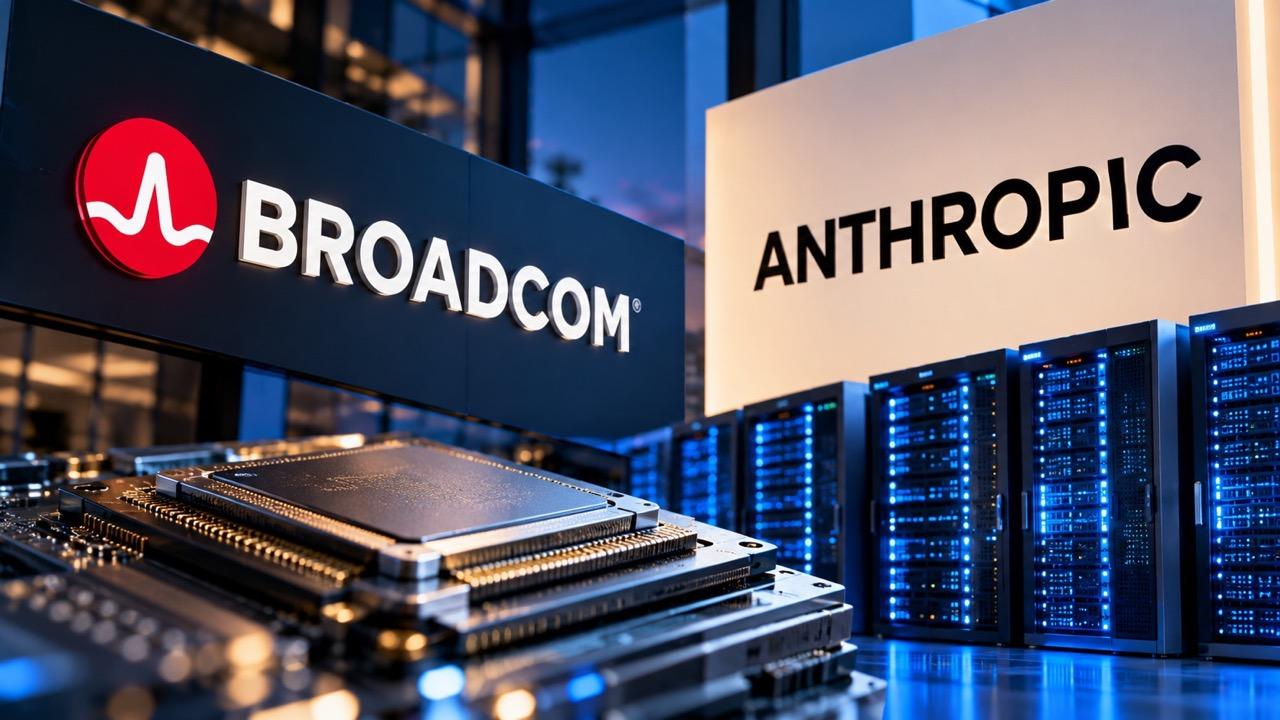
- The proposed financing would deepen the relationship between Broadcom and Anthropic as the AI company commits to billions of dollars in future computing capacity.
Broadcom Inc. (NASDAQ: AVGO) has agreed to lend Anthropic up to $42 billion to help finance the AI company's use of Broadcom-supplied chips, according to a Reuters report and based on details in Anthropic's confidential IPO prospectus.
The arrangement goes beyond a conventional chip-supply agreement. Broadcom would provide financing that Anthropic can use to lease computing equipment, while the semiconductor company could potentially convert the debt into Anthropic shares.
The proposed financing comes as Anthropic prepares for a potential public listing and rapidly expands the computing infrastructure required to train and operate its Claude AI models.
The deal also adds another layer to an increasingly interconnected AI infrastructure market, where chipmakers, cloud providers and AI developers are committing capital to one another.
Broadcom and Anthropic Deepen Their AI Chip Partnership
The $42 billion facility is connected to a much larger infrastructure commitment. Anthropic's convertible note could cover roughly one-third of a $125.2 billion, five-year lease for TPU computing capacity. The arrangement follows an April expansion involving Broadcom, Google and Anthropic. Under that agreement, Anthropic is expected to access approximately 3.5 gigawatts of next-generation TPU-based computing capacity beginning in 2027. Broadcom disclosed the arrangement in an SEC filing.
Google Cloud separately said the expanded relationship would give Anthropic access to multiple gigawatts of TPU capacity beginning in 2027, with the processors supplied through Broadcom. The financing therefore sits inside a broader effort by Anthropic to secure computing capacity as demand for its AI models expands.
Broadcom's exposure to the AI infrastructure cycle has already grown sharply. The company reported $29.6 billion of fiscal third-quarter 2026 revenue, up 86% from a year earlier, while AI semiconductor revenue reached $16.7 billion, an increase of 221%. Broadcom expects fourth-quarter AI semiconductor revenue of $21.7 billion.
The scale of that business is also relevant to investors following the broader AI infrastructure spending cycle, which increasingly extends beyond Nvidia and traditional GPUs into custom accelerators, networking and other components.
Anthropic's AI Infrastructure Spending Creates New Risks
Anthropic's expansion comes with substantial financial commitments. The company's confidential IPO filing shows at least $518 billion of planned AI infrastructure spending over a decade, including long-term agreements with major technology and infrastructure providers.
Broadcom represents one part of that infrastructure network. Anthropic also has major commitments involving Amazon, Google and Microsoft, while the companies can simultaneously serve as cloud providers, investors and competitors.
That structure creates potential conflicts that Anthropic itself has flagged in its IPO documentation. The company also warned that Broadcom could demand immediate repayment of certain lease obligations if specified defaults occur
The proposed financing also highlights a broader question surrounding the economics of the AI boom: how much of the industry's enormous infrastructure spending is ultimately financed by the companies expected to generate revenue from that infrastructure?
That question has become increasingly relevant as investors examine companies supplying the physical infrastructure behind AI, from memory and networking equipment to power systems and custom chips.
Broadcom's own financial results show that AI demand is already producing substantial revenue. The company expects fiscal 2026 AI semiconductor revenue of about $58 billion and has projected $115 billion in fiscal 2027 and $230 billion in fiscal 2028. Those figures are company forecasts rather than guaranteed outcomes.
For Anthropic, however, the infrastructure requirements are occurring alongside its potential IPO. The company is reportedly targeting a valuation of around $2 trillion, while its prospectus shows rapidly rising revenue but also substantial losses and future infrastructure obligations.
The Broadcom financing consequently gives investors another way to view the AI capital cycle: semiconductor companies are not only selling the hardware required to build AI systems, but can increasingly become financially tied to the growth of the companies buying that hardware.