
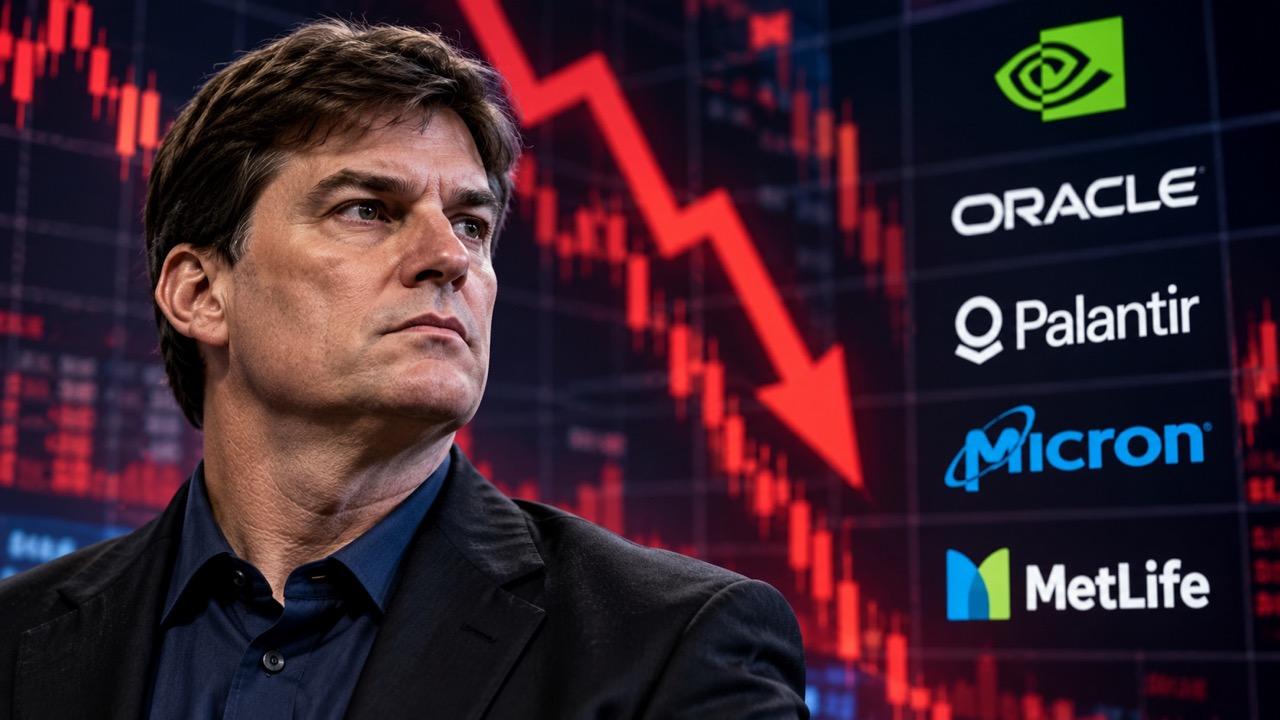
- Michael Burry has shifted most of his bearish stock positions into put options as he brings forward his timeline for a potential downturn in the AI trade.
Michael Burry, the investor portrayed in The Big Short, has changed the structure of his bearish portfolio rather than simply abandoning his bets against AI-related stocks.
In a Sept. 28 trading update, Burry said he had replaced his common-stock short positions with put options, while opening a new bearish position in MetLife Inc. (NYSE: MET). His latest positioning continues to focus heavily on companies connected to artificial intelligence, semiconductors and data-center spending.
That change is important when interpreting headlines about which stocks Burry is “shorting.” A traditional short sale and a put option both benefit from a falling stock price, but they have very different risk profiles and expiration characteristics.
Which Stocks Is Michael Burry Betting Against?
Burry's latest disclosed bearish exposure includes Micron Technology Inc. (NASDAQ: MU), Nebius Group N.V. (NASDAQ: NBIS), NVIDIA Corp. (NASDAQ: NVDA), Palantir Technologies Inc. (NASDAQ: PLTR), Oracle Corp. (NYSE: ORCL), Caterpillar Inc. (NYSE: CAT) and MetLife.
He also has bearish exposure through the iShares Semiconductor ETF (NASDAQ: SOXX) and the Invesco QQQ Trust (NASDAQ: QQQ), although those are ETFs rather than individual companies.
The Sept. 28 repositioning covered common-stock shorts in Micron, Nebius, Caterpillar, Nvidia and Palantir, among others, and replaced much of that exposure with puts extending into 2027. Oracle was also shifted toward longer-dated put exposure. CoreWeave Inc. (NASDAQ: CRWV), which had previously been one of Burry's short positions, was covered rather than replaced with a new put position because of option pricing, according to reporting on the update.
Micron represents a bet against the sustainability of the current memory and AI-chip cycle. The company has delivered extraordinary recent results, with revenue and margins surging as demand for high-bandwidth memory and other products used in AI infrastructure has increased. That makes the bearish thesis more dependent on future normalization than on current weakness. Micron's recent earnings illustrate how far the business has moved during the AI boom.
Nvidia remains one of the most prominent names in Burry's bearish positioning. The company is at the center of the AI accelerator market, but its shares also reflect exceptionally high expectations for continued data-center spending.
Palantir is another major target. The software company has benefited from rapid growth in commercial and government AI demand, but its valuation has also become a central part of the bearish argument surrounding the stock.
Oracle is different from the chip names. Its AI opportunity is tied to cloud infrastructure and enormous data-center commitments. The company has also faced scrutiny over the capital required to support that expansion. Its AI data-center buildout has become an important part of the debate around its stock.
Nebius gives Burry exposure to a smaller and more capital-intensive part of the AI infrastructure market. The company is rapidly expanding computing capacity for AI customers, making its future economics highly dependent on utilization, financing, and the durability of AI demand.
Caterpillar is a less direct AI bet. Burry's bearish exposure reflects the company's connection to construction and infrastructure spending, including the buildout associated with data centers.
MetLife stands apart from the AI-related positions. Burry opened a new bearish position in the insurer as he reshuffled the portfolio in late September. The position means his latest bearish strategy is not exclusively an AI trade.
Why Burry Is Moving From Shorts to Put Options
Burry said his latest changes followed weekend research that caused him to move his timeline forward. He has argued that the enormous investment required to build AI infrastructure could create problems if the revenue generated by those systems fails to justify the capital being deployed.
The timing is notable because AI infrastructure spending continues to accelerate. Goldman Sachs recently estimated that the five largest US hyperscalers could spend roughly $1.2 trillion on AI infrastructure in 2027, highlighting the scale of the capital cycle. AI infrastructure spending is increasingly extending into chips, networking, power, and data centers.
A put option gives Burry a defined expiration date and limits the maximum loss to the premium paid, while a traditional short position does not have a fixed expiration and can generate theoretically unlimited losses if the stock rises.
That difference has become especially relevant because several of Burry's targeted stocks have continued to perform strongly despite his warnings. A September review showed that Palantir, Nvidia, Micron and other bearish positions had moved sharply against earlier short entries during parts of the summer.
Burry's current strategy therefore represents a more time-sensitive bearish position than simply betting that AI stocks are expensive. His puts require the underlying shares to decline sufficiently before expiration for the trades to become profitable.
The latest positioning also comes as Burry expands his broader focus beyond individual AI companies. Reuters reported that he is advising a new short-focused hedge fund targeting weaknesses in private credit, suggesting that concerns about leverage and financing extend beyond the technology sector.
For investors tracking Burry's portfolio, the key fact is that his latest disclosures do not show him simply maintaining the same stock shorts. He has changed the instruments, covered several outright shorts, and added new options exposure while keeping his broader bearish view on parts of the AI investment cycle