
- The biggest beneficiaries of the AI boom may not be the companies building the most visible models. As hyperscalers prepare to spend as much as $1.2 trillion on AI infrastructure in 2027, demand is spreading into memory, networking, power equipment, cooling, and semiconductor manufacturing.
The artificial intelligence investment cycle is becoming much larger than the market for GPUs and large language models. Goldman Sachs expects the five largest US hyperscalers to spend about $1.2 trillion on AI infrastructure in 2027, up from roughly $800 billion this year. The forecast covers Amazon.com Inc. (NASDAQ: AMZN), Alphabet Inc. (NASDAQ: GOOGL), Microsoft Corp. (NASDAQ: MSFT), Meta Platforms Inc. (NASDAQ: META) and Oracle Corp. (NYSE: ORCL).
Goldman also estimates that those companies would need roughly $300 billion in annual AI revenue to break even on the infrastructure investment. That spending does not flow exclusively to GPU suppliers. Every large AI data center also requires memory, high-speed networking, electrical equipment, cooling systems, and increasingly sophisticated semiconductor manufacturing.
Memory, Networking and Chip Equipment Are Becoming Critical
Micron Technology Inc. (NASDAQ: MU)
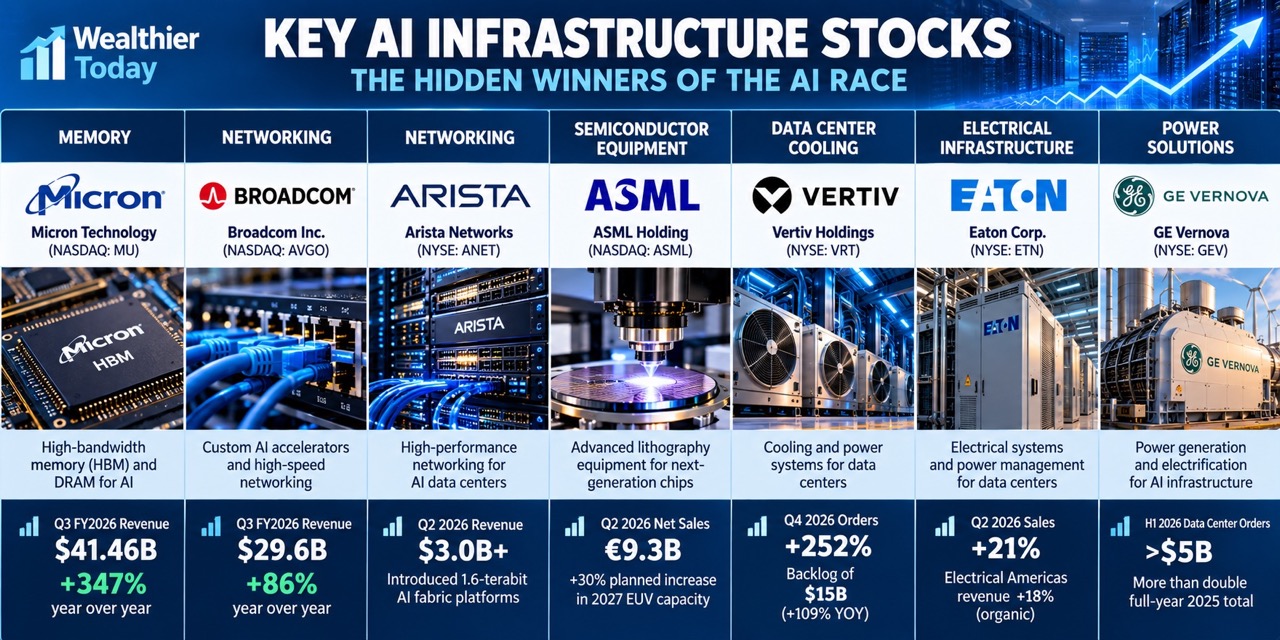
Micron Technology Inc. (NASDAQ: MU) is one example of a company operating deeper in the AI hardware chain. Micron reported record fiscal third-quarter 2026 revenue of $41.46 billion, compared with $23.86 billion in the prior quarter and $9.3 billion a year earlier. The company specifically described memory as strategically important in the AI era as demand for high-bandwidth memory rises alongside AI computing.
Memory has become an increasingly important constraint because AI accelerators require large amounts of high-performance memory to process workloads efficiently. Goldman Sachs said memory producers were generating gross margins of roughly 80%, more than twice their historical average, although it also warned that some of that margin expansion could fade.
Broadcom Inc. (NASDAQ: AVGO)
Broadcom Inc. (NASDAQ: AVGO) reported third-quarter fiscal 2026 revenue of $29.6 billion, up 86% year over year. Its AI semiconductor revenue reached $16.7 billion, up 221%, driven by demand for custom AI accelerators and networking. Broadcom expects AI semiconductor revenue to reach $21.7 billion in its fourth quarter.
Arista Networks Inc. (NYSE: ANET)
Arista Networks Inc. (NYSE: ANET) is exposed to the same networking buildout. The company reported more than $3 billion in quarterly revenue in the second quarter of 2026 and introduced 1.6-terabit AI fabric platforms designed for large-scale AI networks.
ASML Holding NV (NASDAQ: ASML)
ASML Holding NV (NASDAQ: ASML) reported €9.3 billion in second-quarter 2026 net sales and said continuing AI investment was driving demand for advanced logic and memory chips. The company said order intake remained extremely strong and planned to increase 2027 low-NA EUV capacity by about 30% from its 2026 level. This creates exposure to AI spending even though ASML does not sell AI models or GPUs directly.
Power and Cooling Are Becoming AI Infrastructure Bottlenecks
The physical requirements of AI data centers are creating another group of beneficiaries outside traditional technology stocks.
Vertiv Holdings Co. (NYSE: VRT)
Vertiv Holdings Co. (NYSE: VRT) supplies critical digital infrastructure, including cooling and power systems used in data centers. Its fourth-quarter 2025 orders rose 252% organically year over year, while backlog reached $15 billion, up 109%. Vertiv said hyperscale and colocation data centers were major drivers of order growth.
Eaton Corp. plc (NYSE: ETN)
Eaton Corp. plc (NYSE: ETN) reported that second-quarter sales increased 21%, while its Electrical Americas business posted an 18% organic revenue increase. The company said data centers remained a key growth driver, with its 12-month rolling orders in Electrical Americas up 41%.
GE Vernova Inc. (NYSE: GEV)
GE Vernova Inc. (NYSE: GEV) is also benefiting from the power requirements surrounding data-center construction. The company reported more than $5 billion of data-center orders in its Electrification business during the first half of 2026, more than double its full-year 2025 total. Overall second-quarter orders increased 88% organically to $24.2 billion, with Power and Electrification leading the gains.
The trend reflects a basic constraint in the AI buildout: computing capacity cannot expand without enough electricity and the equipment needed to deliver and manage it.
Research from MUFG identifies the same broad AI infrastructure chain, including semiconductor equipment, high-bandwidth memory, advanced packaging, networking, data-center construction, cooling, power management, and electrical infrastructure.