
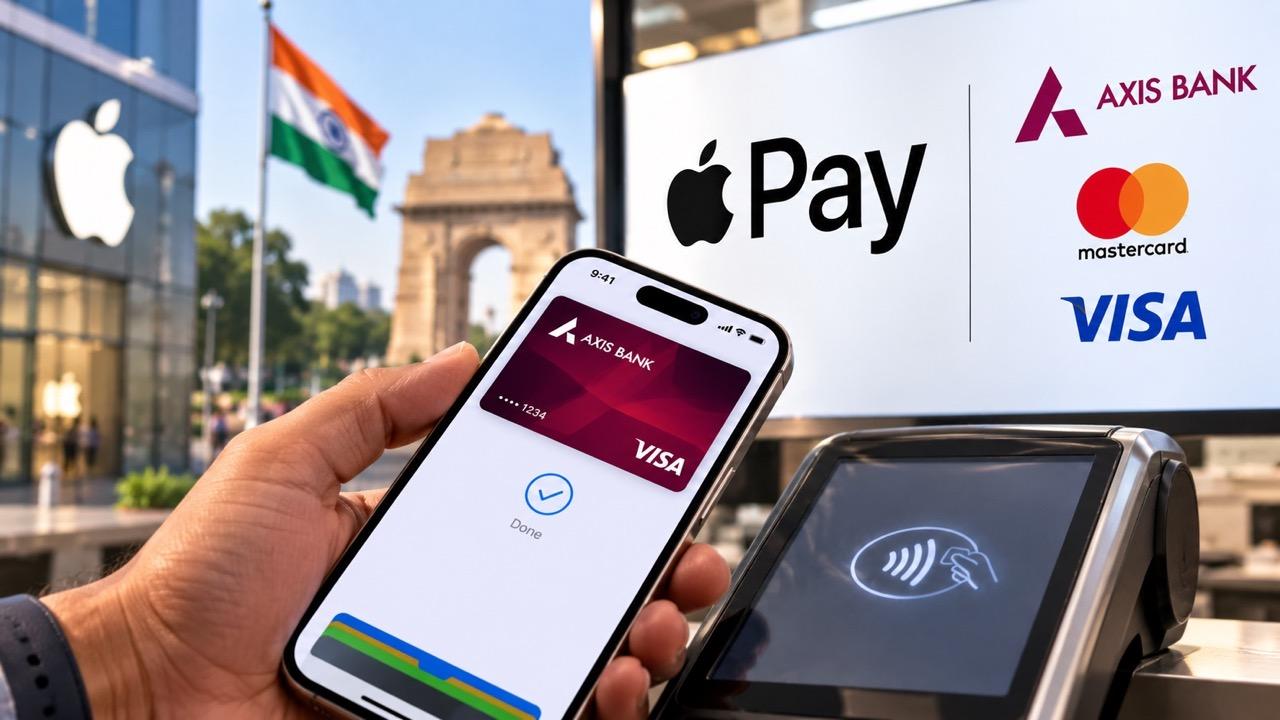
- Apple Pay is now available in India, initially supporting eligible Axis Bank Visa and Mastercard credit cards across iPhone, iPad, and Apple Watch.
Apple Pay has officially launched in India, giving users a new contactless payment option through Apple devices and bringing Apple Inc. (NASDAQ: AAPL) into a digital payments market dominated by local platforms and card networks.
Apple announced the rollout on Sept. 30, saying customers in India can now use Apple Pay on iPhone, iPad and Apple Watch, with Mac support coming soon. Eligible Axis Bank-issued Visa and Mastercard credit cards can be added to Apple Wallet and used at thousands of merchants across the country.
The launch gives Apple another potential source of engagement across its large installed device base. The company's shares have also remained closely watched by investors, including after earlier pressure surrounding Apple's Mac and iPad pricing.
The initial rollout is narrower than Apple's established payments presence in other markets. Reuters reported that Axis Bank is Apple's first Indian banking partner, with Visa and Mastercard credit cards supported at launch while cards running on India's domestic RuPay network are not currently supported.
How Apple Pay Works in India
Customers with eligible Axis Bank cards can add their cards to Apple Wallet through the latest Axis Bank app or directly through the Wallet app on an iPhone. In physical stores, users authenticate with Face ID, Touch ID or a device passcode before holding the iPhone or Apple Watch near a contactless payment terminal.
Apple said Apple Pay can also be used for purchases inside apps and on the web, without requiring users to repeatedly enter card, billing or shipping information. Mac support is expected to arrive later.
The service is initially available across millions of merchant locations, including Apple Store locations, Blinkit, Croma, Ixigo, Reliance brands, Tata 1mg and Zomato. Apple also said it worked with payment service providers including Cashfree, Juspay, Mswipe, Paytm, PayU, Pine Labs, Razorpay and Worldline to support merchant networks.
The merchant rollout puts Apple Pay into a market where acceptance is already an important competitive factor for payment networks. American Express' expansion beyond 190 million merchant locations worldwide illustrates how payment companies have been investing in broader acceptance to increase the number of places where customers can use their cards.
Apple Pay's security model is based on tokenization rather than transmitting the customer's actual card number to a merchant. Apple said the card number is not stored on the device or its servers. Instead, a unique Device Account Number is encrypted and stored in the device's Secure Element.
Apple also said transactions made through Apple Pay do not require users to enter a card PIN or one-time password at checkout. Payments are authenticated on the device.
Compatible hardware is required. Apple says Apple Pay in India requires an iPhone XR or later running iOS 18 or later, while Apple Watch support starts with Series 6 or later running watchOS 11 or later.
Apple Pay Enters a Market Dominated by UPI
Apple is entering India at a time when digital payments are already deeply embedded in everyday commerce. The country's Unified Payments Interface, or UPI, processed 24.51 billion transactions worth 29.82 trillion rupees in August 2026, according to data from the National Payments Corporation of India.
Apple is launching primarily as a card-based contactless payment service, rather than as another UPI payment application. Reuters reported that UPI accounts for about 84% of India's digital payments by volume and that Apple has been discussing potential partnerships with other major Indian banks, including HDFC Bank and ICICI Bank. No additional banking agreements had been finalized at the time of the report.
Axis Bank had about 16.3 million credit cards in circulation as of August, according to Reuters, giving Apple access to a substantial existing cardholder base even though the service does not initially support every major Indian card network.
The launch therefore gives Apple an entry point into India's payments market without immediately attempting to replicate the reach of UPI. Globally, Apple said Apple Pay is now available in more than 90 countries and regions and works with more than 11,000 bank and network partners. The company expects additional merchants and apps to join the Indian ecosystem over time.
For investors, the India launch adds another development to watch within Apple's broader services and device ecosystem. The initial rollout is limited to eligible Axis Bank Visa and Mastercard credit cards, but expansion to additional banks and payment networks could determine how widely Apple Pay is adopted in the country.