
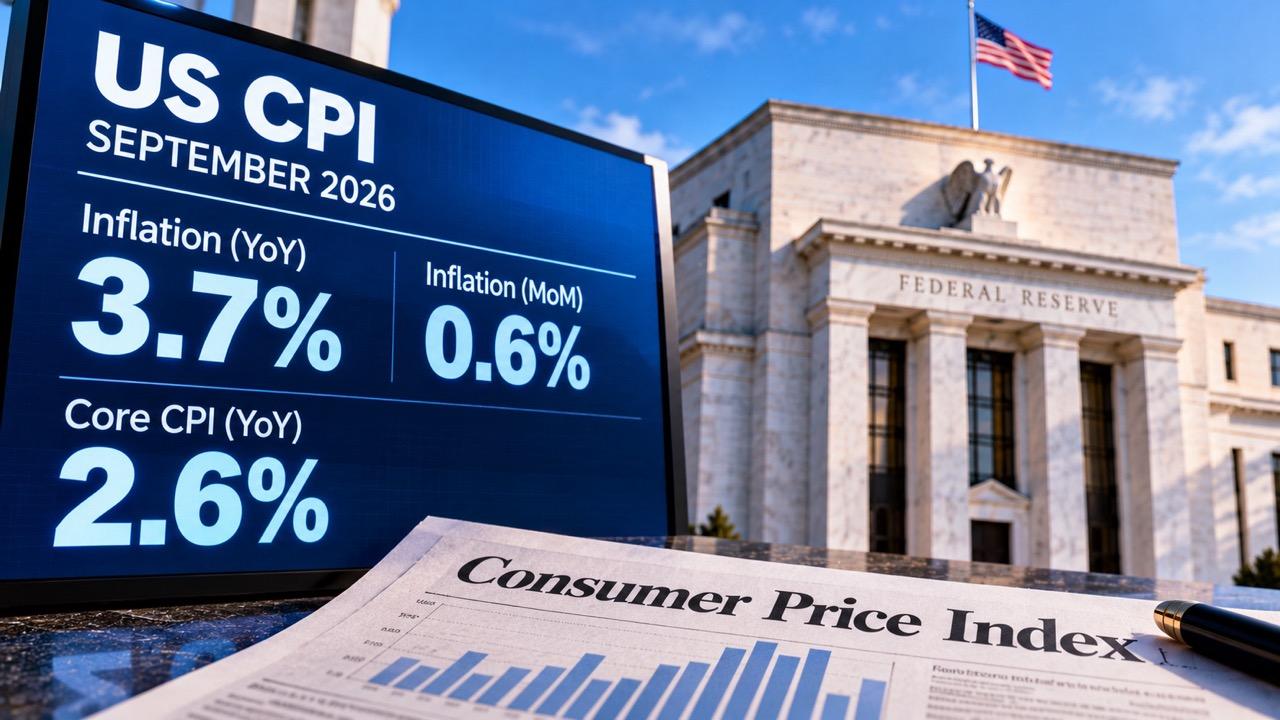
- September inflation accelerated to 3.7% annually as energy costs surged, sending Treasury yields higher and stock futures lower while investors reassessed the Federal Reserve’s next move and the outlook for borrowing costs.
The September 2026 Consumer Price Index report delivered a fresh challenge for financial markets on Wednesday, October 14, after inflation accelerated more than expected and strengthened expectations that the Federal Reserve could raise interest rates again.
The Bureau of Labor Statistics’ September CPI release showed headline consumer prices rose 3.7% from a year earlier, up from 3.4% in August. Monthly inflation reached 0.6%, compared with 0.4% in the previous month. Economists had expected annual inflation of 3.6%.
Core CPI, which excludes food and energy, increased 0.3% month over month and 2.6% annually. The annual core rate exceeded the 2.5% forecast, suggesting that price pressures were not limited to energy.
Markets reacted quickly. The two-year US Treasury yield, which is particularly sensitive to expectations for Federal Reserve policy, climbed to around 4.9%, while the 10-year yield rose above 5.3%. Stock futures reversed earlier gains, and the US dollar strengthened as investors adjusted their rate expectations. The October 14 market reaction highlighted renewed pressure on technology shares and other investments sensitive to borrowing costs.
The report also follows a period of elevated bond yields and energy prices. Rising Treasury yields and the bond selloff had already raised concerns about financing costs before the latest inflation figures arrived.
Why the September CPI Report Changed the Federal Reserve Rate Outlook
Energy costs were the largest immediate contributor to September's headline inflation increase. The BLS reported that the energy index climbed 5.2% during the month, while gasoline prices rose 9.1%, accounting for more than half of the monthly increase in overall CPI. Energy prices were up 20.4% over the year.
However, investors also had to consider underlying inflation. Core CPI rose 0.3% monthly, matching August's increase, while the annual rate accelerated to 2.6% from 2.4%. Shelter prices increased 0.4% in September, adding to concerns that inflation could remain persistent even if energy prices stabilize.
The combination complicates the Federal Reserve's policy choices. Higher inflation argues for keeping monetary policy restrictive or considering another rate increase, while weaker employment growth can weigh against tightening financial conditions further. Policymakers must assess both risks rather than react to a single inflation reading.
Market pricing shifted after the report. According to Reuters' coverage of the market response, the implied probability of an October rate increase rose sharply following the release. Other market reporting put the probability of a quarter-point increase at roughly 44% to 47%, compared with around 20% before the data.
That shift does not mean the Fed has committed to raising rates at its October 28 meeting. The inflation report is one input into the decision, and policymakers will have to weigh additional economic data and the risk that higher borrowing costs could weaken growth. Some analysts expect the release to keep attention focused on the December meeting rather than force an immediate move.
For investors, the key question is whether September marks a temporary energy-driven spike or the start of a broader period of persistent inflation. The distinction will influence how markets price the path of interest rates over the coming months.
What Higher Treasury Yields Mean for Mortgage Rates and Rate-Sensitive Stocks
The bond market reaction matters beyond government debt. Treasury yields help determine borrowing costs across the economy, including mortgage rates and corporate financing. When yields rise, lenders and investors can demand higher returns on other forms of credit, although mortgage rates do not move in lockstep with Treasury yields.
That creates another challenge for the housing market. The average 30-year fixed mortgage rate had already climbed above 7% in September, according to Wealthier Today's mortgage-rate coverage. A sustained increase in Treasury yields could keep mortgage financing expensive, putting pressure on affordability and potentially limiting homebuyer demand. The CPI release alone, however, does not establish how much mortgage rates will change.
Higher yields can also weigh on stocks whose valuations depend heavily on future earnings. Growth and technology companies may face particular pressure because investors discount expected future profits at higher rates. Companies that rely on frequent borrowing can also face higher financing expenses, while utilities and real estate investment trusts may become less attractive relative to bonds offering higher yields.
The market impact will not be uniform. Banks, energy companies and other sectors may respond differently depending on their earnings, balance sheets and exposure to interest rates. Strong corporate results could offset some of the pressure from higher yields, while weaker guidance could make stocks more vulnerable to the changing rate outlook.
Investors should also monitor whether the stronger dollar and higher borrowing costs persist beyond the initial reaction. A sustained rise in yields could tighten financial conditions even without an immediate Federal Reserve rate increase.
The September CPI report has made the inflation outlook more difficult to interpret. Energy prices drove much of the monthly increase, but the acceleration in core inflation and shelter costs gives policymakers additional reasons to remain cautious. The next market-moving signals will include further inflation data, labor-market indicators and Federal Reserve commentary.
For now, the report has increased uncertainty around the timing of the Fed's next move, while reinforcing the importance of Treasury yields for mortgage costs, equity valuations and broader financial conditions.