
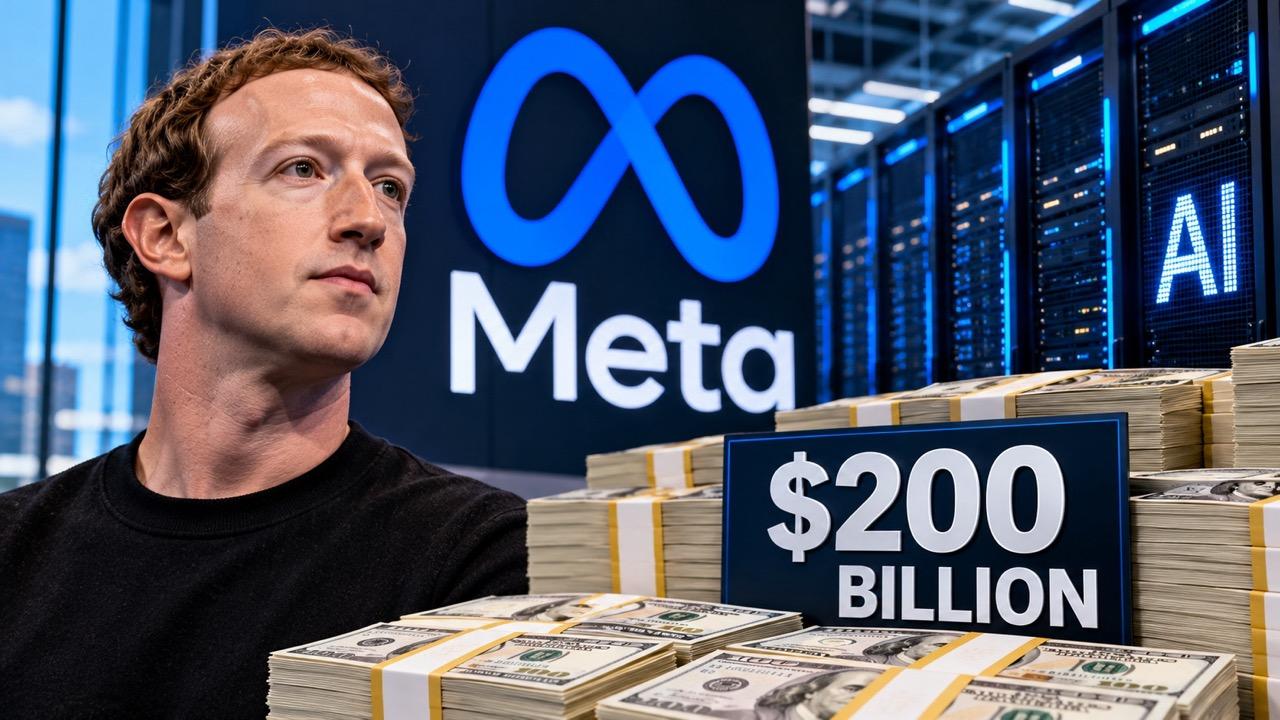
- Meta Platforms Inc. (NASDAQ: META) was prepared to commit as much as $200 billion to artificial intelligence before confirming that its next-generation models would succeed.
Zuckerberg described the potential investment during an appearance on the Cheeky Pint podcast, released Monday, October 12. Speaking about discussions with Meta Chief AI Officer Alexandr Wang late last year, Zuckerberg said the company was excited by research progress but had not yet seen the models that would ultimately determine whether the strategy worked, Business Insider reported.
Zuckerberg said he had discussed committing roughly $100 billion to $200 billion and asked Wang whether he was confident the effort would succeed. Wang said the research looked promising, but there was no guarantee of success.
The discussion illustrates the tension between Meta’s ambition to compete at the forefront of AI and the enormous cost of developing the technology. The company is expanding its computing infrastructure, recruiting technical talent and developing AI products while investors look for evidence that the spending can translate into sustained revenue and profits.
Meta’s latest financial guidance puts its 2026 capital expenditures, including principal payments on finance leases, at $130 billion to $145 billion. That is a forecast for the current year, not a confirmed $200 billion AI spending commitment. The larger figure discussed by Zuckerberg referred to a potential investment whose exact scope and timeframe were not specified.
Meta's CFO Warned of the Financial Consequences if AI Failed
Wang also described conversations with Meta Chief Financial Officer Susan Li during an executive gathering in Hawaii. Li repeatedly warned him that a failure of the AI effort could have serious financial consequences, he said in the podcast.
The comments show that Meta’s leadership recognized the risk before the results of the new models were established. A project of this scale requires substantial spending on data centers, specialized chips, networking equipment and the electricity needed to operate AI systems.
Meta’s second-quarter results show how quickly those costs are growing. The company reported $31.08 billion in capital expenditures for the quarter ended June 30, 2026, and said full-year spending could reach $130 billion to $145 billion. Its official second-quarter earnings release also reported revenue of $60.8 billion, up 28% from a year earlier.
That revenue growth gives Meta a substantial existing business to help finance its AI ambitions. Advertising across Facebook and Instagram remains central to the company’s finances, while AI is being used to improve recommendations, advertising performance and user engagement.
However, spending on infrastructure can weigh on cash flow before new products generate meaningful revenue. Meta reported $784 million in free cash flow for the second quarter, down sharply from operating cash flow of $31.86 billion, reflecting the scale of its investment and other cash uses during the period.
The company’s strategy also extends beyond training AI models. Meta is developing its own processors to support AI workloads, including recommendation systems and generative AI services. Its custom AI chip program is intended to improve computing efficiency and reduce dependence on general-purpose hardware for selected tasks. The challenge is not simply to build more computing capacity, but to use it efficiently enough to justify the cost.
Zuckerberg Says AI Failure Would Have to Be Industrywide
Zuckerberg argued that Meta’s investment would still leave the company with alternative uses for its computing infrastructure even if its immediate AI plans did not succeed. He said a failure of Meta’s models would likely imply a broader failure of AI across the industry, while noting that the computing resources could be used productively in other ways.
That view reflects the strategic importance Meta places on AI beyond any single product. The company is incorporating AI into its existing applications and developing assistants and other services that could increase engagement or create new ways to generate revenue.
Meta has also been expanding its AI offering for businesses. Its Muse AI assistant and enterprise tools are part of an effort to extend the technology beyond consumer-facing chat and into business workflows.
Investors, however, are increasingly focused on the return from the industry's infrastructure spending. Large technology companies are competing to secure chips, data-center capacity and power, creating opportunities for suppliers but also raising questions about how quickly that investment can be monetized. Forecasts for hyperscaler AI infrastructure spending show how much capital the sector could continue deploying.
Meta has not provided a specific revenue target for the models discussed by Zuckerberg and Wang, nor has it announced a formal $200 billion commitment tied to that conversation. The figure should therefore be understood as the scale of a potential investment Zuckerberg described, rather than a finalized budget.
The financial test will be whether Meta can turn its AI infrastructure into products and services that strengthen its advertising business or establish additional revenue streams. Until that becomes clearer, the company’s spending will remain a central issue for investors assessing its growth prospects and the risks attached to its AI strategy.