
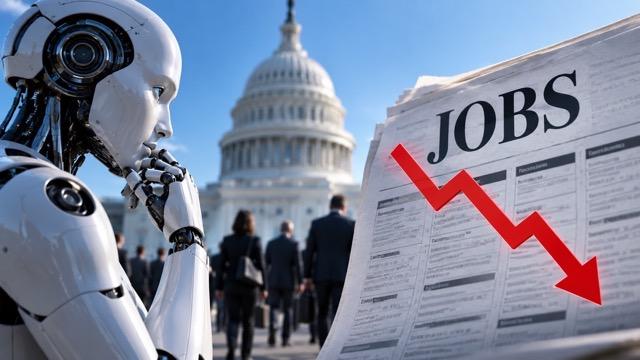
- The US labor market delivered a surprisingly weak September jobs report, but the latest data do not provide enough evidence to conclude that artificial intelligence is responsible for the slowdown.
US employers added just 29,000 nonfarm payroll jobs in September, according to the Bureau of Labor Statistics, well below the roughly 90,000 increase economists had expected. The unemployment rate also edged up to 4.2% from 4.1% in August, while average hourly earnings increased just 0.1% for the month and 3.0% from a year earlier.
The weakness came alongside significant revisions to earlier data. July payrolls were revised from a previously reported 21,000 gain to a 10,000 decline, while August was revised down to 133,000 from 162,000. Together, the revisions reduced previously reported employment growth for those two months by 60,000 jobs.
The figures have intensified debate over whether the rapid adoption of AI is beginning to affect hiring, particularly in white-collar occupations. But the September report itself does not identify AI as a cause of the slowdown.
AI Is Affecting Some Jobs, But The Data Do Not Show It Drove September Weakness
There are signs that AI is changing demand for certain types of workers. Federal Reserve Governor Lisa Cook said in a recent speech on AI and the economy that there is limited evidence so far of major structural changes to the overall labor market from AI adoption.
Cook did acknowledge evidence that AI may be reducing labor demand in some areas, including software coding and simultaneous translation. She also said the technology could be contributing to the difficulty some recent college graduates are experiencing in finding entry-level positions.
That distinction matters when interpreting September's numbers. The BLS report showed employment changing little across all major industries rather than recording a concentrated collapse in occupations most exposed to AI. Healthcare added 17,000 jobs, construction gained 11,000, and manufacturing increased payrolls by 9,000. At the same time, information employment fell by 10,000, financial activities declined by 7,000, and professional and business services lost 9,000 positions.
Reuters noted that construction and manufacturing hiring could be connected to investment in AI infrastructure, meaning the technology may actually be supporting employment in some parts of the economy even as it potentially reduces demand elsewhere.
The broader labor-market picture also does not resemble a wave of AI-driven layoffs. Weekly applications for unemployment benefits have remained historically low, and economists continue to describe the environment as one in which companies are hiring cautiously but are also reluctant to make large-scale layoffs.
Another factor is seasonality. Economists told Reuters that payroll growth has historically tended to underperform when Labor Day falls relatively late in September, as it did this year. That makes the monthly figure more volatile and weakens the case for attributing the entire shortfall to structural changes caused by AI.
The latest US job openings data also point toward a broader cooling in labor demand rather than an AI-specific shock. Job openings fell to 7.079 million in August, while layoffs remained low.
What The September Jobs Report Actually Says About The US Economy
The more immediate story is that the US labor market has entered a period of slower hiring. Payroll growth averaged 51,000 jobs per month over the three months through September, according to Reuters. That compares with 23,000 over the same period a year earlier, although the current pace is only around the level economists estimate is needed to keep employment broadly aligned with the working-age population.
The labor force itself grew in September. The household survey showed 485,000 people entering the labor force, while employment increased by 406,000. That pushed the unemployment rate higher even though the number of employed people also increased.
Wage growth is another important signal. Average hourly earnings rose 3.0% over the past year, down from 3.1% in August. The slowdown reduces evidence of a wage-driven inflation problem, but it also raises questions about how much purchasing power households will have if income growth continues to cool.
The report therefore has implications for Federal Reserve policy. The Federal Reserve raised its benchmark interest rate to a range of 3.75% to 4% in September, citing elevated inflation. The weaker labor-market data reduce some of the pressure for another immediate increase, although inflation remains a major consideration.
That shift is already being reflected in markets. Wealthier Today's recent coverage of the Fed's response to the September jobs slowdown noted that expectations for an October rate increase declined following the employment report.
AI is clearly changing how companies organize work and where they invest. But the current evidence does not support the stronger claim that AI caused the disappointing September jobs report. The data point instead to a combination of cautious hiring, weak employment momentum, seasonal volatility and broader economic pressures, with AI playing a more targeted role in specific occupations and industries.
The distinction will become more important as AI adoption expands and future employment reports provide more evidence about which jobs are being displaced, which are being created, and whether productivity gains translate into broader hiring.