
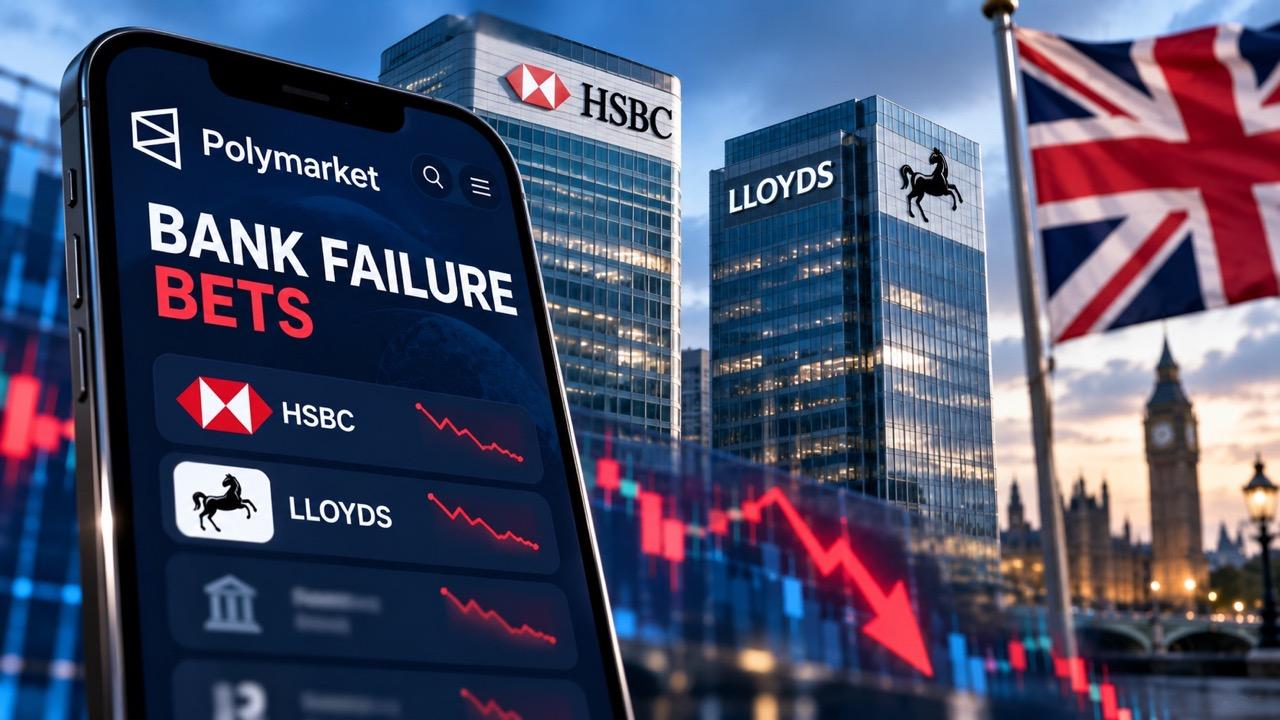
- Thousands of dollars have been wagered on whether major banks, including HSBC and Lloyds, will fail by year-end, raising concerns about market manipulation and financial stability.
UK authorities are facing pressure to examine prediction-market activity after users placed roughly $77,500 in positions on whether major global banks will fail before the end of 2026, including HSBC and Lloyds Banking Group, according to the Guardian.
The contracts cover a range of major lenders, including JPMorgan Chase & Co. (NYSE: JPM), BNP Paribas, HSBC and Lloyds. Polymarket's market page currently shows about $77,453 in volume across the bank-failure contracts.
The existence of the contracts does not indicate that the banks are expected to fail. They allow traders to take positions on whether a specified event will occur, with the value of those positions changing as market participants assess the likelihood of the outcome.
Polymarket's offshore platform restricts users in the UK, US, Canada and the European Union from participating, while users in other jurisdictions can access the markets.
FCA Discusses Prediction Markets With Regulators
The UK's Financial Conduct Authority said it has been in discussions with international regulators about prediction markets as authorities examine potential threats to market integrity. The concern centers partly on whether prediction markets could create financial incentives for insider trading or attempts to influence events underlying the contracts.
That issue becomes more sensitive when the underlying event involves a major financial institution. A sudden deterioration in sentiment toward a bank can potentially affect its share price, funding conditions and customer behavior.
Bobby Dean, a Liberal Democrat member of the UK's Treasury committee, called for authorities to intervene if activity surrounding bank-failure contracts expands. He warned that rapidly growing activity could potentially intensify shifts in market sentiment and contribute to a bank run.
The warning comes after the failures of Silicon Valley Bank and Credit Suisse in 2023, when rapid withdrawals and widespread discussion on social-media platforms contributed to pressure on the institutions.
European regulators have also identified prediction markets as an emerging market-integrity issue. The European Securities and Markets Authority warned in September about potential insider-trading and market-manipulation risks associated with these markets, particularly where participants can operate through blockchain-based wallets.
Polymarket Defends Bank-Failure Contracts
Polymarket's legal chief, Neal Kumar, defended the contracts, arguing that information about banks is already available through conventional financial markets used by professional investors. The company maintains that prediction markets can make information accessible to a broader group of participants rather than creating information that otherwise would not exist.
The Bank of England has separately been preparing banks for the possibility of faster bank runs as customers increasingly rely on mobile banking and social-media information. The regulatory question is therefore broader than whether users should be allowed to bet on an individual bank. Authorities are also examining whether markets tied to financially sensitive events could interact with real-world market movements.
There is currently no evidence that the Polymarket contracts have caused a bank failure or triggered a bank run involving HSBC or Lloyds. The contracts represent trading positions on a potential outcome, not evidence that either institution is in financial distress.