
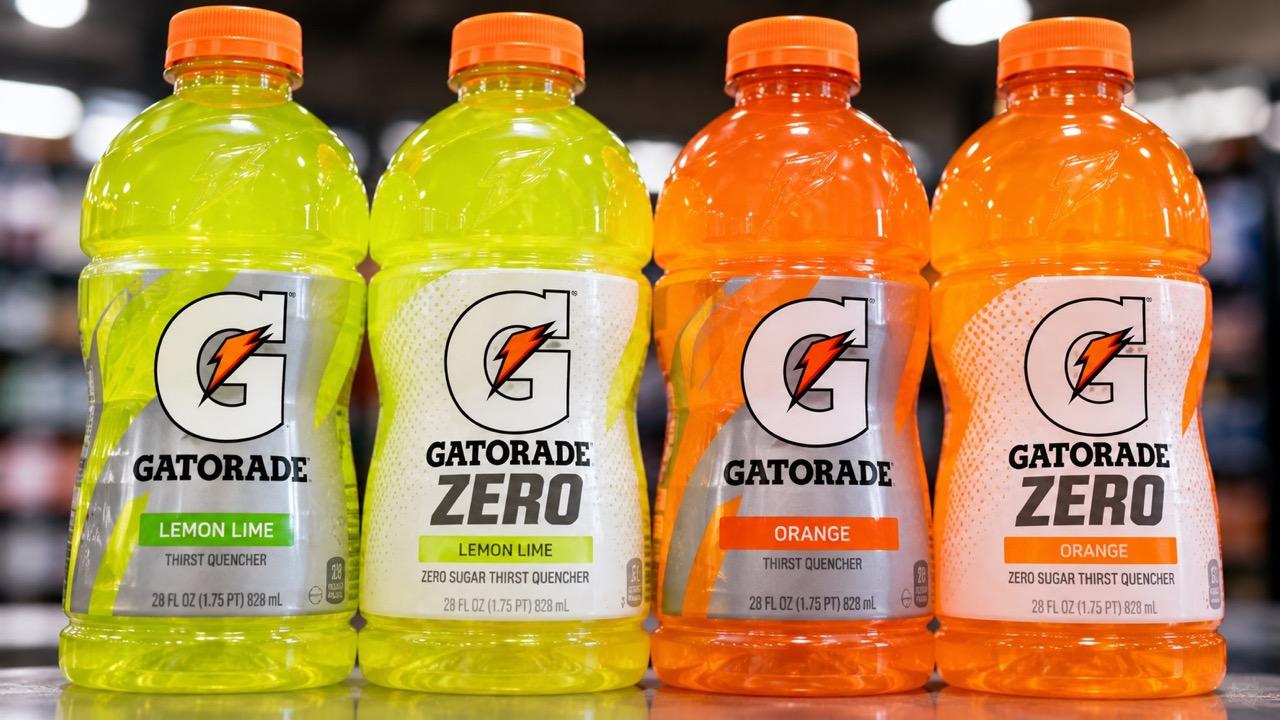
- PepsiCo has recalled 122,021 cases of four Gatorade flavors across 37 states after the products were found to contain undeclared Yellow No. 5 and/or Yellow No. 6, according to FDA enforcement data.
PepsiCo Inc. (NASDAQ: PEP) initiated the voluntary recall on Sept. 25, 2026, covering 28-ounce bottles of Gatorade Lemon Lime, Gatorade Lemon Lime Zero, Gatorade Orange and Gatorade Orange Zero. The FDA enforcement record for the recall lists the action as H-0009-2027 and says it remained ongoing as of Oct. 5. The FDA classified the recall as Class II on Oct. 2.
The affected products were distributed across 37 states, including California, Florida, New York, Texas, Pennsylvania, Illinois, and Washington. The recall involves specific production lots rather than every bottle of the four flavors. Consumers therefore need to compare the lot and date information on their bottles with the codes identified by the FDA.
Which Gatorade Products Are Recalled?
The recalled beverages are limited to 28-ounce bottles of four varieties: Gatorade Lemon Lime, Gatorade Lemon Lime Zero, Gatorade Orange, and Gatorade Orange Zero. The FDA record lists multiple affected lots with best-by dates ranging from April 18, 2027, through June 8, 2027. Among the listed codes are 091026 DL, 091126 DL, 072226 DT, 072426 TL, 073126 TL, 072926 TL, and 073026 TL, along with additional lots identified in the enforcement record.
The issue is the presence of Yellow No. 5 and/or Yellow No. 6 without those color additives being declared on the product labels. Both are permitted food color additives. The FDA's consumer guidance on food color additives identifies FD&C Yellow No. 5, also known as tartrazine, and FD&C Yellow No. 6 among certified colors allowed for use in foods.
The regulatory issue in this recall is therefore the failure to declare the colors on the labels, rather than an FDA determination that the dyes themselves are prohibited ingredients. FDA food-allergy and labeling guidance says Yellow No. 5 must be specifically identified on food labels because some people can experience hypersensitivity reactions.
The agency says Yellow No. 5 can cause symptoms such as itching and hives in some sensitive individuals. The recall does not establish that every person who consumes an affected beverage will experience an adverse reaction.
The situation comes as PepsiCo continues to manage its broader US beverage and food portfolio. The company has also been adjusting parts of its product lineup as consumer preferences change, including the removal and reformulation of familiar PepsiCo grocery products.
FDA Class II Recall Remains Ongoing
The FDA's Class II designation provides important context about the severity of the Gatorade recall. The agency defines a Class II recall as one involving a product whose use or exposure may cause temporary or medically reversible adverse health consequences, or where the probability of serious adverse health consequences is remote.
That differs from a Class I recall, which applies when there is a reasonable probability that exposure could cause serious adverse health consequences or death. The Gatorade action was voluntary and firm-initiated, according to the FDA enforcement record. The recall had not been terminated as of Oct. 5, meaning the agency continued to list the action as ongoing.
The distribution footprint is also significant. The recalled products reached 37 states, spanning much of the country. The affected states include Alaska, Alabama, Arizona, Arkansas, California, Colorado, Florida, Georgia, Hawaii, Idaho, Illinois, Indiana, Iowa, Kansas, Kentucky, Louisiana, Michigan, Minnesota, Mississippi, Missouri, Nebraska, Nevada, New Jersey, New Mexico, New York, North Carolina, North Dakota, Ohio, Oklahoma, Pennsylvania, South Carolina, South Dakota, Tennessee, Texas, Utah, Washington, and Wisconsin.
The FDA enforcement record does not list a public press release for the recall.
For consumers, the most important step is to check whether a 28-ounce bottle of one of the four affected flavors matches an FDA-listed lot code before drinking it. Consumers who identify a matching product should follow the recall instructions available through the FDA and PepsiCo rather than assuming that every bottle of an affected flavor is included.
The recall also highlights why ingredient labeling remains an important part of food safety. Even when an additive is legally permitted for use in food, accurate labeling allows consumers with known sensitivities to make informed choices.
For PepsiCo, the Gatorade recall adds another product-quality issue to monitor as the company manages a large portfolio of beverages and snacks across the US market. The immediate financial impact of the recall cannot be determined from the FDA enforcement record, and there is no basis in the available data to estimate its effect on PepsiCo's earnings or PEP stock.
For now, the confirmed facts are narrower: 122,021 cases of specified 28-ounce Gatorade products were voluntarily recalled, the products contained undeclared Yellow No. 5 and/or Yellow No. 6, the FDA classified the action as Class II on Oct. 2, and the recall remained ongoing as of Oct. 5.