

Financial markets currently expect at least one or two Federal Reserve rate cuts before the end of the year, and this could greatly impact mortgage rates. Expectations are that the central bank will begin lowering borrowing costs later this year if inflation continues to drop. If this happens, though, the ripple effects would be felt through the financial markets and even trickle down into the personal lives of citizens.
Federal Reserve Rate Cuts Could Lower Mortgage Costs
A mortgage could become more affordable if the Federal Reserve begins cutting interest rates later this year, but homeowners and prospective buyers shouldn't expect borrowing costs to fall overnight. While the central bank's benchmark interest rate strongly influences the broader economy, mortgage rates are driven by several factors, including Treasury yields, inflation expectations, investor sentiment, and demand in the bond and real estate markets.
Such a move would likely improve financing conditions for millions of Americans, although the pace and magnitude of any decline in mortgage costs will depend on how financial markets respond. Housing economists say even modest reductions in borrowing costs could significantly improve affordability after years of elevated home prices and historically high financing costs.
This would happen even though the Federal Reserve does not directly set mortgage rates. This is because its decisions have a powerful influence on long-term borrowing costs throughout the economy. When the central bank lowers the federal funds rate, yields on U.S. Treasury securities often decline as investors anticipate easier monetary policy.
Mortgage lenders typically use the 10-year Treasury yield as one of the primary benchmarks when pricing 30-year fixed-rate home loans. As a result, a series of Federal Reserve rate cuts could gradually push mortgage rates lower, reducing monthly payments for new borrowers and creating refinancing opportunities for existing homeowners.
For example, a borrower financing a $400,000 home with a 30-year mortgage at 6.70% would face a monthly principal-and-interest payment of roughly $2,580. If rates fell to 5.75%, that payment would decline to approximately $2,335, producing monthly savings of about $245, or nearly $3,000 per year. Wealthier Today’s Mortgage Calculator gives you a clear idea of what this could mean for your payments.
Lower borrowing costs could also stimulate home sales by encouraging buyers who have remained on the sidelines during the recent period of elevated financing costs. Homebuilders may benefit as improved affordability increases demand for newly constructed homes. Existing homeowners who are locked into low pandemic-era rates could also find it easier to move without facing prohibitively expensive financing.
Mortgage Rates Have Eased, But Remain Above Historic Lows
Interestingly, current mortgage rates have improved modestly from recent highs despite the Federal Reserve keeping interest rates the same. However, these rates remain well above the record lows experienced during the pandemic. According to recent market data, the average 30-year fixed rate currently stands at approximately 6.52%, down from peaks above 7.10% reached during the past year. That represents a decline of nearly 0.6 percentage points, offering meaningful savings for qualified borrowers entering the housing market today.
The 15-year fixed mortgage has also fallen during this time, averaging at around 5.69% the time of this report, compared with levels above 6.30% earlier in the year. Adjustable-rate mortgages have similarly eased as Treasury yields moderated.
Looking across multiple time periods shows just how much mortgage rates have changed:
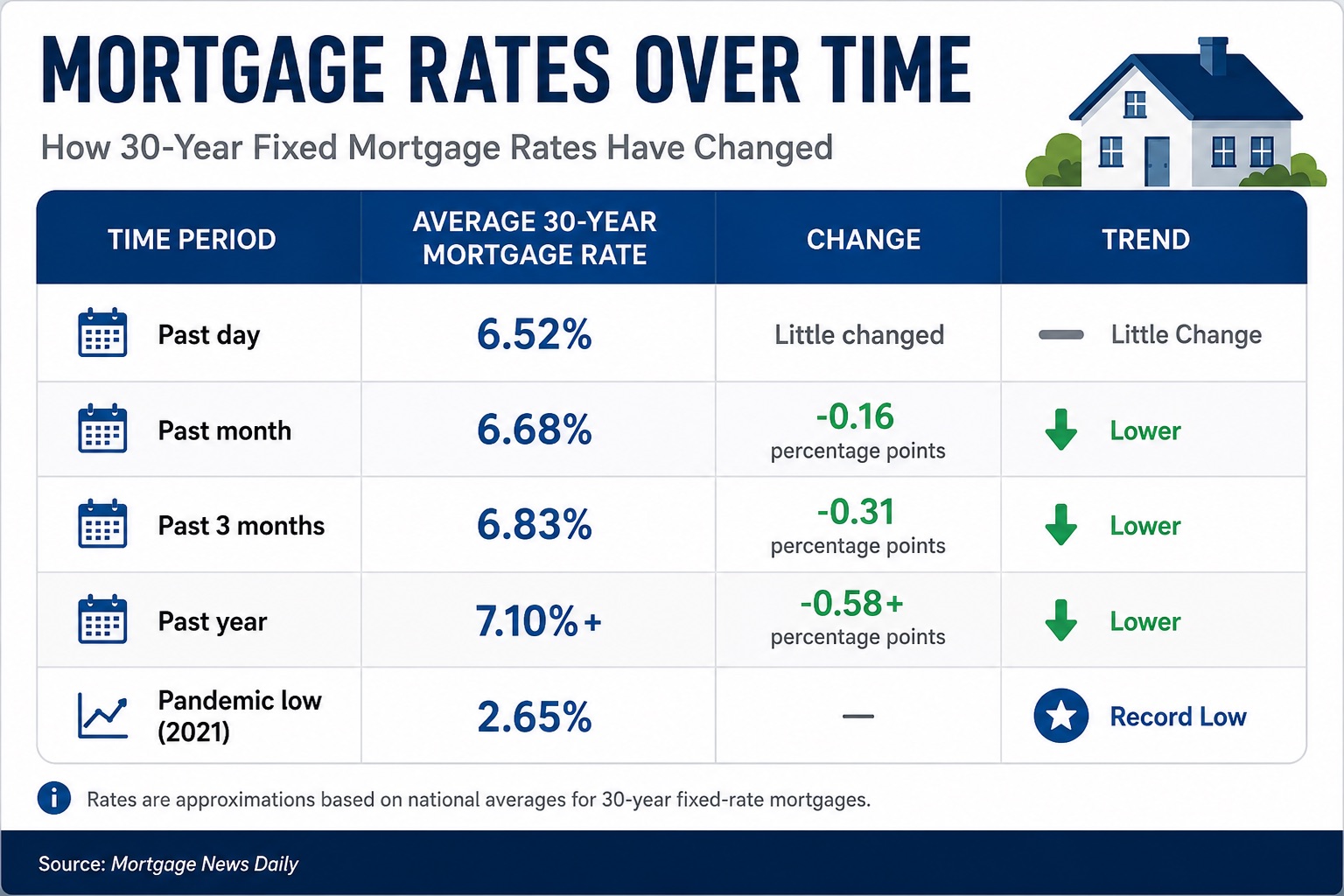
Although today's mortgage rates are significantly lower than last year's highs, they remain nearly four percentage points above the all-time lows recorded during 2021. This is understandable because 2021 was filled with unprecedented monetary stimulus and aggressive bond purchases, which forced the Federal Reserve to push borrowing costs to historic lows.
That difference, despite seeming small, has a substantial impact on affordability. Compared with financing at 2.65%, today's borrowers can pay hundreds of dollars more each month for the same home purchase, even if home prices remain unchanged. Housing affordability, therefore, continues to be one of the largest challenges facing prospective buyers. While lower mortgage rates could provide welcome relief, elevated home prices, limited housing inventory, and higher insurance and property tax costs continue weighing on affordability in many parts of the United States.