
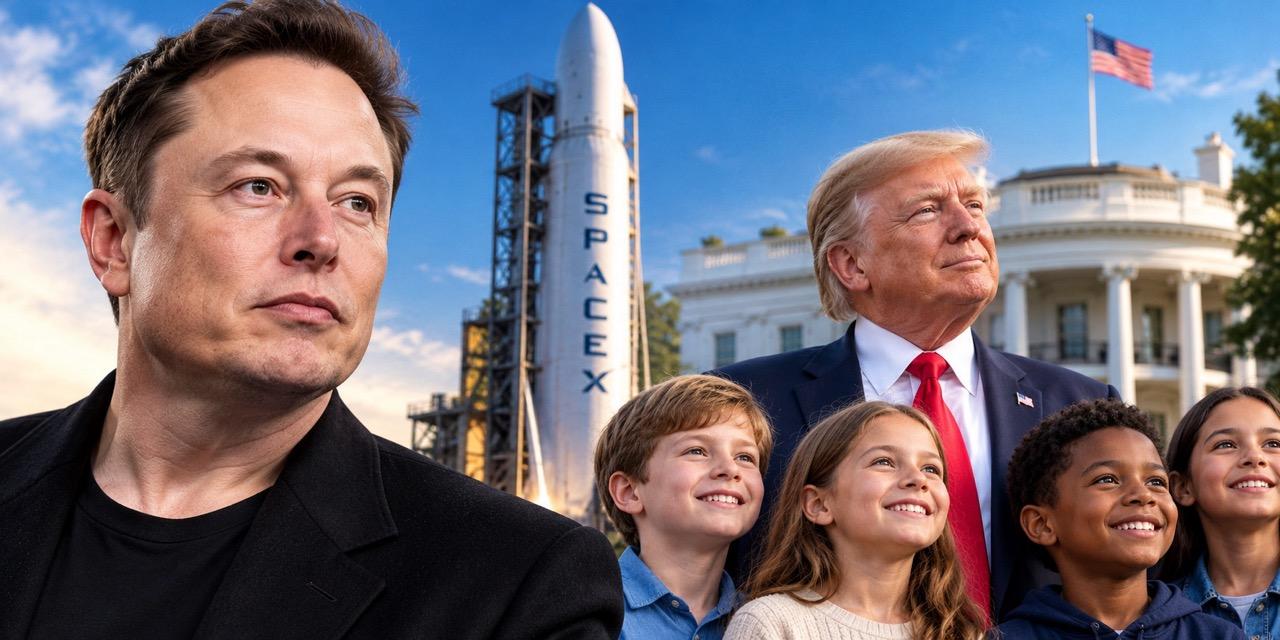
Elon Musk’s proposed SpaceX stock giveaway could place company shares worth billions of dollars into investment accounts for millions of American children. The plan relies on Treasury rules that allow qualifying stock donations to Trump Accounts, but the transfer has not yet taken place and important details remain unresolved.
Musk announced the pledge on October 19, saying he would give one SpaceX share to every child in America in 2027. President Trump subsequently confirmed that the donation would be made through Trump Accounts.
The potential scale is substantial because the US Census Bureau counts roughly 72 million people under age 18. Using SpaceX’s October 16 closing price of $146.03, Axios estimated that distributing one share to each child would represent a gift worth about $10.5 billion. The final value would depend on the stock price and the number of children who ultimately qualify.
Trump Accounts are government-created, tax-advantaged investment accounts for eligible US children under 18. Despite the name, they are not personal accounts for the Trump family. The program is designed to help children invest over the long term, with a $1,000 federal seed contribution available to qualifying children born between January 1, 2025, and December 31, 2028, once the account is properly claimed.
How SpaceX Shares Would Enter Trump Accounts
The main connection is a change in how the accounts can receive investments. In July, the US Treasury announced a process for accepting qualifying donations of publicly traded company stock and allocating the shares to children’s accounts under donor instructions and applicable rules. That mechanism gives Musk a potential way to donate shares directly rather than sell them and contribute cash.
The process is separate from the accounts’ standard investment arrangements. Ordinary contributions are generally invested in eligible low-cost index funds and exchange-traded funds, rather than individual companies chosen freely by parents. The stock-donation rules create a specific path for eligible philanthropic gifts. Wealthier Today previously covered the change that allows qualifying individual-stock donations into Trump Accounts.
The rules also matter for families receiving the shares. Under the temporary regulations, contributed stock generally must remain in an account for five years or until the end of the calendar year in which the child turns 17, whichever comes first. There are limited exceptions. InvestmentNews reported that families generally cannot refuse the donated shares or sell them at will during the required holding period.
That restriction makes the proposal different from receiving cash. A child could become the beneficiary of SpaceX stock without having the ability to immediately sell it or move the proceeds into a diversified fund. The value of the gift would therefore rise or fall with SpaceX’s share price during the holding period.
Musk has not published a complete distribution plan. His original announcement did not specify precisely which children would qualify or explain how shares would be allocated. The account framework also has eligibility requirements, including US citizenship and a valid Social Security number for children under 18. The final distribution rules and number of beneficiaries will need to be clarified before the pledge can be assessed as a completed gift.
What the Donation Means for Children and Musk
For children, the proposal could provide an investment asset with potential long-term value. It also introduces a risk that is less pronounced in a diversified index fund: a single company’s performance can have a significant effect on the value of the donated share. SpaceX has businesses spanning rocket launches, satellite connectivity and AI computing, but those operations do not guarantee future stock-market returns.
Parents should also distinguish between the account itself and the donation. A child with a Trump Account does not automatically qualify for Musk’s share simply because the account exists. Eligibility for the stock giveaway has not been fully detailed, and the company shares have not yet been distributed.
The pledge follows an earlier SpaceX-related contribution. In July, SpaceX President Gwynne Shotwell and her husband pledged one share each to Trump Accounts for more than two million children, primarily targeting those aged 11 to 17 in lower-income communities. Those shares had not yet been distributed as of October 21,.
Other donors have supported the program through cash contributions. Michael and Susan Dell pledged $6.25 billion to provide $250 each to as many as 25 million children. Their approach differs from Musk’s proposed in-kind transfer of company shares, but both efforts use Trump Accounts to channel private wealth into children’s long-term investments. The earlier Dell contribution to Trump Accounts illustrates how the program is becoming a vehicle for large philanthropic pledges.
Donating stock can also have different tax consequences from selling shares and giving away cash. In qualifying circumstances, a donor may avoid realizing capital gains on appreciated stock and may be eligible for a charitable deduction. The actual treatment depends on the applicable tax rules and the donor’s circumstances; the announced pledge should not be treated as confirmation of a specific tax benefit.
The timetable is another open question. Musk said the shares would be distributed next year, but he has not provided the operational details or a schedule. SpaceX’s stock price could also change materially before any transfers occur, affecting the total market value of the promised gift.
For now, the link between Musk’s SpaceX shares and Trump Accounts is a planned use of a government mechanism for qualifying stock donations. The proposal could give children exposure to a high-profile company, but the size of the eventual gift and its value to beneficiaries will depend on the rules, implementation and future performance of SpaceX shares.