
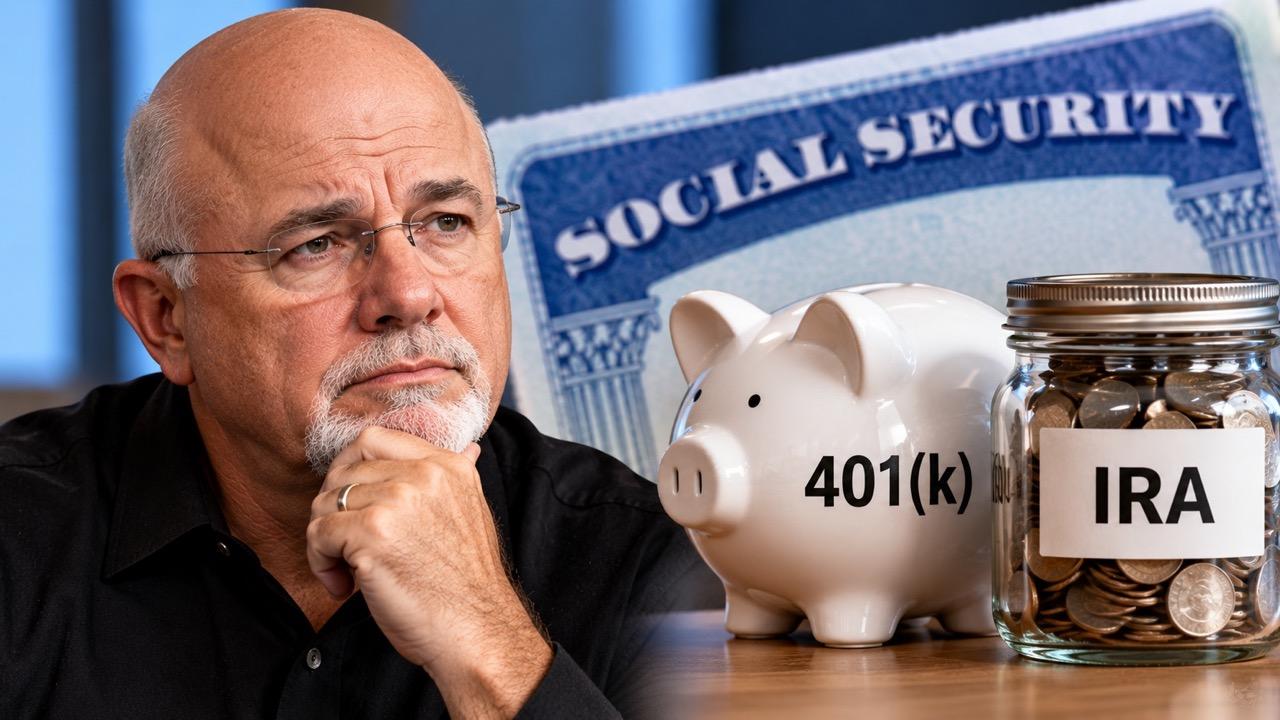
- Personal finance author Dave Ramsey is advising Americans to address consumer debt and build emergency savings before increasing retirement investments, then target a 15% savings rate through workplace plans and IRAs.
Ramsey's latest comments, reported by TheStreet on Oct. 4, focus on how workers should balance debt repayment, cash reserves, and long-term investing. His recommendation comes as Social Security faces a documented funding shortfall, although the program is not projected to stop paying benefits in 2034.
The Social Security Board of Trustees said in its 2026 report that the combined Old-Age and Survivors Insurance and Disability Insurance trust funds are projected to pay all scheduled benefits until the third quarter of 2034. After that, continuing program income would cover about 83% of scheduled benefits if Congress makes no changes to the system.
Ramsey's 15% Retirement Savings Rule
Ramsey's starting point differs from the common advice to immediately maximize retirement contributions. He argues that workers should first become free of consumer debt and maintain an emergency fund covering three to six months of expenses.
His reasoning is that heavy monthly debt payments can restrict the amount of income available for investing, while inadequate cash reserves can force people to tap retirement accounts when unexpected expenses arise. The advice is part of Ramsey's broader approach to building wealth through controlled spending, debt reduction, and consistent investing.
Once those financial pressures are addressed, Ramsey recommends investing 15% of income for retirement through accounts such as a 401(k), Roth 401(k), or IRA.
That percentage is Ramsey's personal-finance framework rather than a federal retirement requirement. Individual savings needs can vary substantially depending on income, age, existing assets, pension coverage, expected retirement spending, and when someone plans to stop working.
The IRS allows considerably more room for retirement contributions than Ramsey's 15% guideline alone might suggest. For 2026, employees can contribute up to $24,500 to a 401(k), 403(b), governmental 457 plan, or federal Thrift Savings Plan. Workers eligible for catch-up contributions can contribute an additional $8,000, with a higher $11,250 limit for certain employees ages 60 through 63.
The 2026 IRA contribution limit is $7,500, rising to $8,600 for people age 50 or older. Those limits make tax-advantaged accounts an important part of long-term wealth building, particularly for workers who have enough cash flow to increase their savings rate over time.
Ramsey also recommends starting with an employer's 401(k) match before moving additional retirement savings into a Roth IRA. His suggested sequence is to capture the full employer match, fund a Roth IRA, and then direct additional savings toward workplace retirement accounts.
Automatic contributions are another part of his approach. Setting retirement contributions to come directly from a paycheck can make savings more consistent and reduce the likelihood that the money is spent elsewhere.
Social Security Faces a Funding Gap, Not an Immediate End
Ramsey's warning about Social Security is based partly on the program's long-term financial position. The 2026 Trustees Report says the combined trust funds are projected to be depleted in 2034. At that point, incoming revenue would still be sufficient to pay roughly 83% of scheduled benefits under current projections.
The OASI Trust Fund, which pays retirement and survivor benefits, is projected to become depleted earlier, in the fourth quarter of 2032. The trustees estimate that 78% of scheduled OASI benefits could be paid at that point from continuing income.
That distinction matters because Social Security is not projected to disappear when reserves are depleted. The issue is the size of the potential gap between scheduled benefits and the revenue available to pay them.
The program already represents an important source of retirement income for millions of Americans. The average monthly benefit for retired workers reached $2,087.52 in August 2026, according to data from the Social Security Administration reported by Kiplinger.
At the same time, the Federal Reserve's latest household survey found that 61% of adults had a tax-preferred retirement account such as a 401(k) or IRA in 2025, while 67% had either a tax-preferred retirement account or a pension.
The figures underscore why retirement income is generally built from multiple sources rather than a single program. Social Security can provide a base level of income, while workplace plans, IRAs, pensions and taxable investments can provide additional resources.
For investors building that foundation, low-cost index funds are one option for gaining diversified market exposure inside retirement accounts.
Ramsey's broader message is therefore less about predicting the end of Social Security and more about avoiding dependence on it as the only source of retirement income. His 15% savings recommendation is one framework for addressing that risk, while the appropriate contribution rate will depend on each household's financial circumstances.
Workers can also compare retirement accounts with other long-term investment strategies when determining how to allocate savings beyond employer matches and annual IRA limits.