

- US stock markets will remain open on Monday, October 12, 2026, even though Columbus Day is a federal holiday. The NYSE and Nasdaq will follow their regular trading schedules, while the US bond market will close.
Investors can trade stocks on Columbus Day as usual, with the New York Stock Exchange and Nasdaq both listing October 12 as a regular trading day rather than a market holiday. The decision means investors will still be able to buy and sell shares in companies such as Apple Inc. (NASDAQ: AAPL), NVIDIA Corp. (NASDAQ: NVDA) and Microsoft Corp. (NASDAQ: MSFT) during the holiday.
Columbus Day is observed on the second Monday in October. The holiday is also recognized as Indigenous Peoples' Day in many states and communities, although observance varies by jurisdiction.
What Time Does the Stock Market Open on Columbus Day?
The NYSE and Nasdaq will follow their standard US equity market hours on Monday, October 12.
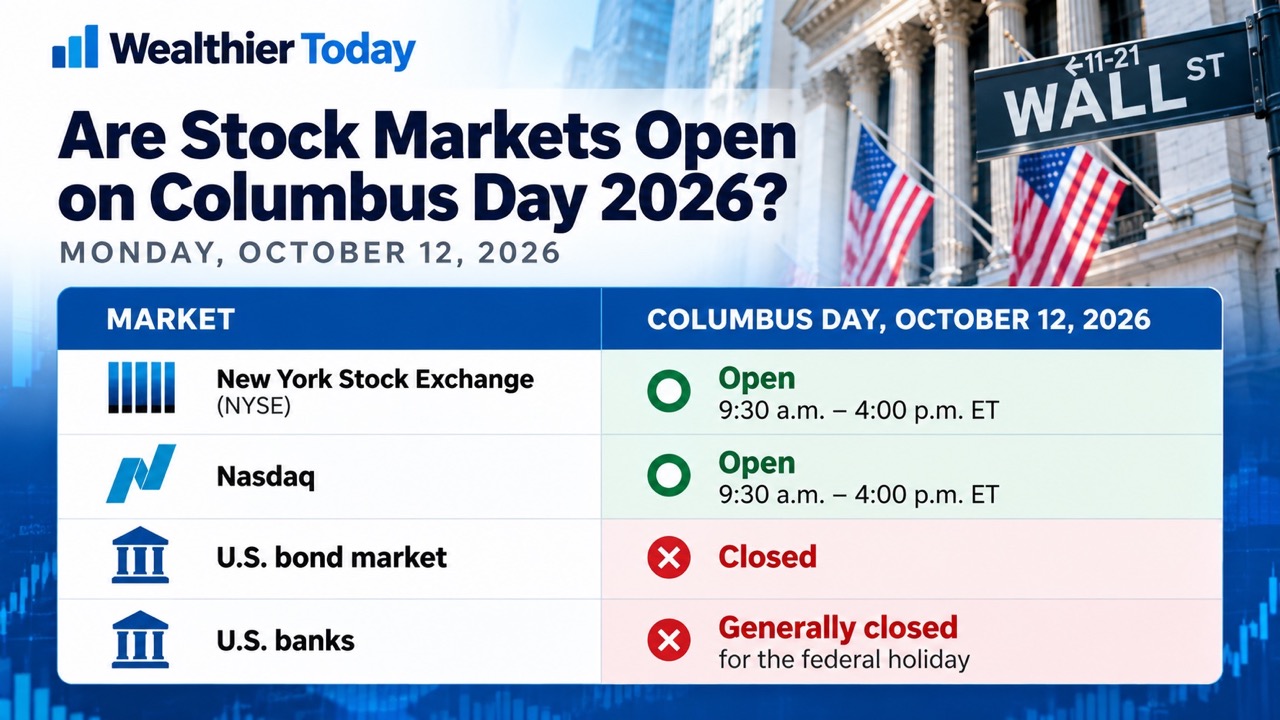
The regular trading session runs from 9:30 a.m. to 4:00 p.m. Eastern Time. Investors using premarket or after-hours sessions should check their broker's schedule because access and trading hours can vary by platform.
The Nasdaq 2026 holiday calendar confirms that Columbus Day is not among the exchange's scheduled closures. The NYSE's official trading calendar likewise lists the holidays when its markets close, including Thanksgiving and Christmas, but not Columbus Day.
Although equity trading will continue, the bond market follows a different holiday schedule. The Securities Industry and Financial Markets Association recommended a full closure of US dollar-denominated fixed-income markets on October 12, covering US government securities, corporate bonds, municipal bonds and other specified instruments.
The difference matters for investors following Treasury yields, which influence borrowing costs and can affect stock valuations. Those monitoring how rising bond yields affect stocks should be aware that bond-market activity will be limited by the holiday even as equity trading continues.
When Will the Stock Market Close for Its Next Holiday?
After Columbus Day, the next full-day closure for the NYSE and Nasdaq is Thanksgiving Day on Thursday, November 26, 2026. Both exchanges are scheduled to close for the holiday.
Markets will reopen on Friday, November 27, but trading will end early at 1:00 p.m. Eastern Time. The bond market is scheduled to close early at 2:00 p.m. ET that day under the published holiday recommendations.
The stock market will also close on Friday, December 25, for Christmas Day. An early equity-market close is scheduled for Thursday, December 24, at 1:00 p.m. ET.
Investors should check the NYSE holiday schedule and Nasdaq's trading calendar before placing orders around upcoming holidays. Trading calendars can differ between stocks, bonds, options and other financial instruments.
For investors planning around market holidays, it is also useful to distinguish between exchange closures and changes in trading conditions. A market that remains open may still see different trading volumes as some institutional participants take the day off. Lower participation can affect liquidity in individual stocks, although it does not guarantee that prices will become more volatile.