
A $5,000 investment in SpaceX could theoretically grow to about $119,000 if the company’s valuation increases from $2.1 trillion to $50 trillion. The scenario is based on billionaire investor Ron Baron’s long-term forecast, while Elon Musk has since suggested SpaceX could exceed $100 trillion within a decade. Both figures are speculative, and neither represents a guaranteed investment outcome.
How Much Could $5,000 in SpaceX Stock Be Worth at $50 Trillion?
A $5,000 investment in SpaceX could be worth approximately $119,000 if the company reaches a $50 trillion valuation from a starting point of $2.1 trillion, based on the assumptions used in billionaire investor Ron Baron’s forecast.
Baron, founder of Baron Capital and a longtime investor in Elon Musk’s businesses, said SpaceX could be worth $20 trillion, $30 trillion or even $50 trillion within 10 years. His comments reflect his expectations for growth in satellite internet, space transportation and artificial intelligence infrastructure.
The calculation is based on a roughly 23.81-fold increase in valuation, from $2.1 trillion to $50 trillion. Applying that multiple to $5,000 produces a hypothetical investment value of approximately $119,048, or a gain of about $114,048 before taxes and transaction costs.
That outcome assumes the share count remains unchanged and the stock price rises in line with the company's market capitalization. New share issuance, dilution, stock splits and changes in valuation could affect the result.
The starting valuation also matters. SpaceX’s market capitalization stood at approximately $1.98 trillion at the October 16 close. Using that figure instead, a $5,000 investment would need to increase approximately 25.25 times to reach $126,263 at a $50 trillion valuation.
These are hypothetical calculations, not forecasts of what an investor will earn. SpaceX shares could rise or fall substantially before any long-term valuation target is reached.
SpaceX Investment Calculator: What $5,000 Could Become
The potential outcome changes considerably depending on how far SpaceX's valuation grows. The table below uses the earlier $2.1 trillion starting valuation to keep the scenarios comparable.
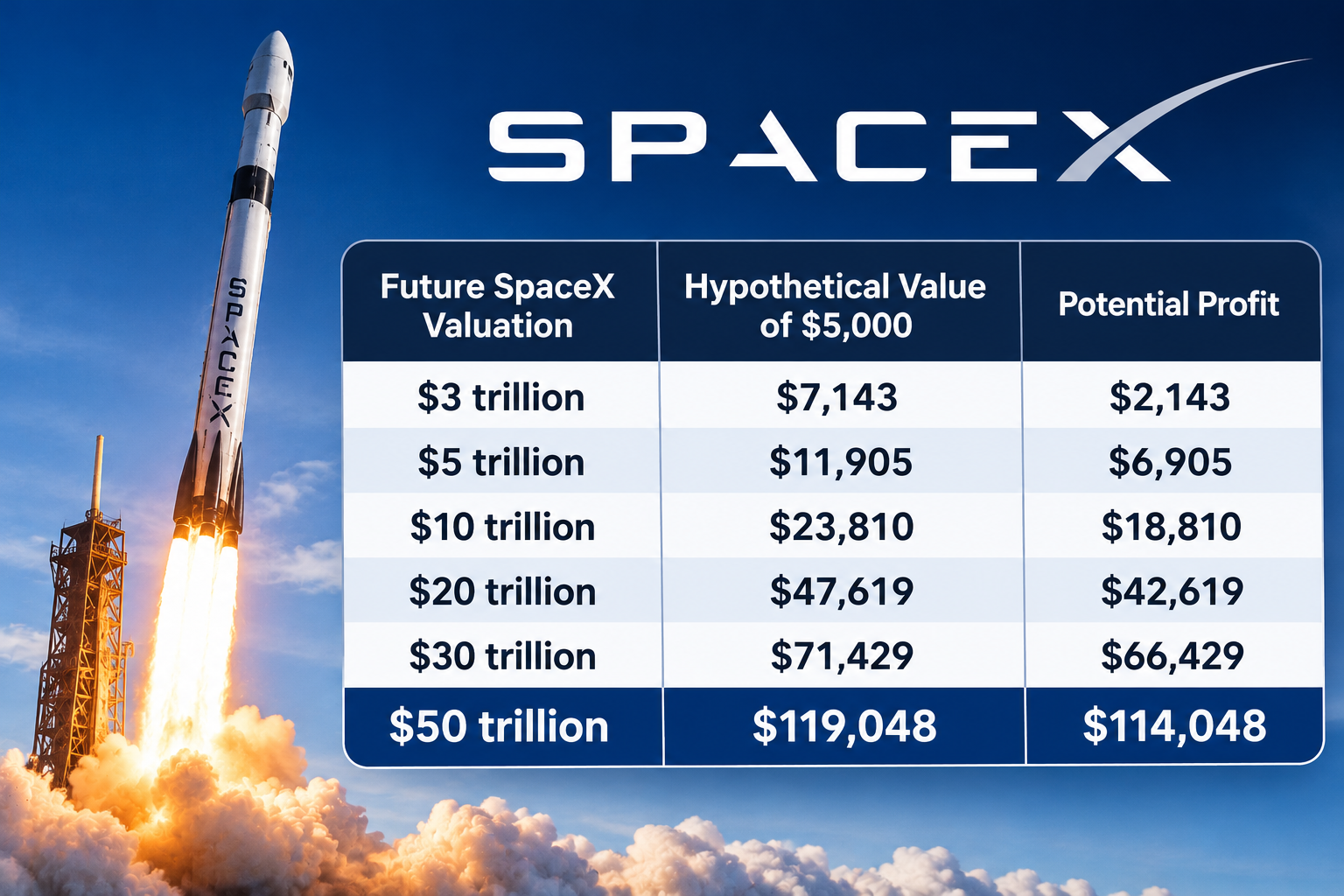
Figures are rounded and assume an unchanged share count, with no taxes, trading costs or additional investments.
Even a $10 trillion valuation would represent a major expansion from the starting point, but it would produce a much smaller return than the $50 trillion scenario. Conversely, if SpaceX's valuation declines, an investor could lose money.
The calculations illustrate why the purchase price is important. A company can continue expanding its business while its stock delivers disappointing returns if investors initially pay too much for its future growth.
Elon Musk Has Floated an Even Higher SpaceX Valuation
Baron's prediction received additional attention after Musk made an even more ambitious claim. On October 15, Musk wrote on X that SpaceX would probably exceed a $100 trillion valuation in less than 10 years, barring a major world war. Yahoo Finance reported Musk's response after Baron said he believed the company could reach $50 trillion and that Musk considered his estimate too conservative.
Musk's statement was a projection, not a formal financial forecast backed by published revenue or earnings guidance. The company would need to expand dramatically to justify a valuation at that level.
At a $100 trillion valuation, a $5,000 investment based on a $2.1 trillion starting point would theoretically be worth approximately $238,095, assuming the same share-count conditions. That would be nearly 48 times the original investment.
The higher target makes the underlying challenge even clearer: investors would need to distinguish ambitious expectations about future technology from financial results that SpaceX has already demonstrated.
Why Ron Baron Sees Trillions in SpaceX's Future
Baron's investment case extends beyond rocket launches. He expects SpaceX's satellite-internet business, Starlink, and potential space-based computing infrastructure to become enormous sources of future value.
Starlink Could Become a Major Business
Baron has suggested that Starlink alone could eventually be worth between $14 trillion and $15 trillion within a decade. The business provides satellite internet connectivity to residential, commercial and government customers, including people in areas where traditional telecommunications infrastructure is limited.
Its growth depends on subscriber numbers, pricing, operating costs, satellite deployment and competition. A much higher valuation would require Starlink to generate substantial, sustainable revenue and profits.
Starlink's importance to SpaceX also reflects the relationship between its businesses: the company's launch systems can support satellite deployment, while a larger satellite network can create recurring connectivity revenue.
Space-Based AI Data Centers Add to the Ambition
Baron has also pointed to the potential for data centers in space, arguing that orbital computing infrastructure could eventually become even more valuable than Starlink.
The concept would involve deploying computing equipment in orbit to support artificial intelligence and other data-processing workloads. However, the commercial case remains uncertain. Launch costs, hardware durability, power availability, data transmission and maintenance could all influence whether space-based data centers become economically competitive with facilities on Earth.
SpaceX's potential AI opportunity therefore remains a long-term possibility rather than an established revenue stream on the scale required to support a multitrillion-dollar valuation.
What Could Prevent SpaceX From Reaching $50 Trillion?
A $50 trillion market capitalization would require SpaceX to become far more valuable than it is today. The forecast depends on several businesses expanding successfully, including satellite communications, launch services and emerging computing infrastructure.
There are meaningful risks. Technical setbacks, delays in satellite deployment, rising capital requirements or weaker-than-expected demand could slow growth. New competitors could also pressure prices and profit margins.
Valuation is another concern. Even if SpaceX grows significantly, its stock may not deliver the expected return if its market price already reflects overly optimistic assumptions about future performance.
The company's trading history provides a reminder that investor sentiment can shift quickly. Since its June 2026 public listing, SPCX shares have experienced significant volatility as investors reassess the company's growth prospects and ambitious projects.
Wealthier Today's coverage of SpaceX's post-IPO stock performance examines how market expectations can change even when a company's long-term business story remains intact.
Is a $5,000 Investment in SpaceX Worth the Risk?
SpaceX offers exposure to satellite connectivity, reusable launch systems and potential AI infrastructure, but investors must weigh those opportunities against the valuation they are paying.
The most useful indicators to monitor include Starlink's business growth, launch activity, capital spending, progress on new technologies and the company's ability to turn investment into sustainable profits.
Investors should also consider their time horizon, portfolio concentration and capacity to absorb losses. A speculative long-term target should not replace an assessment of a company's current financial position and the risks attached to its shares.
Bottom line: A $5,000 investment in SpaceX could theoretically grow to approximately $119,000 at a $50 trillion valuation, using a $2.1 trillion starting point. Musk's subsequent suggestion that SpaceX could exceed $100 trillion is even more ambitious, but both projections remain uncertain. The actual outcome will depend on business performance, future share count, market conditions and the valuation investors are willing to pay.