
Investing in Bitcoin sounds complicated until you separate the idea from the first transaction. Your first BTC investment does not need a trading setup, a whole coin, a private Discord group, or a heroic price prediction. It needs a clear route, a small amount of money you can afford to see fluctuate, and a plan for where the Bitcoin will sit after you buy it.
This guide is the step-by-step version of our broader Investing in Bitcoin overview. That article explains the long-term thesis, Bitcoin's history, and why investors consider it. This one focuses on the practical beginner question: how do you make your first Bitcoin investment without turning a simple experiment into an avoidable mistake?
Quick Answer: How To Invest In Bitcoin
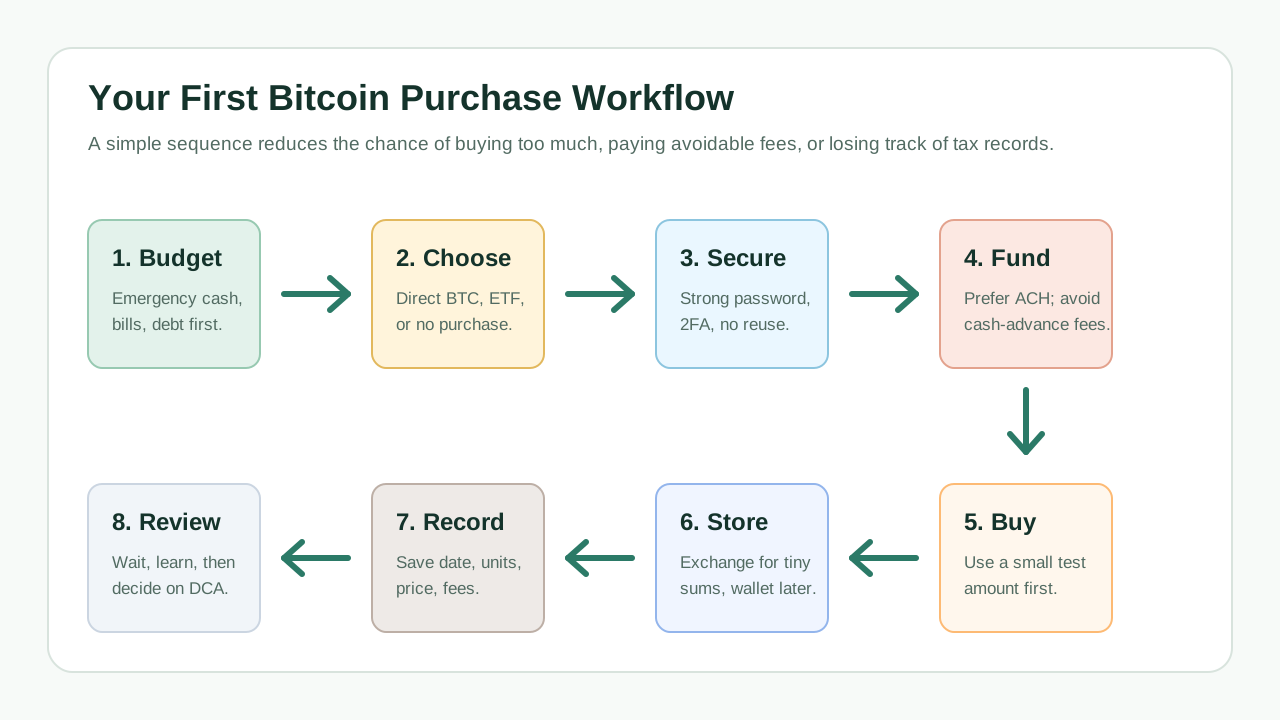
The simplest beginner path is:
- Make sure your emergency fund, bills, and high-interest debt are not being ignored.
- Decide whether you want direct Bitcoin ownership or a spot Bitcoin ETF.
- Choose a reputable exchange, broker, or brokerage account.
- Secure the account with a unique password and two-factor authentication.
- Fund the account with a low-cost method, usually ACH rather than a credit card.
- Buy a small dollar amount of BTC or a Bitcoin ETF.
- Save your transaction record.
- Wait before adding more, then decide whether to use dollar-cost averaging.
That is it. Everything else is optimization, custody, tax hygiene, and risk management.
What Bitcoin Investment Actually Means
Bitcoin is a digital asset with a public ledger, a native unit called BTC, and a fixed monetary schedule. It is not a company, so it has no earnings, board of directors, dividend, or quarterly revenue report. Its value comes from market demand for a scarce, transferable, censorship-resistant asset.
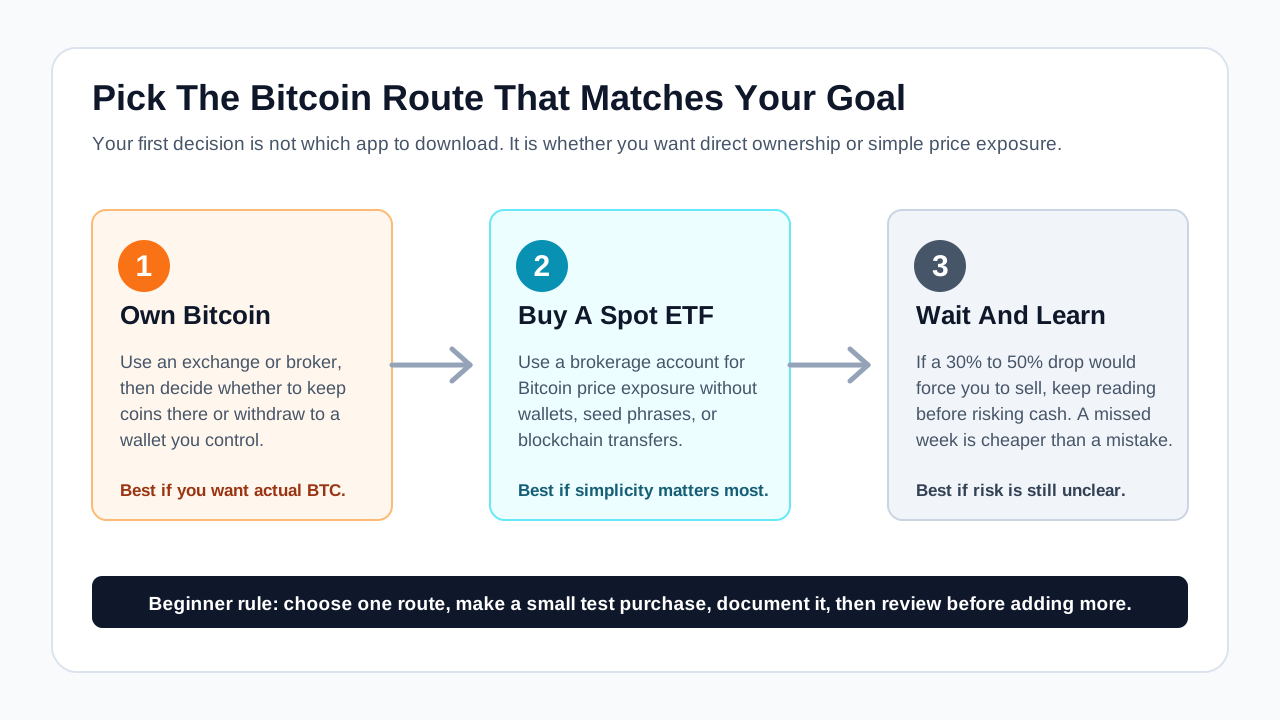
You can invest in Bitcoin in two main ways:
| Route | What you own | Where it lives | Main advantage | Main tradeoff |
|---|---|---|---|---|
| Buy BTC directly | Actual Bitcoin | Exchange account, broker, hot wallet, or hardware wallet | You can withdraw and self-custody it | You must understand custody and transfer risk |
| Buy a spot Bitcoin ETF | Shares of a fund tied to Bitcoin | Brokerage account | Simple access, familiar statements, no wallet setup | You do not control actual BTC |
| Buy Bitcoin-related stocks | Equity in a company with Bitcoin exposure | Brokerage account | Fits normal stock investing tools | Company risk can dominate Bitcoin exposure |
For a first investment, most beginners should compare only the first two routes. Bitcoin-related stocks can be useful for advanced investors, but they add business risk, debt risk, management risk, and stock-market valuation risk on top of Bitcoin's own volatility.
Can You Buy Less Than One Bitcoin?
Yes. You do not need enough money to buy a whole Bitcoin.
Bitcoin is divisible into tiny units called satoshis. One bitcoin equals 100,000,000 satoshis. If Bitcoin traded at $100,000, a $100 purchase would buy about 0.001 BTC before fees. If it traded at $50,000, the same $100 would buy about 0.002 BTC before fees.
This is one of the biggest beginner misconceptions in search results. Many new investors see a five-figure Bitcoin price and assume the door is closed. It is not. Most platforms let you enter a dollar amount rather than a whole-coin amount.
Step 1: Decide Whether Bitcoin Fits Your Finances
Before choosing an app, answer four questions:
| Question | If the answer is no |
|---|---|
| Do you have cash for near-term bills? | Wait. Bitcoin should not compete with rent, groceries, insurance, or tax payments. |
| Do you have an emergency fund started? | Build cash first. Volatile assets are a poor emergency fund. |
| Is high-interest debt under control? | Paying down expensive debt may be a better guaranteed return. |
| Could you hold through a 30% to 50% drawdown? | Use a smaller amount or keep learning before buying. |
Bitcoin can rise quickly, but it can also fall violently. A good first purchase is sized so that a bad month does not force you to sell, panic, or raid money meant for something else.
For broader portfolio thinking, read our guides to risk and reward, diversification, and long-term investments.
Step 2: Pick Direct Bitcoin Or A Spot Bitcoin ETF
This is the most important beginner decision.
Choose Direct Bitcoin If You Want Actual BTC
Direct ownership means you buy BTC through a platform and can usually withdraw it to a Bitcoin wallet. This route makes sense if you want to learn how Bitcoin works, send or receive BTC, use a hardware wallet, or hold the asset outside a traditional brokerage account.
The tradeoff is responsibility. If you withdraw to your own wallet and lose the seed phrase, there is no bank reset button. If you send BTC to the wrong address, the transfer generally cannot be reversed. If you leave the BTC on an exchange, you are trusting the platform's custody and withdrawal controls.
Start with our guides to Bitcoin wallets and hardware wallets before moving meaningful sums off-platform.
Choose A Spot Bitcoin ETF If You Want Simple Exposure
A spot Bitcoin ETF trades in a normal brokerage account and gives exposure to Bitcoin's price without requiring wallet setup. The U.S. spot Bitcoin ETF market opened after the SEC approved the listing and trading of spot Bitcoin exchange-traded products in January 2024. That changed the beginner route because investors could access Bitcoin exposure through familiar brokerage infrastructure.
The tradeoff is control. ETF shares are not the same as self-custodied Bitcoin. You cannot send ETF shares over the Bitcoin network, use them in a wallet, or take personal possession of the fund's BTC. You are buying regulated market exposure, not the bearer asset.
For many beginners, that tradeoff is acceptable. For people who care about Bitcoin's self-custody principle, it is not.
Step 3: Choose Where To Buy
You have several options:
| Platform type | Good for | Watch for |
|---|---|---|
| Crypto exchange | Buying BTC directly and possibly withdrawing to a wallet | Trading fees, withdrawal fees, custody risk, security setup |
| Brokerage with crypto | Familiar interface and simple first purchase | Whether withdrawals are allowed, spread costs, limited coin support |
| Spot Bitcoin ETF | Brokerage-account exposure | Expense ratio, premium or discount, market-hour trading only |
| Bitcoin ATM | Cash access in some areas | High fees, scam risk, poor beginner experience |
| Peer-to-peer marketplace | Privacy or local settlement needs | Counterparty risk, scams, legal and payment complexity |
Most first-time U.S. investors should start with a reputable exchange, a mainstream brokerage that supports BTC, or a spot Bitcoin ETF. Avoid anyone who contacts you first, promises guaranteed returns, asks you to send Bitcoin to "unlock" funds, or pressures you to move quickly.
If you want help comparing platforms, use our Bitcoin exchanges guide and exchange reviews for Coinbase, Kraken, Gemini, and Binance.
Step 4: Secure The Account Before Funding It
Security should happen before money arrives.
Use a password manager and create a unique password for the exchange or brokerage account. Turn on two-factor authentication. App-based authentication is generally stronger than SMS because phone numbers can be targeted through SIM-swap attacks. Add withdrawal allowlisting if the platform supports it. Confirm the website URL manually rather than clicking sponsored ads or links in messages.
Also secure the email account tied to the platform. If someone controls your email, they may be able to reset financial accounts connected to it.
Step 5: Fund With The Cheapest Sensible Payment Method
Funding method matters because fees can quietly punish small beginners.
ACH bank transfers are often cheaper than debit cards, credit cards, or instant-buy flows. Credit cards can be especially expensive because the card issuer may treat the purchase as a cash advance. Bitcoin ATMs can also charge steep fees and are a poor default for a first investment.
Before you click buy, preview the order and compare:
| Cost | What it means |
|---|---|
| Trading fee | A visible platform commission or percentage |
| Spread | The difference between the quoted buy price and the market price |
| Funding fee | Cost to deposit with a card, bank transfer, or other method |
| Withdrawal fee | Cost to move BTC from the platform to a wallet |
| ETF expense ratio | Annual fund cost for ETF investors |
A beginner buying $25 of Bitcoin should care about fees more than clever timing. Paying 3% to 8% in combined costs creates a hole before the investment starts.
Step 6: Place Your First Bitcoin Order
For a first direct BTC purchase, keep it boring:
- Search for BTC or Bitcoin.
- Choose buy, not trade with leverage.
- Enter a small dollar amount.
- Use a market order for simplicity or a limit order if you understand the price you are setting.
- Review the fees, estimated BTC amount, and final total.
- Submit the order.
- Save or download the confirmation.
For a first ETF purchase, the steps are similar to buying any ETF:
- Search the ETF ticker in your brokerage account.
- Confirm you selected the correct fund.
- Enter a small dollar amount or share quantity if fractional ETF shares are supported.
- Use a market order during normal market hours or a limit order if spreads are wide.
- Review the estimated price and fees.
- Submit the order.
- Save the confirmation.
Avoid margin, futures, options, perpetual swaps, and leverage. Those are trading tools, not beginner investment tools.
Step 7: Decide Where The Bitcoin Should Sit
After buying direct BTC, you have three practical storage choices.
| Storage choice | Best for | Risk |
|---|---|---|
| Leave it on the exchange | Very small learning purchases | Platform failure, account takeover, withdrawal freeze |
| Move to a hot wallet | Small active balances and learning transfers | Device compromise, phishing, seed phrase mistakes |
| Move to a hardware wallet | Larger long-term holdings | Seed phrase loss, setup mistakes, physical security |
For a tiny first purchase, leaving BTC on a reputable platform while you learn can be reasonable. For larger long-term holdings, learn self-custody carefully and test with a small withdrawal before moving more.
Do not rush wallet transfers. The most expensive beginner mistake is not "buying five dollars too high." It is sending coins to the wrong network or losing a recovery phrase.
How Much Should A Beginner Invest In Bitcoin?
There is no universal number, but a useful beginner range is 1% to 5% of investable assets. More conservative investors may start below 1%. Aggressive investors may choose more, but they should understand that Bitcoin can dominate portfolio behavior once the allocation gets large.
Here is a simple sizing framework:
| Beginner situation | Sensible first move |
|---|---|
| You are curious but unsure | Buy $10 to $100 as a learning position |
| You have a stable emergency fund and diversified investments | Consider a small 1% to 3% allocation |
| You already understand wallets and volatility | Build a written allocation plan before adding more |
| You would panic after a major drawdown | Do not buy yet, or buy an amount too small to affect your decisions |
Your first Bitcoin purchase should teach you how the process works. It does not need to change your net worth.
Should You Buy Bitcoin All At Once Or Use Dollar-Cost Averaging?
Dollar-cost averaging means investing a fixed amount on a fixed schedule, such as $25 every week or $100 every month. It is useful for beginners because it reduces the pressure to pick the perfect day.
Lump-sum investing can work if you already know your target allocation and can tolerate the risk. But many beginners buy a large amount after a price spike, then panic during the first pullback. A small test buy followed by a scheduled plan is usually more durable.
For the full strategy, read our dollar-cost averaging guide.
A Beginner's First 30 Days After Buying Bitcoin
The first month matters because it sets habits.
| Day | What to do |
|---|---|
| Day 1 | Save the order confirmation and write down why you bought. |
| Day 2 to 7 | Learn how your platform displays cost basis, fees, and withdrawals. |
| Day 7 to 14 | Read about wallets before attempting any transfer. |
| Day 14 to 21 | Decide whether this is a one-time learning purchase or a recurring plan. |
| Day 21 to 30 | Review allocation size and rebalance rules before adding more. |
Writing down your reason is not busywork. If your reason was "Bitcoin is a long-term scarce asset," a 10% weekly move should not change the plan. If your reason was "I saw it going up today," you probably do not have an investment plan yet.
Bitcoin Taxes: Records To Keep From Day One
In the United States, the IRS says digital assets are treated as property for federal tax purposes. Buying Bitcoin with dollars and simply holding it is different from selling, exchanging, spending, or otherwise disposing of it. Disposals can create reportable gains or losses.
Keep these records:
- Date and time of purchase
- Asset purchased
- Number of BTC or ETF shares
- U.S. dollar price
- Fees and spread if visible
- Platform used
- Wallet transfer records, if any
- Sale proceeds when you eventually sell
The IRS digital assets page also notes that taxpayers may need to answer a digital asset question on their return and keep records that support reported positions. A tax form from an exchange is helpful, but it is not a substitute for your own clean records.
This is not tax advice. If your Bitcoin activity includes mining, staking, business payments, DeFi, frequent trading, gifts, or large gains, work with a qualified tax professional.
Common Beginner Mistakes
The biggest beginner mistakes are simple:
| Mistake | Better move |
|---|---|
| Buying because the price is pumping | Decide allocation before opening the app |
| Using leverage | Buy spot BTC or an ETF only |
| Ignoring fees | Preview the order and compare funding methods |
| Sending a large wallet transfer first | Test with a small amount |
| Losing seed phrases | Learn wallet backups before self-custody |
| Trusting social media DMs | Ignore anyone promising guaranteed returns |
| Treating Bitcoin like a savings account | Keep emergency cash in cash |
| Forgetting tax records | Save confirmations immediately |
Bitcoin rewards patience more often than frantic clicking. A slow first purchase is a feature, not a flaw.
Is Bitcoin A Good Investment For Beginners?
Bitcoin can be a reasonable beginner investment only if the beginner treats it as a volatile satellite position, not as a shortcut to wealth. It has survived multiple cycles, attracted institutional products, and remains the largest crypto asset by market attention. It also has no guaranteed return, no cash flow, and a history of deep drawdowns.
The better question is not "Is Bitcoin good?" It is "What job would Bitcoin have in my portfolio?"
Possible answers include:
- A small long-term allocation to a scarce digital asset
- A learning position in crypto market infrastructure
- A hedge against monetary debasement, with no guarantee it behaves that way every year
- A high-volatility diversifier outside traditional stocks and bonds
Poor answers include:
- "I need to get rich fast"
- "Everyone online says it is going up"
- "I will sell before the crash"
- "I cannot afford to miss out"
If you want to understand the investment case more deeply, read What Is Bitcoin? and Investing in Bitcoin. If you are comparing Bitcoin with other assets, read Gold vs Bitcoin and Bitcoin price predictions.
Direct Bitcoin vs ETF: Which Is Better For Your First Purchase?
Choose direct Bitcoin if your goal is to own BTC, learn wallet custody, or eventually withdraw to self-custody. Choose a spot Bitcoin ETF if your goal is simple price exposure in a brokerage account.
Neither route is morally superior for every investor. They solve different problems.
Direct BTC is closer to Bitcoin's original design because you can hold and transfer the asset yourself. ETFs are easier for retirement accounts, traditional reporting, and investors who do not want custody responsibility. The mistake is buying one while assuming it works like the other.
Bottom Line
Your first Bitcoin investment should be small, deliberate, and easy to explain.
If you want actual BTC, use a reputable platform, secure the account, buy a small amount, save the record, and learn wallet custody before moving meaningful funds. If you want simple exposure, compare spot Bitcoin ETFs inside a brokerage account and understand that ETF shares are not self-custodied Bitcoin.
Do not let the price of one whole Bitcoin intimidate you. You can buy a fraction. Do not let hype rush you either. A good first BTC investment is not the one that feels exciting. It is the one you can hold, document, and review calmly after the market moves against you.
Frequently asked questions
What is the easiest way for a beginner to invest in Bitcoin?
The easiest route is usually a small purchase through a reputable exchange, broker, or spot Bitcoin ETF. Direct Bitcoin gives you actual BTC and optional wallet control. A spot Bitcoin ETF gives price exposure inside a brokerage account without managing private keys.
Can I invest in Bitcoin with $10 or $100?
Yes. Bitcoin is divisible, so you do not need to buy a whole coin. Many platforms let investors buy a dollar amount, such as $10, $25, or $100, which represents a small fraction of one BTC.
Should I buy Bitcoin directly or buy a Bitcoin ETF?
Buy Bitcoin directly if you want actual BTC that can be withdrawn to a wallet. Consider a spot Bitcoin ETF if you want simpler brokerage-account exposure and do not want to manage wallets, blockchain transfers, or seed phrases.
How much of my portfolio should go into Bitcoin?
A conservative beginner allocation is often small, such as 1% to 5% of an investable portfolio. The right amount depends on your emergency fund, debt, time horizon, income stability, and ability to tolerate large drawdowns.
Do I owe taxes when I buy Bitcoin?
In the United States, simply buying Bitcoin with dollars is generally not the taxable event. Selling, exchanging, spending, or otherwise disposing of digital assets can create reportable transactions, so keep records of date, units, price, fees, and proceeds.
Continue reading
More resources
- InvestingBest Long-Term Investments for 2026Compare the best long-term investments, including index funds, ETFs, bonds, real estate, dividend stocks, retirement accounts, and Bitcoin.Read next
- InvestingDollar Cost AveragingDollar cost averaging is an investment strategy which seeks to minimize risk when investing in volatile markets.Read next
- InvestingFinancial Independence, Retire Early (FIRE)Learn how Financial Independence, Retire Early (FIRE) works, how to calculate your FIRE number, and how Lean, Fat, Coast, and Barista FIRE differ.Read next
- BitcoinTop Bitcoin Price Predictions For EOY 2026A source-by-source comparison of the biggest Bitcoin price predictions for the end of 2026, including bank targets, options-implied scenarios, bearish drawdown cases and the assumptions behind each forecast.Read next