

Bitcoin price predictions for the end of 2026 now range from a severe crypto-winter downside near $31,000 to bull-market scenarios around $200,000. That spread is the story.
As of mid-June 2026, Bitcoin is not trading like an asset on a clean path to a new high. The Economic Times reported that Bitcoin was around $61,380 on June 10, roughly 50% below its reported October 2025 peak near $126,198. Investopedia reported that spot Bitcoin ETFs had seen 13 straight trading days of outflows, putting ETF demand back at the center of the debate.
That matters because most serious 2026 forecasts are not simple "number goes up" calls. They are bets on whether ETF flows, institutional adoption, monetary policy, crypto legislation and risk appetite recover before year-end.
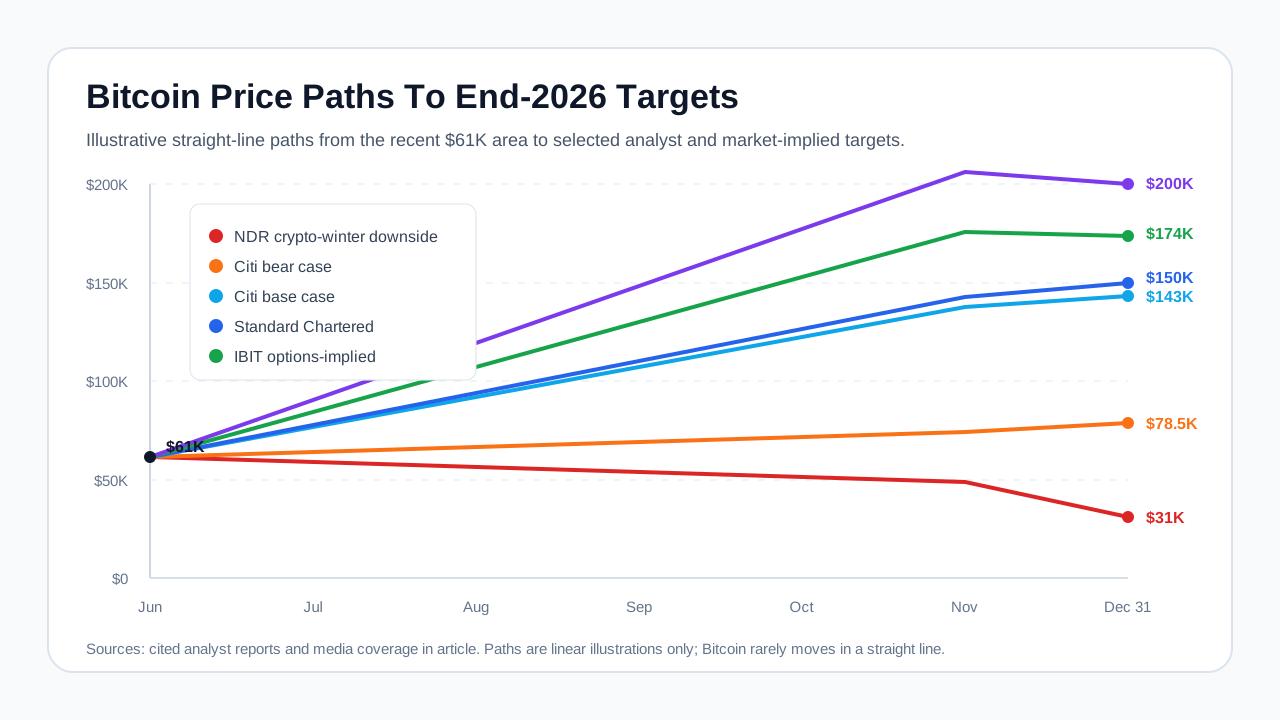
Bitcoin 2026 Prediction Summary
The highest-quality forecasts come from banks, research firms and market structure data. We gave less weight to anonymous algorithmic prediction pages because they often publish daily numbers without explaining the driver, failure condition or forecast history.
| Source or signal | 2026 Bitcoin level | Type of call | What has to happen |
|---|---|---|---|
| Ned Davis Research | $31,000 downside | Bear-market drawdown case | The current selloff turns into a full crypto winter. |
| Citi bear case | About $78,500 | Bank downside scenario | Recession or weak risk appetite limits ETF demand. |
| Citi base case | $143,000 | Bank base forecast | ETF adoption continues and crypto regulation improves. |
| Standard Chartered | $150,000 | Bank target | ETF buying replaces fading treasury-company demand. |
| IBIT options activity | About $174,000 implied BTC equivalent | Market-positioning signal | Long-dated BlackRock Bitcoin ETF options price in a large recovery. |
| Bernstein | $200,000 bull scenario | Research bull-market call | Bitcoin's cycle extends into 2026 and possibly 2027. |
The practical takeaway: Citi and Standard Chartered cluster around $143,000 to $150,000, which would require Bitcoin to more than double from the recent $61,000 area. The most bullish institutional scenario, Bernstein's $200,000 case, would require a much stronger recovery. The most bearish research case, Ned Davis Research's $31,000 scenario, assumes the current drawdown becomes a full crypto winter.
1. Citi: $143,000 Base Case, $78,500 Bear Case, $189,000 Bull Case
Citi has one of the clearest 2026 frameworks because its forecast is tied directly to ETF demand.
MarketWatch reported that Citi analysts put their Bitcoin base case at $143,000 for 2026, with a bull case north of $189,000 and a bear estimate around $78,500. The bank's reasoning was that investor adoption through ETFs could continue, with about $15 billion of ETF inflows helping lift token prices.
That makes Citi's forecast useful because the assumption is testable. If spot Bitcoin ETF flows recover, Citi's base case becomes more plausible. If outflows persist, the forecast weakens.
Citi's call also lines up with one of the biggest ranking gaps in existing Bitcoin prediction content: many pages give a price target but do not show the catalyst. Citi's forecast is not just "$143,000 because Bitcoin goes up." It is "$143,000 if ETF adoption keeps expanding."
The weakness is timing. ETF flows have recently moved in the wrong direction. Investopedia reported that more than $4 billion had left spot Bitcoin ETFs since May 15, citing Farside Investors data. For Citi's base case to work by December 31, 2026, Bitcoin likely needs a second-half flow reversal.
2. Standard Chartered: $150,000 By 2026, But With A Big Forecast Cut
Standard Chartered remains bullish, but its 2026 Bitcoin forecast has already been cut sharply.
Business Insider reported that Geoff Kendrick, Standard Chartered's global head of digital assets research, lowered the bank's 2026 Bitcoin target to $150,000 from a previous $300,000 estimate. The same report said the bank's previous end-2025 target had been $200,000 before being reduced to $100,000.
Investopedia also reported that Standard Chartered cut its 2026 target to $150,000 from $300,000 after Bitcoin's decline from its highs.
This is still one of the most important forecasts because Standard Chartered has been among the more visible institutional Bitcoin bulls. But the revision matters. A lower target is not automatically bearish; it shows the analyst is responding to price action, liquidity and demand conditions.
The bank's key point is that Bitcoin treasury companies may no longer be the same price support they were earlier in the cycle. That shifts the burden to ETFs. If ETF inflows return, $150,000 remains in reach. If ETFs keep bleeding assets, the forecast becomes harder to defend.
Compared with Citi, Standard Chartered's target is slightly higher but not dramatically different. Both forecasts imply that Bitcoin roughly doubles from the June low-$60,000 area by year-end.
3. IBIT Options: The $174,000 Market-Implied Scenario
Options activity is not the same as an analyst price target, but it can show where sophisticated traders are willing to place long-dated bets.
After options trading launched on BlackRock's iShares Bitcoin Trust, MarketWatch reported that first-day activity included large call-option trades expiring in 2026 at a $100 IBIT strike. Galaxy Digital's Michael Harvey said an IBIT price of $100 corresponded to a Bitcoin price of roughly $174,000.
That does not mean traders "know" Bitcoin will hit $174,000. Options buyers can be hedging, speculating, expressing convex upside or structuring trades with limited risk. Still, the level is useful because it shows a real-market scenario that sits above Citi and Standard Chartered but below Bernstein's more aggressive $200,000 bull case.
The $174,000 level is also an important semantic gap in many Bitcoin prediction articles. Search results often list analyst forecasts but skip derivatives positioning. For an asset as reflexive as Bitcoin, options markets matter because they can reveal where investors are paying for upside.
4. Bernstein: $200,000 Bull Case If The Cycle Extends
Bernstein's forecast is the cleanest high-upside institutional bull case.
MarketWatch reported that Bernstein analysts led by Gautam Chhugani argued Bitcoin could reach $200,000 in the next 6 to 12 months and that the bull market could extend into 2027. Their case was tied to institutional adoption, U.S. regulatory support and the possibility that Bitcoin's traditional four-year cycle has changed.
The strength of Bernstein's call is that it accounts for market structure. Spot ETFs changed how traditional investors access Bitcoin after the SEC approved spot Bitcoin ETF listings in January 2024. Axios reported that the approval gave Bitcoin a path into ordinary portfolios through listed funds from firms including BlackRock, Fidelity, Grayscale, ARK, VanEck and Bitwise.
The weakness is that an extended-cycle thesis asks investors to believe Bitcoin is breaking from its older boom-bust rhythm. That may be true, but it is not yet proven. A $200,000 year-end 2026 price requires more than stabilization. It likely requires a renewed bull market, a strong ETF bid, improving liquidity and fewer regulatory disappointments.
For readers comparing Bitcoin with other stores of value, Bernstein's thesis is closest to the argument that Bitcoin keeps taking share from gold. We cover that broader framework in our guide to gold vs Bitcoin.
5. Ned Davis Research: $31,000 Crypto-Winter Downside
The bear case deserves the same attention as the bullish targets.
Business Insider reported that Ned Davis Research saw potential downside to $31,000 if the selloff escalated into a full crypto winter. The firm looked at prior Bitcoin drawdowns and said a 70% to 75% peak-to-trough decline could pull Bitcoin much lower, though it also noted that institutional ownership might make drawdowns less severe than in earlier cycles.
This is not a base forecast. It is a risk scenario. But it is high-value because it answers a question many bullish articles dodge: how bad could the downside get if the cycle breaks?
Using the October 2025 peak near $126,000 as the reference point, a drop to $31,000 would be a roughly 75% decline. That is severe, but it is not unprecedented in Bitcoin's history. Investors using Bitcoin as part of a long-term plan should understand that volatility before sizing a position. Our guides to risk and reward and diversification explain why position sizing matters more when an asset can move this violently.
6. K33: Bullish On 2026, But Without A Hard Price Target
K33 is useful because it gives a catalyst map rather than a precise price.
Business Insider reported that K33 entered 2026 with a constructively bullish view and argued Bitcoin could outperform stocks and gold. The firm's reasons included attractive valuation after the 2025 drawdown, expected Federal Reserve rate cuts, a pro-crypto U.S. administration, a strategic Bitcoin reserve, potential 401(k) access to crypto exposure and possible progress on the CLARITY Act.
This is not as easy to chart as a $143,000 or $150,000 target. Still, it helps explain what the bullish camp needs: lower rates, regulatory clarity and new pools of traditional capital.
K33 also highlights a topical vector many prediction pages underuse: retirement-account access. If 401(k) and financial-advisor channels become more open to Bitcoin exposure, the addressable buyer base changes. That would support the ETF-flow forecasts from Citi and Standard Chartered.
7. Tom Lee And Fundstrat: Positive 2026 Cycle View, But Watch Forecast History
Fundstrat's Tom Lee has been one of the most visible Bitcoin bulls on Wall Street, but the current 2026 view is more about cycle direction than a precise end-year Bitcoin number.
MarketWatch reported that Lee thought 2026 could break Bitcoin's usual four-year down-year pattern, pointing to macro and cycle signals. MarketWatch later reported that Lee saw unusual technical action as evidence of a new crypto bull market, while also noting that some prior aggressive Bitcoin calls had been too optimistic.
That history matters. Lee's bullishness has often been directionally useful during risk-on periods, but investors should separate a macro-cycle view from a price target. A forecast with a clear number, time frame and failure condition is easier to evaluate than a broad bullish stance.
Forecast Comparison Chart
The chart below compares the main numerical scenarios against the recent $61,380 reference price.
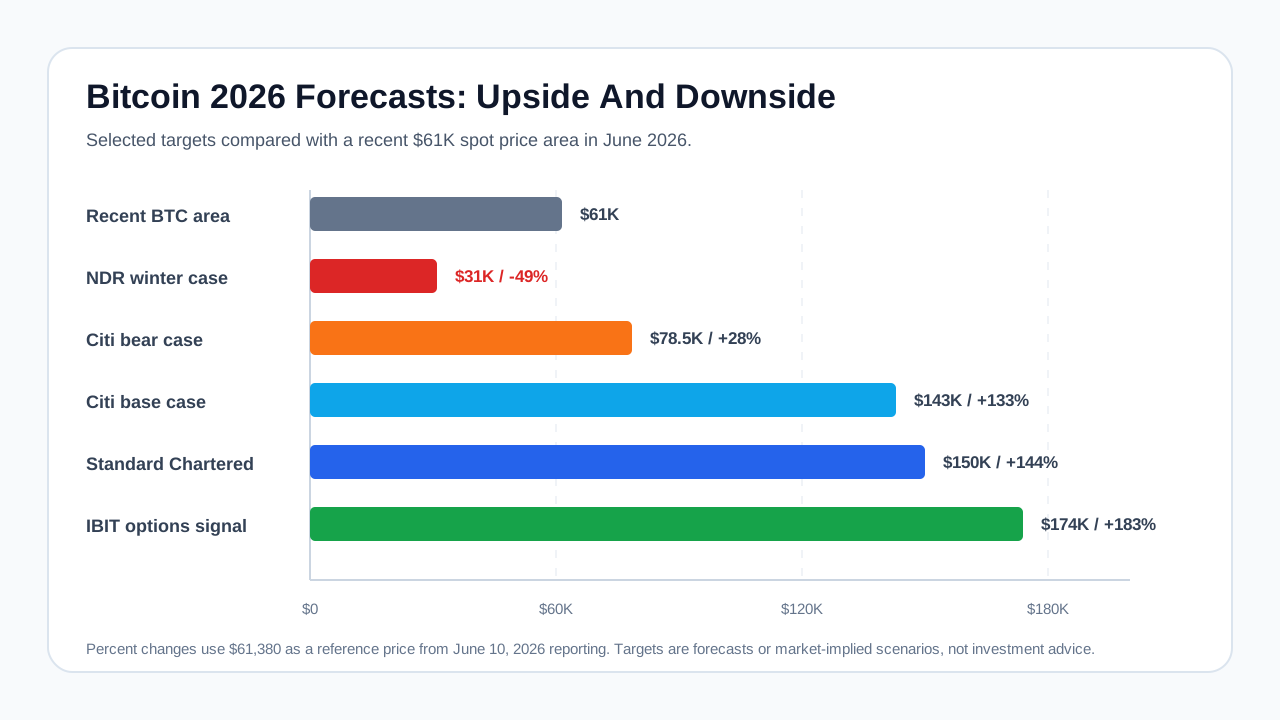
The clustering is important. Citi's base case and Standard Chartered's target are close enough that they form the institutional consensus zone: roughly $140,000 to $150,000. The IBIT options level and Bernstein's $200,000 scenario are the high-upside zone. Citi's bear case and Ned Davis Research's winter case define the risk zone.
Which Bitcoin Prediction Has The Best Track Record?
No Bitcoin forecaster deserves blind trust. The best way to compare predictions is to ask four questions.
First, did the forecast include a time frame? "Bitcoin will eventually hit $1 million" is not as useful as "Bitcoin will reach $150,000 by the end of 2026."
Second, did the forecast explain the driver? Citi and Standard Chartered point to ETF demand. K33 points to rates, regulation and retirement-account access. Ned Davis Research points to historical drawdown behavior. Those are testable.
Third, did the analyst revise when facts changed? Standard Chartered's cut from $300,000 to $150,000 weakens the headline bull case, but it improves transparency because the bank acknowledged weaker price action and shifting demand.
Fourth, does the forecast beat a simple baseline? This is where prediction content gets uncomfortable. A 2026 paper on arXiv, Bitcoin Price Prediction: Peer-Reviewed Evidence and Social Media Discourse, argued that short-to-medium horizon Bitcoin forecasting has not shown robust superiority over naive baselines across multiple regimes. In plain English: many models look impressive until they are tested across different market environments.
That does not mean forecasts are useless. It means they should be treated as scenario maps, not promises.
What Most Bitcoin Prediction Pages Miss
The live search results for Bitcoin price prediction content are crowded, but many articles have the same structural weaknesses.
They list targets without ranking source quality. A Wall Street bank target, a crypto research report, a trader's options position and an anonymous algorithmic forecast are not the same type of evidence.
They ignore failure conditions. A useful forecast should say what would make it wrong. For 2026, the biggest failure condition for bullish targets is continued ETF outflows.
They skip path math. A move from $61,000 to $150,000 by December 31, 2026 is not a small bounce. It implies roughly 144% upside from the recent reference price. A move to $200,000 implies roughly 226% upside.
They under-cover bearish institutional research. The $31,000 Ned Davis Research scenario may not be the base case, but it helps investors understand drawdown risk.
They blur Bitcoin with the broader crypto market. Bitcoin may benefit from ETF demand and store-of-value narratives, while Ethereum, Solana and other assets depend more heavily on activity, fees, stablecoin flows, developer ecosystems and decentralized finance. For broader context, see our guides to crypto, Ethereum and DeFi.
What Would Need To Happen For $150,000 Bitcoin?
The $143,000 to $150,000 zone is the most important forecast range because it is bullish but still grounded in major bank research.
For Bitcoin to reach that zone by year-end 2026, several things likely need to happen.
ETF outflows need to reverse. The spot ETF market is now a central price channel, and weak flows are one of the clearest current headwinds.
Risk appetite needs to improve. Bitcoin has recently behaved more like a liquidity-sensitive risk asset than a stable hedge. If rates fall and investors rotate back into crypto, the price path improves.
Crypto legislation needs momentum. The CLARITY Act and related market-structure debates matter because regulatory clarity can make it easier for institutions, advisors and platforms to support Bitcoin exposure.
Corporate and sovereign selling pressure needs to stay limited. Strategy's sale rattled sentiment because it challenged the idea that large holders would never sell. The U.S. strategic reserve argument is bullish only if investors believe seized coins are effectively removed from future sell-side pressure.
Retail participation needs to return. ETF adoption can move large sums, but Bitcoin bull markets usually also need improving retail sentiment.
What Would Need To Happen For $200,000 Bitcoin?
A $200,000 year-end 2026 Bitcoin price is possible but demanding.
It would require the $150,000 conditions plus a stronger momentum phase. Bitcoin would likely need to reclaim its prior high, attract new ETF inflows, benefit from macro easing and avoid a major regulatory or liquidity shock.
It would also require investors to believe the old halving-cycle playbook has changed. Bernstein's extended-cycle argument is the clearest version of that thesis. The risk is that if Bitcoin remains tied to broader liquidity cycles, the market may not give it enough time to reach $200,000 in 2026.
For long-term investors, this is where strategy matters. Buying Bitcoin because it might reach $200,000 is different from using dollar-cost averaging into a volatile asset over many years. We explain that approach in our guide to dollar-cost averaging.
What Would Need To Happen For $31,000 Bitcoin?
The $31,000 downside case becomes more plausible if three conditions appear together.
First, ETF outflows continue and become self-reinforcing. Second, the macro backdrop stays risk-off, with investors preferring cash, Treasuries, gold, AI equities or other assets. Third, long-term holders or treasury companies create fresh selling pressure.
Bitcoin does not need all three to fall further, but a full crypto-winter move usually needs more than ordinary volatility. It needs forced selling, disappearing demand and damaged confidence at the same time.
That is why storage and counterparty risk still matter. Investors holding Bitcoin directly should understand wallets, exchanges and custody before buying. Start with our guides to Bitcoin wallets, hardware wallets and Bitcoin exchanges.
Bottom Line
The most defensible end-of-2026 Bitcoin prediction range is not a single number. It is a scenario band.
Citi and Standard Chartered put the main bullish institutional range around $143,000 to $150,000. IBIT options activity shows that traders have been willing to express upside near a $174,000 Bitcoin equivalent. Bernstein's $200,000 case is the aggressive bull-market scenario. Ned Davis Research's $31,000 case is the severe crypto-winter warning.
If ETF flows recover and macro liquidity improves, the $140,000 to $150,000 zone is the cleanest upside target to watch. If flows stay negative and risk appetite weakens, the market may spend more time defending the low-$60,000 area than chasing new highs.
For investors, the right conclusion is not to pick the biggest number. It is to understand what each number assumes, watch whether those assumptions are coming true, and size Bitcoin exposure as a volatile asset rather than a guaranteed forecast. To build from the basics, start with what Bitcoin is and how investing in Bitcoin fits into a broader portfolio.
Frequently asked questions
What are the top Bitcoin price predictions for the end of 2026?
Major 2026 Bitcoin forecasts include Citi's base case near $143,000, Standard Chartered's $150,000 target, an IBIT options-implied scenario near $174,000, Bernstein's aggressive $200,000 bull-market scenario and Ned Davis Research's bearish crypto-winter downside case near $31,000.
Which Bitcoin 2026 forecast is the most credible?
The most credible forecasts are not necessarily the highest. Bank forecasts from Citi and Standard Chartered have clearer assumptions around ETF flows, adoption and macro conditions, while bearish drawdown work from Ned Davis Research is useful for risk framing. Options-implied levels show positioning, not a formal forecast.
Could Bitcoin reach $200,000 in 2026?
Bitcoin could reach $200,000 in 2026 only if the market returns to a strong bull phase, ETF demand recovers and macro liquidity improves. Bernstein has argued for a possible move toward $200,000, but that scenario requires a much sharper recovery from the recent low-$60,000 range.
Why do Bitcoin price predictions vary so much?
Bitcoin predictions vary because analysts use different models. Some focus on ETF inflows, others on market cycles, volatility-adjusted comparisons with gold, macro liquidity, mining economics, technical momentum or historical drawdowns. Small changes in adoption assumptions can create very different price targets.
Continue reading
More resources
- InvestingBest Long-Term Investments for 2026Compare the best long-term investments, including index funds, ETFs, bonds, real estate, dividend stocks, retirement accounts, and Bitcoin.Read next
- InvestingDollar Cost AveragingDollar cost averaging is an investment strategy which seeks to minimize risk when investing in volatile markets.Read next
- InvestingFinancial Independence, Retire Early (FIRE)Learn how Financial Independence, Retire Early (FIRE) works, how to calculate your FIRE number, and how Lean, Fat, Coast, and Barista FIRE differ.Read next
- MoneyHow to Build Wealth From Scratch and Push Your Net Worth Above $100,000Learn how to build wealth from a low starting point with a practical first-$100K plan covering cash flow, index funds, ETFs, stocks, real estate, Bitcoin, crypto, and generational wealth protection.Read next