
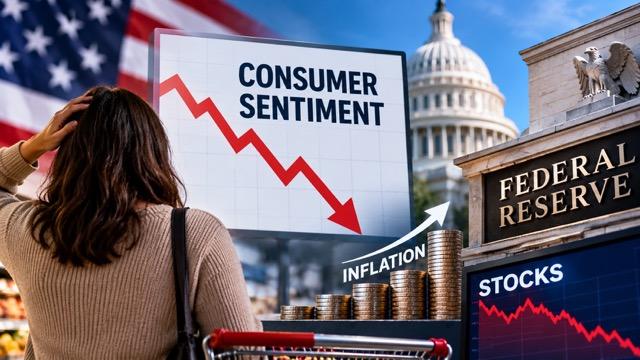
- US consumer sentiment weakened for a third consecutive month in early October as rising living costs deepened concerns about the economy, while higher inflation expectations added uncertainty to the outlook for Federal Reserve policy and financial markets.
The University of Michigan's preliminary Consumer Sentiment Index fell to 46.3 in October from 48.1 in September, missing economists' expectations of 47.8, according to the October 9 survey results. The reading was 13.6% below the 53.6 recorded a year earlier.
The deterioration reflects growing frustration with the cost of living as higher energy prices and geopolitical tensions add pressure to household budgets. The survey's director, Joanne Hsu, said consumers across political groups increasingly believed the economic outlook had weakened since the beginning of the year.
The latest figures arrive as investors weigh inflation risks, Treasury yields and the outlook for corporate earnings. The combination could influence consumer spending, expectations for interest rates and the performance of US stocks.
Why Consumer Sentiment Is Falling and Inflation Expectations Are Rising
The survey's measure of current economic conditions dropped to 44.7 from 50.9 in September, a record low. The index of consumer expectations, however, increased slightly to 47.3 from 46.3, suggesting that expectations improved even as assessments of current conditions deteriorated.
Inflation remains a central concern. Consumers' year-ahead inflation expectations rose to 4.7% from 4.6% in September, while long-run expectations increased to 3.5% from 3.4%. Both measures rose for a second consecutive month and reached their highest levels since May, according to the University of Michigan.
Higher energy prices have contributed to the pressure on household budgets. The rise in oil prices has also complicated the outlook for businesses and financial markets, as investors assess whether elevated fuel and transportation costs could feed into broader inflation.
The survey showed that lower-income households and people with smaller stock portfolios experienced particularly sharp declines in sentiment. Those groups generally have fewer financial resources to absorb higher prices, making changes in food, fuel, housing and borrowing costs especially important.
Weak sentiment does not necessarily mean consumer spending will decline immediately. Recent economic conditions have shown a gap between how households feel about the economy and how much they continue to spend. Higher-income households, in particular, may be better positioned to maintain spending even as confidence deteriorates.
Nevertheless, prolonged pressure on household finances could weigh on discretionary purchases and affect companies that depend on consumer demand. Investors tracking the latest US stock market outlook will be watching whether weaker confidence begins to appear in retail sales, corporate earnings and business guidance.
What the Sentiment Data Means for Interest Rates and Stocks
The increase in inflation expectations creates a challenge for Federal Reserve policymakers. If households expect prices to rise more quickly, those expectations can influence wage negotiations, purchasing decisions and business pricing. That can make it more difficult for inflation to return to the Fed's target.
At the same time, declining confidence could signal weaker future demand. A softer economy may reduce companies' pricing power and eventually ease inflationary pressure, but the effect depends on how consumer spending and employment develop.
The Fed must balance these competing risks when deciding whether interest rates should remain elevated or move lower. The October sentiment report alone will not determine the next policy decision; inflation data, employment figures and other economic indicators will also influence policymakers.
For investors, the key issue is how the data affects expectations for interest rates and bond yields. Persistent inflation concerns can push Treasury yields higher, increasing borrowing costs for households and businesses and putting pressure on stock valuations. Higher yields can be particularly challenging for growth stocks whose valuations depend heavily on expected future earnings.
Investors will also be watching the upcoming earnings season for evidence of whether companies are seeing weaker demand or higher costs. Management commentary on pricing, hiring and consumer spending could help determine whether declining confidence is translating into slower business activity.
The University of Michigan is scheduled to publish its final October sentiment results on October 23. Until then, the preliminary figures suggest that cost-of-living concerns remain elevated and inflation expectations are moving in the wrong direction for policymakers seeking to restore price stability.