
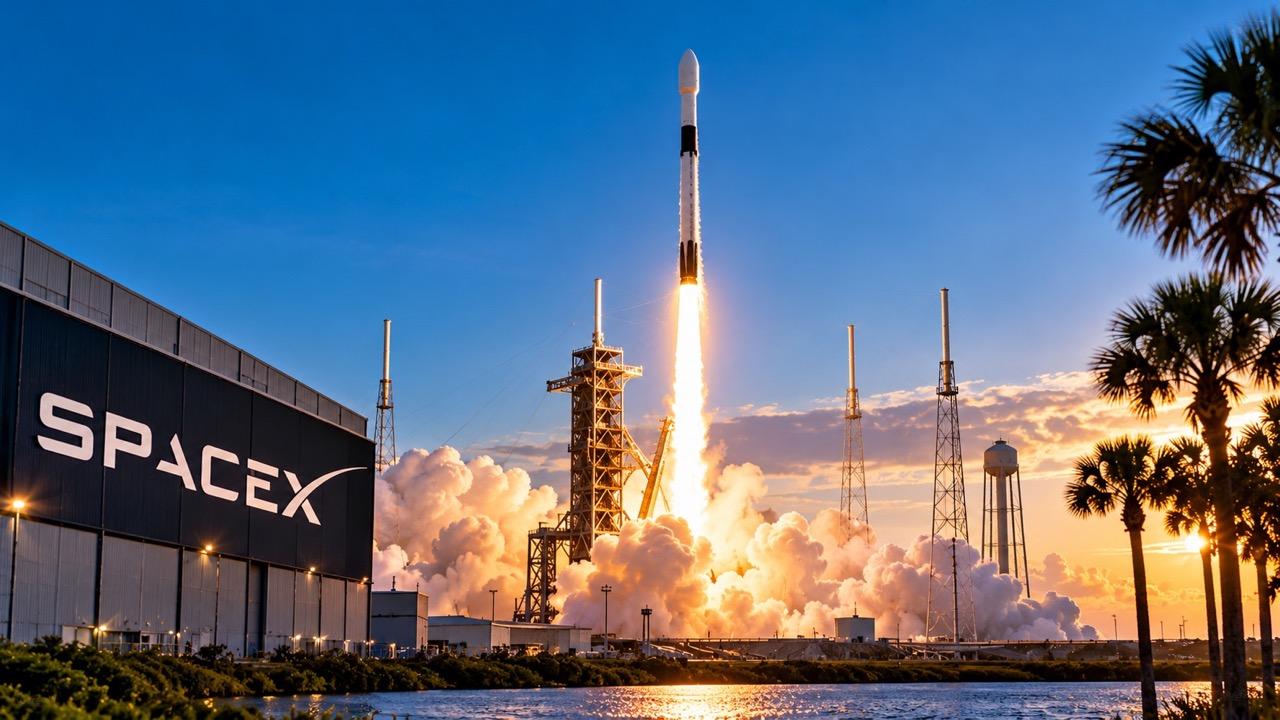
SpaceX launched its Bandwagon-5 mission from Cape Canaveral on October 20, carrying 32 payloads into orbit aboard a Falcon 9 rocket. The rideshare flight included satellites and experimental reentry vehicles, while the rocket’s first-stage booster completed its 19th flight and landed at sea.
SpaceX (NASDAQ: SPCX) launched its Bandwagon-5 mission from Cape Canaveral Space Force Station in Florida on Tuesday, October 20, carrying 32 payloads into space as part of the company’s commercial satellite rideshare program.
The Falcon 9 rocket lifted off from Space Launch Complex 40 at approximately 7:04 a.m. EDT, according to launch coverage from Florida Spaceflight. The flight followed a one-day delay caused by unfavorable weather conditions around the booster recovery area in the Atlantic Ocean.
The mission gave commercial and institutional customers a shared launch opportunity instead of requiring each operator to arrange an individual rocket launch. SpaceX’s Bandwagon-5 mission page identifies the flight as part of its rideshare launch program.
The launch also highlighted the continued use of reusable rocket hardware. The Falcon 9 first-stage booster, designated B1085, completed its 19th flight before landing on the autonomous droneship A Shortfall of Gravitas in the Atlantic Ocean.
What Is SpaceX’s Bandwagon-5 Mission?
Bandwagon-5 is the fifth flight in SpaceX’s Bandwagon series, which provides access to mid-inclination orbits for multiple satellite customers. These orbits allow spacecraft to operate across a range of latitudes and support different commercial and research applications.
By placing multiple payloads on one rocket, SpaceX spreads launch costs among customers. The approach can make orbital access more practical for smaller satellite operators that might otherwise struggle to justify the expense of a dedicated launch.
The 32 payloads included CubeSats, microsatellites and reentry vehicles. Launch provider and mission integrator Exolaunch coordinated 20 of the customer payloads, including four radio-frequency monitoring satellites for HawkEye 360, four satellites for Finnish Earth-observation company ICEYE and six navigation satellites for California-based Xona Space Systems.
One of the mission’s notable payloads was SpaceX’s Starfall reentry capsule. The experimental spacecraft is designed to support microgravity research and in-space manufacturing, with the potential to return materials and experiments to Earth.
The flight also carried Varda Space Industries’ W-7 reentry capsule. Its mission includes a pharmaceutical experiment involving a compound known as Protac, with researchers examining whether processing materials in microgravity can improve their properties, including solubility.
Another payload was Portal Space Systems’ Starburst-1 spacecraft, which is intended to demonstrate orbital maneuvering capabilities. The mission provides an early test of technology that could support future commercial spacecraft operations.
These payloads illustrate the expanding range of activity in the commercial space industry, from satellite communications and navigation to pharmaceutical research and spacecraft development. Investors tracking the sector can follow broader market developments through Wealthier Today’s investing coverage.
Why Was Bandwagon-5 Launched From Florida?
SpaceX launched Bandwagon-5 from Cape Canaveral Space Force Station, a major US spaceflight hub on Florida’s Atlantic coast. The site offers established launch infrastructure and access to orbital trajectories suited to a wide range of commercial and government missions.
Florida’s eastern coastline also allows rockets to travel over the Atlantic during ascent, providing a suitable corridor for many launches while keeping initial flight paths away from densely populated areas.
SpaceX operates Falcon 9 launches from several locations, including facilities in Florida and California. The launch site is selected according to mission requirements, including the intended orbit, rocket operations and available launch infrastructure.
Bandwagon-5’s southeasterly trajectory supported the mission’s planned orbital deployment. Following stage separation, the first-stage booster returned toward the Atlantic recovery area while the rocket’s upper stage continued carrying the payloads toward orbit.
The successful booster landing added another recovery to SpaceX’s reusable-launch operations. Reusing first-stage boosters allows the company to fly previously used hardware again rather than building a new first stage for every mission.
Bandwagon-5 also demonstrates how rideshare launches serve a growing commercial market. Customers with different spacecraft and research objectives can share one launch, while SpaceX operates the rocket and manages the flight.
The immediate next steps for the mission’s customers are to establish contact with their spacecraft, check onboard systems and begin commissioning operations where applicable. The launch itself marks the start of those activities rather than the completion of each satellite’s operational objectives.