

- The Congressional Budget Office projects Social Security's retirement trust fund will be exhausted in 2032, raising the prospect of benefit reductions unless Congress changes the program's finances.
The US Congressional Budget Office has released its latest long-term Social Security projections, and the numbers have renewed debate over how the retirement program should be financed. The CBO's Sept. 17 report projects that the Old-Age and Survivors Insurance Trust Fund will be exhausted in fiscal 2032 under current law. The agency says the gap between Social Security's revenues and spending is expected to widen over the next 75 years.
The projection is generating particular attention because of what happens after the trust fund reaches zero. In an illustrative scenario, CBO estimates that benefits would have to be reduced by 7% in 2032 and by an average of 28% annually from 2033 through 2036 if payments were limited to the program's dedicated revenues.
That differs from the 26% figure highlighted in recent analysis from the Committee for a Responsible Federal Budget, which said CBO's latest projections imply a 26% benefit cut when the retirement trust fund becomes insolvent. The distinction matters because the size and timing of any eventual reduction would depend on what Congress changes and how those changes are implemented.
Why Is Social Security Facing a Funding Crisis?
The underlying problem is that Social Security's costs are growing faster than its dedicated revenues. CBO projects Social Security spending will rise from 5.2% of GDP in 2026 to 6.0% in 2056 if benefits are paid as scheduled. Over the same period, revenues are projected to remain close to 4.5% of GDP. The difference increasingly puts pressure on the trust fund.
The demographic shift is a major factor. The number of Americans receiving Social Security benefits is projected to increase from about 71 million in 2026 to 82 million in 2036, while the number of people age 65 and older continues to grow as the baby-boom generation retires.
Social Security is primarily financed through payroll taxes. In 2026, the combined payroll tax rate is 12.4% on earnings up to $184,500, with employees and employers generally paying 6.2% each. Self-employed workers generally pay the full 12.4%.
But payroll-tax revenue is not keeping pace with benefit obligations. CBO projects OASI spending will grow by an average of about 5% annually over the coming decade, while noninterest income, which is primarily payroll-tax revenue, grows by about 4%. The resulting cash deficits steadily reduce the trust fund balance.
The following illustrates the central timeline in the latest CBO projection:
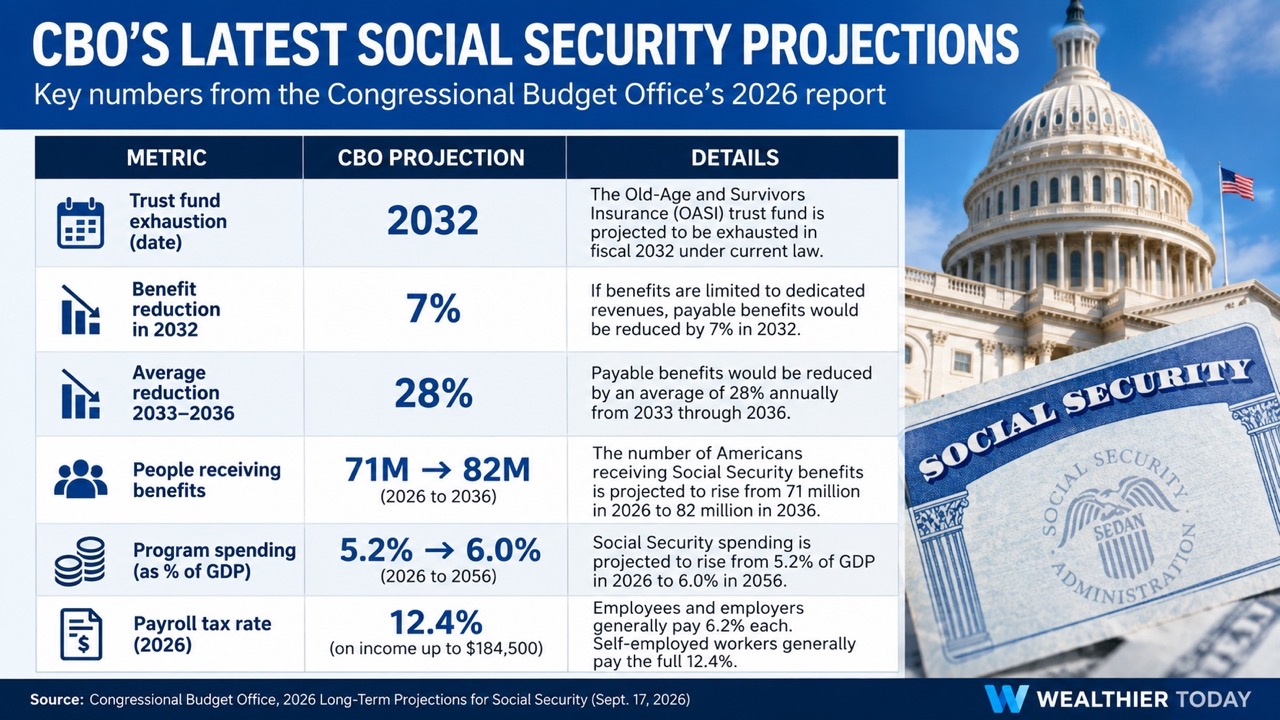
The 2032 date is therefore the critical deadline in the latest projection. It does not mean Social Security would disappear in 2032. Rather, without legislative changes, the OASI trust fund would no longer have enough assets to pay the full benefits scheduled under current law.
CBO also projects that the combined Old-Age, Survivors and Disability Insurance trust funds would remain solvent until 2033 if their balances were hypothetically combined. Under current law, however, the two funds are legally separate.
What Could Congress Do About Social Security?
The new CBO projection has intensified debate over the two broad ways to close Social Security's financing gap: increase revenues, reduce future benefits, or combine elements of both approaches.
One option being discussed is increasing the amount of income subject to the Social Security payroll tax. The taxable maximum is $184,500 in 2026, meaning wages above that amount are generally not subject to the 12.4% Social Security payroll tax.
A recent CBS News analysis cited an estimate from the Cato Institute that raising the payroll tax rate from 12.4% to 17% could cost a median worker earning about $62,000 roughly $2,600 to $3,000 more per year, with the cost generally divided between workers and employers. That is an estimate of one potential policy approach, not a CBO recommendation.
Other proposals include increasing the taxable maximum, changing the formula used to calculate benefits, raising the retirement age, reducing benefits for higher-income retirees or combining additional revenues with benefit changes.
The Washington Post has highlighted the political debate from opposing perspectives. A Sept. 17 editorial argued that raising the payroll tax would not solve the underlying problem, while a Sept. 22 opinion column argued that higher-income Americans could afford to contribute more. Those are editorial and opinion positions, not CBO conclusions.
The central issue raised by the CBO projection is therefore not that Social Security is scheduled to stop paying benefits in 2032. The issue is that under current law, the retirement trust fund is projected to be exhausted that year, creating a funding gap that Congress would need to address to avoid automatic reductions in payable benefits.
CBO's projections also carry uncertainty. Economic growth, inflation, wage growth, immigration, fertility, mortality, and future legislation can all change the program's financial outlook. The agency explicitly describes its figures as projections under current laws rather than predictions of what Congress will ultimately do.
For Americans planning for retirement, the important takeaway from the latest Social Security projection is the 2032 trust-fund exhaustion date and the size of the potential funding gap, rather than any single headline figure for a future benefit cut. The eventual impact on retirees will depend on the legislation adopted before then.