
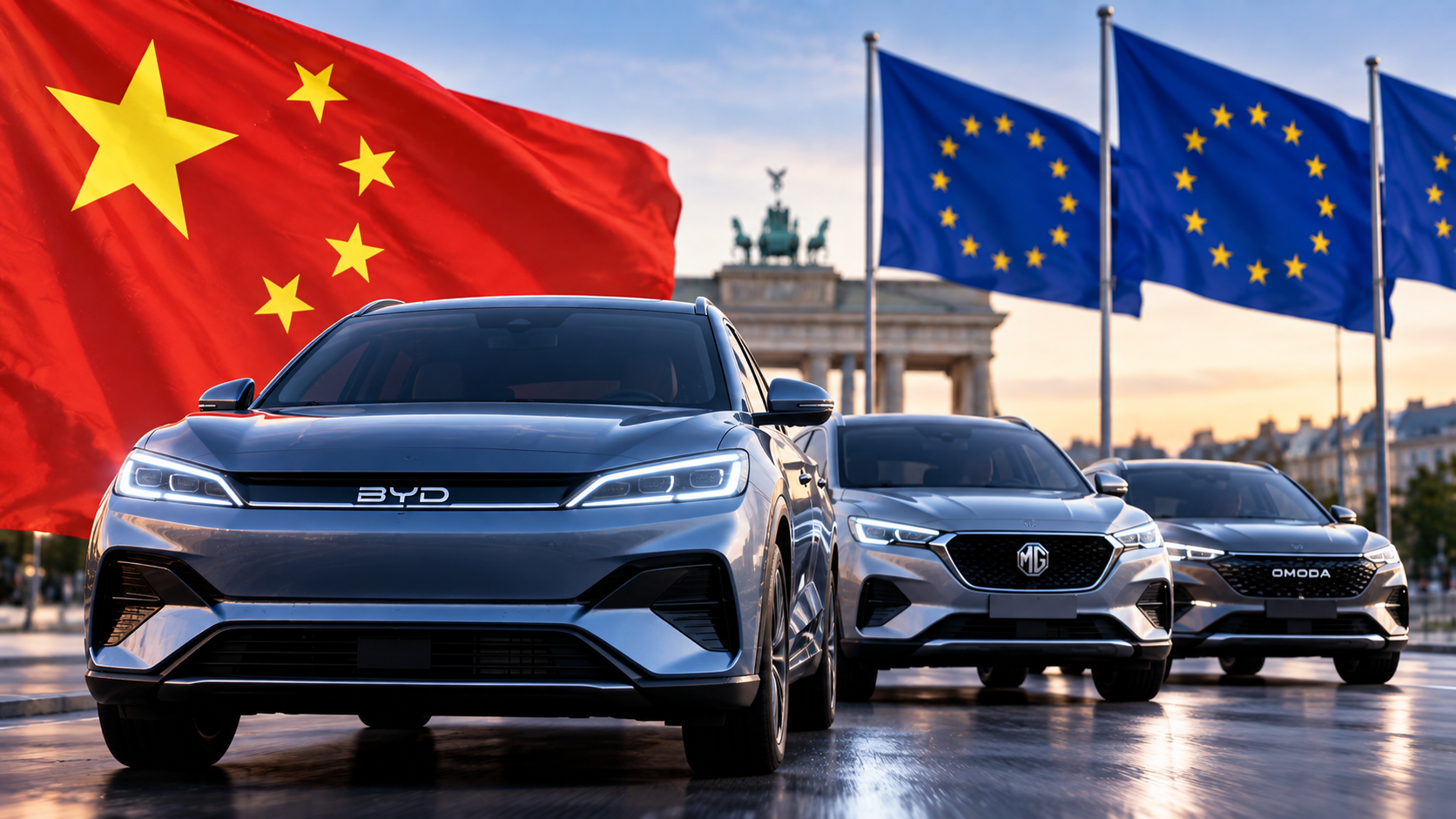
- Chinese automakers captured nearly 12% of Europe’s new-car market in August, with hybrids helping brands such as BYD expand despite European tariffs on Chinese electric vehicles.
Chinese automakers are taking a record share of Europe's car market, and the latest gains are coming increasingly from hybrid vehicles rather than fully electric cars. Brands including BYD accounted for nearly 12% of new-car sales across the region in August, according to Dataforce data cited by Bloomberg. Chinese brands also represented about one in four hybrid sales and roughly one in three plug-in hybrid sales.
The shift highlights how Chinese automakers are adapting their product mix to European demand while taking advantage of differences in the European Union's trade rules.
Why Are Chinese Cars Selling So Well in Europe?
One reason is that European consumers remain cautious about switching completely to battery-powered vehicles. Bloomberg reported that concerns over charging infrastructure and driving range are encouraging some buyers to choose hybrids instead. Chinese automakers have responded with a growing selection of hybrid and plug-in hybrid models that offer an alternative to fully electric vehicles.
The strategy is also helping Chinese brands navigate EU tariffs. The additional duties imposed on Chinese battery-electric vehicles do not apply in the same way to hybrids, giving manufacturers more room to compete on price.
The European Commission's trade measures have reduced the share of Chinese-made battery-electric vehicles in the EU market, but Chinese automakers have continued expanding through hybrids, new brands and localized production.
BYD and Other Chinese Brands Are Expanding
BYD is among the companies benefiting from the shift. Other Chinese-owned brands, including SAIC's MG and Chery's Omoda and Jaecoo, have also been gaining ground in Europe. Chinese brands reached a 10.9% share of Europe's new-car market in June, with sales rising 118% year over year to 150,272 vehicles, according to Dataforce figures covering most of the EU, the UK and EFTA markets.
Plug-in hybrids and full hybrids were important contributors because they are not subject to the EU's additional tariffs on fully electric vehicles. By July, Chinese-brand registrations for the year had already reached 813,096 vehicles, exceeding their full-year 2025 total of 812,452, according to Dataforce figures reported by TeslAnt. Chinese brands held an 11.2% share of the market that month.
Hybrids Are Becoming the Entry Point
The European market is still shifting toward electrification, but consumers are not moving at the same speed toward fully electric cars. Dataforce reported that combined battery-electric and hybrid demand increased 27% in August, helping offset a decline in vehicles powered solely by combustion engines.
For Chinese automakers, that creates an opportunity. They can offer buyers lower-emission vehicles without requiring the same commitment to charging infrastructure as a fully electric car.
The approach also reflects China's broader strength in electric and electrified vehicle manufacturing. The International Energy Agency said China produced about 16 million electric cars in 2025, while Chinese electric-car exports more than doubled to a record above 2.5 million.
What Happens Next?
Chinese automakers are increasingly combining exports with plans to manufacture vehicles inside Europe. The IEA said Chinese manufacturers and Chinese-owned brands are expanding their European production footprint, while Transport & Environment estimates that Chinese automakers have announced 10 European production facilities since the EU began its anti-subsidy investigation in 2023.
That means the competition is no longer simply about shipping cheaper cars from China into Europe. Manufacturers are adapting their vehicle lineups, increasing hybrid sales and establishing production capacity closer to European customers.
For European automakers, the growing presence of Chinese brands adds competitive pressure across both electric and hybrid segments. For consumers, the expansion means more choice as the market moves away from traditional gasoline-powered vehicles.