

- Ethereum price predictions have diverged sharply in 2026, with Wall Street targets ranging from roughly $2,200 to $40,000 and some crypto executives projecting significantly higher levels.
Ethereum (ETH) is back above $2,700 after a sharp recovery in August and September, but the bigger question for investors is how high the cryptocurrency could climb over the next five years. ETH was trading around $2,750 on Sept. 23, according to market data, putting it roughly 44% below its August 2025 all-time high of $4,946.05.
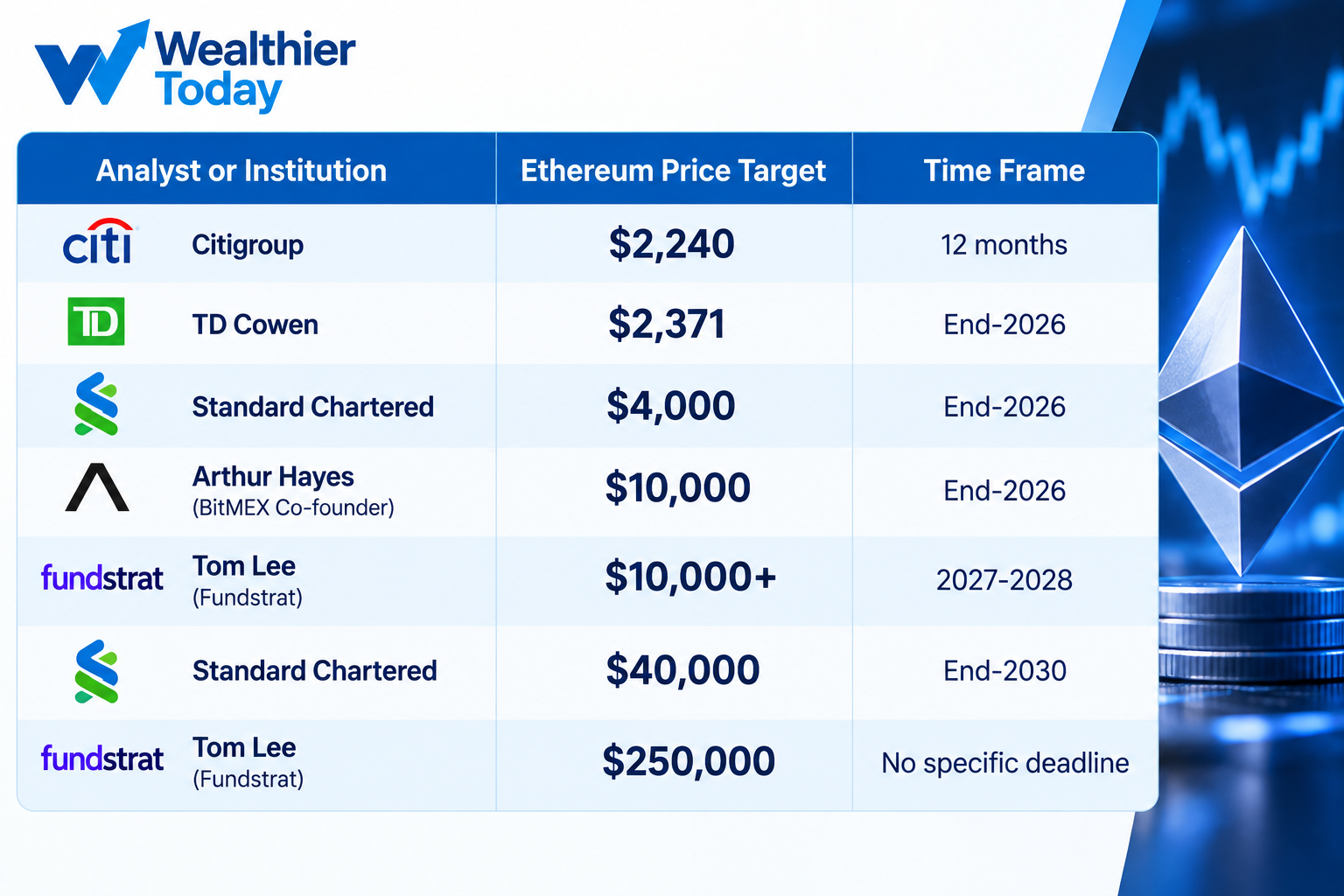
Recent forecasts show just how uncertain the long-term outlook has become. Citigroup has a 12-month target of $2,240, while TD Cowen expects $2,371 by the end of 2026. At the other end of the spectrum, Standard Chartered has maintained a $40,000 target for 2030, while Tom Lee has argued that ETH could exceed $10,000 within one to two years.
Those forecasts are not directly comparable because they use different time horizons and assumptions. But together they provide a useful framework for considering where Ethereum could be in 2030.
What Are the Latest Ethereum Price Predictions?
The differences are substantial, and some of the most aggressive numbers are not traditional institutional forecasts.
Standard Chartered Sees Ethereum at $40,000 by 2030
Standard Chartered remains one of the most prominent institutional voices with a long-term Ethereum target. In September, the bank's digital-assets research chief Geoffrey Kendrick reiterated a $4,000 end-2026 target and $40,000 target for 2030. The bank's forecast path also includes approximately $10,000 in 2027 and $18,000 in 2028.
The thesis centers on Ethereum's role in stablecoins, tokenized real-world assets, and decentralized finance. Kendrick has argued that Ethereum's underlying network activity has remained stronger than its token price suggests. Standard Chartered expects the stablecoin market to expand substantially and believes Ethereum's position as a settlement layer for tokenized assets could translate into greater demand for ETH.
At $40,000, Ethereum's market capitalization would be several trillion dollars based on today's supply. That means Standard Chartered's forecast requires considerably more adoption and economic activity across the Ethereum ecosystem over the remainder of the decade.
Tom Lee Says Ethereum Could Top $10,000
Tom Lee, co-founder of Fundstrat and chairman of BitMine Immersion Technologies, has offered some of the more aggressive Ethereum forecasts of 2026. In an Aug. 26 interview, Lee said Ethereum could "easily" exceed $10,000 in 2027 or 2028, arguing that another crypto bull cycle combined with Wall Street tokenization and AI adoption could increase demand for the network.
Lee has also discussed substantially higher long-term possibilities. In June, he outlined a scenario in which ETH could reach $250,000, based on a thesis involving corporate validators, decentralized finance and AI-driven payments. The forecast did not specify a firm date for reaching that level.
That distinction matters. The $10,000 projection has a stated 2027-2028 timeframe, while the $250,000 figure is a much more speculative long-term scenario without a specific deadline.
Arthur Hayes Has a $10,000 Ethereum Target
BitMEX co-founder Arthur Hayes has also projected a much higher near-term price. In a Sept. 3 essay, Hayes put forward a $10,000 ETH target for the end of 2026. The forecast was described as a speculative target rather than a detailed valuation model.
Hayes' call is particularly aggressive relative to the institutional forecasts because it would require ETH to more than triple from its Sept. 23 price in only a few months.
Citi Has Taken the Opposite Approach
Citigroup's latest forecast is considerably more cautious. On July 1, Citi cut its 12-month Ethereum target to $2,240 from $3,175, citing weaker investor demand, negative ETF flows and limited progress on US digital-asset legislation. Citi also reduced its assumption for net crypto ETF inflows over the following 12 months to zero.
Ethereum has since traded above that target. By late September, ETH was around $2,750, meaning the market had already moved beyond Citi's July projection. That does not necessarily invalidate the underlying analysis. Price targets are based on assumptions that can change as market conditions change.
TD Cowen Has a More Moderate Long-Term Path
TD Cowen also reduced its Ethereum assumptions in July. The brokerage lowered its end-2026 ETH forecast to $2,371 from approximately $3,650. It also projected $3,347 for 2027, $4,554 for 2028 and $5,969 for 2029.
The analysts cited slower-than-expected progress toward a US regulatory framework for tokenized financial assets as a reason for pushing some of the expected growth further into the future. TD Cowen's forecast is therefore useful because it provides a middle-ground scenario between Citi's cautious outlook and Standard Chartered's much more bullish long-term view.
How High Could Ethereum Go by 2030?
The forecasts published during the past three months suggest three broad possibilities. A lower-growth scenario would keep ETH closer to the $2,000-$6,000 range over the next several years. Citi's $2,240 target and TD Cowen's $5,969 2029 forecast show what a more conservative institutional path looks like.
A strong-growth scenario would put ETH above $10,000 during the 2027-2028 period. Tom Lee's latest forecast falls into this category, while Arthur Hayes has used $10,000 as a much nearer-term target. A high-end institutional scenario reaches $40,000 by 2030. That is Standard Chartered's current long-term target.
The $250,000 scenario from Tom Lee sits far outside those institutional estimates and does not have a specific deadline, making it difficult to treat as a conventional five-year price target.
What Could Drive Ethereum Toward $10,000 or Higher?
Stablecoins
Stablecoins are increasingly important to Ethereum's economic activity. Standard Chartered expects the global stablecoin market to grow substantially and believes Ethereum's existing share of that market could translate into greater network activity.
Tokenized Assets
Tokenization is another major part of the bullish case. Financial institutions are increasingly experimenting with tokenized funds, securities, and other real-world assets. Standard Chartered expects tokenized assets to become a much larger market and believes Ethereum is positioned to capture a significant portion of that activity.
Institutional Demand
Ethereum's institutional market has also expanded through spot ETFs and corporate treasury companies. Bitmine, chaired by Tom Lee, had accumulated nearly 5.9 million ETH by the end of August, representing roughly 4.9% of Ethereum's total supply, according to The Block.
That type of accumulation can affect the available supply of ETH, although it does not guarantee higher prices.
Artificial Intelligence
Tom Lee's more aggressive forecasts also depend partly on AI. His argument is that increasingly autonomous AI agents could eventually need blockchain-based financial infrastructure to hold funds, execute transactions, and interact with financial markets.
Ethereum's Recent Price Action Matters Too
Ethereum's short-term momentum has improved considerably. Reuters reported Sept. 22 that ETH had broken above the $2,661.52 level after forming a bull-flag pattern following its August rally. The technical setup pointed to an initial target around $3,050, with potential upside toward $3,395-$3,445 if momentum continued. R
euters also identified $2,560-$2,565 and $2,350-$2,360 as important downside levels. Those levels are technical targets, not five-year forecasts. They do, however, show why Ethereum's current price is already moving away from some of the more conservative forecasts issued earlier in the summer.
So, How High Could Ethereum Be in Five Years?
The recent forecasts do not establish a single consensus target for Ethereum. Instead, they show a very wide range.
By the end of 2026: published targets range from roughly $2,240 to $10,000, depending on the forecaster and methodology.
By 2028: TD Cowen's forecast is $4,554, while Tom Lee has said ETH could exceed $10,000 and Standard Chartered's path is around $18,000.
By 2030: Standard Chartered's published target is $40,000.
At the current price of roughly $2,750, a move to $10,000 would represent about a 3.6-fold increase, while a move to $40,000 would represent roughly a 14.5-fold increase.