
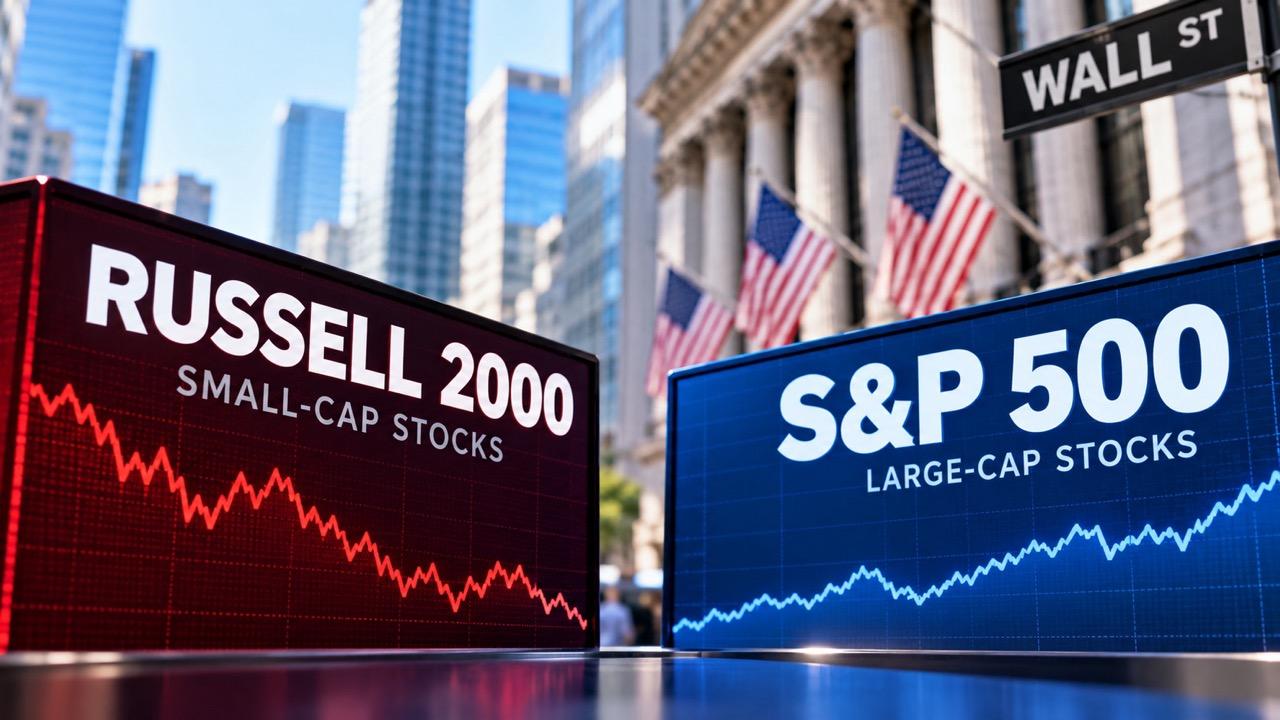
- Small-cap stocks are showing signs of weakness that the S&P 500’s near-record performance may obscure: the Russell 2000 has retreated sharply from its August peak and is testing a key technical level.
The gap between small-cap stocks and the S&P 500 is becoming harder to ignore. On October 13, the Russell 2000 fell 0.4% to 2,783.37, while the S&P 500 slipped less than 0.1% and remained close to its record high, according to the Associated Press market summary.
The difference is more pronounced over a longer period. The S&P 500 was up 14% for 2026 through October 13, compared with a 12.1% gain for the Russell 2000. But the small-cap index has fallen nearly 9% from its August record, reflecting a difficult stretch for companies that tend to be more sensitive to financing costs and domestic economic conditions.
The divergence matters because the headline index can remain strong even when a substantial portion of the market is struggling. Recent S&P 500 market-breadth data has also highlighted how gains in the benchmark can mask weaker performance among individual stocks.
Why Small-Cap Stocks Are Lagging the S&P 500
One major pressure point is the cost of borrowing. Smaller companies often have less access to inexpensive financing than large, established corporations, and some rely more heavily on floating-rate debt. When Treasury yields rise, financing costs and the returns investors demand from riskier businesses can increase.
A recent MarketWatch analysis of rising Treasury yields linked the move in long-term yields to weakness in small-cap shares, which had been among the market’s earlier winners. The Russell 2000’s decline since August has coincided with renewed concerns about inflation, energy prices and the path of Federal Reserve policy.
Large technology companies have been better positioned to withstand those pressures. Many generate substantial cash flow and have access to deep capital markets, while investor enthusiasm for artificial intelligence has supported demand for leading technology stocks. That concentration has helped keep the S&P 500 near record levels even as smaller companies have struggled.
The pattern does not mean every small company is in trouble or that the S&P 500’s gains are entirely narrow. It does show that investors are treating different parts of the market differently. The recent semiconductor earnings boom has supported some large-cap names, while smaller firms face a different mix of financing needs, profit expectations and economic exposure.
The Russell 2000’s technical position has also become a focus. On October 13, the index approached its 200-day moving average, a widely watched measure of its longer-term trend. MarketWatch reported that it was poised to close that level below for the first time since March 30, based on FactSet data. A sustained break could reinforce concerns about the small-cap trend, although one move below a moving average does not determine what happens next.
What the Russell 2000’s Weakness Means for Investors
The Russell 2000’s retreat is a warning about the uneven nature of the current market rally, not proof that the S&P 500 is about to fall. Small-cap stocks can weaken because investors expect slower economic growth, higher financing costs or lower profit margins, even while large companies continue to report solid earnings.
The distinction is important when assessing how rising bond yields affect dividend stocks and growth investors. Higher yields can make bonds more competitive with equities and place additional pressure on companies whose valuations depend on future earnings. Smaller businesses with substantial debt or limited cash reserves may be particularly exposed.
A sustained recovery in small-cap stocks would likely require more than a rebound in share prices. Investors would want to see borrowing costs stabilize, earnings expectations improve and corporate management teams become more confident about demand. Those developments could support a broader rally, but they are not yet established by the latest index moves.
The recent decline has also brought the Russell 2000 close to correction territory. A correction generally refers to a decline of at least 10% from a recent peak. The index came within roughly that distance of its August record in the previous week before rebounding.
The analysis identified potential resistance near the October 6 high, while warning that a decisive move below a key support level could leave the index vulnerable to further losses. These are technical reference points, not reliable predictions of future prices.
Investors should also avoid treating small-cap weakness as a standalone recession signal. The Russell 2000 reflects the performance of smaller publicly traded companies, whose results can vary widely by industry, balance-sheet strength and exposure to domestic demand. Its decline can reveal pressure building in parts of the market without establishing that the wider economy is contracting.
For now, the main takeaway is that the S&P 500’s resilience does not tell the whole story. The Russell 2000 is lagging, Treasury yields remain an important variable, and the next test is whether smaller companies can stabilize as investors reassess earnings and financing conditions. A sustained improvement in small-cap performance would provide stronger evidence of broader market participation; continued weakness would suggest that the rally remains uneven.