

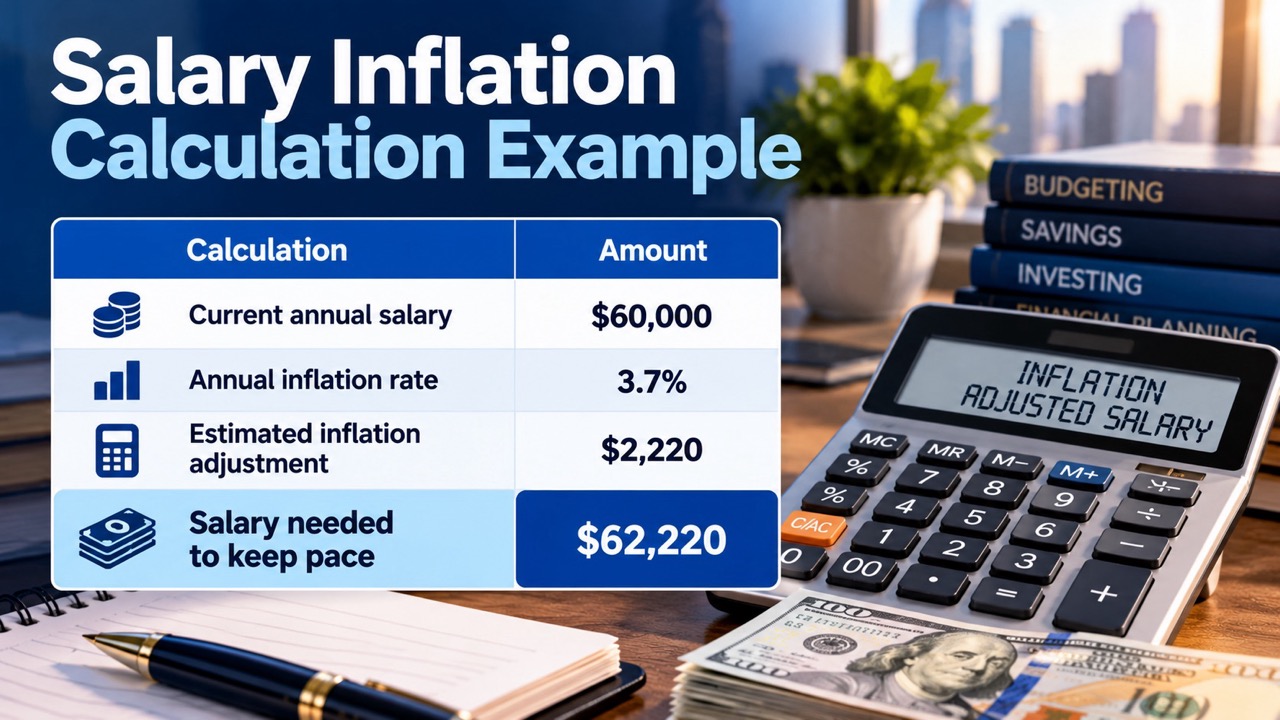
A salary inflation calculator shows how much you need to earn today to maintain the purchasing power of an earlier salary. With US consumer prices rising 3.7% over the 12 months ending in September 2026, a worker earning $60,000 would need approximately $62,220 to match the same purchasing power if their salary were adjusted by that rate.
Inflation can reduce the value of a paycheck even when the amount deposited into a bank account stays the same. When rent, groceries, transport and other household expenses become more expensive, the same salary buys less than it did a year earlier.
Use the Wealthier Today Salary Inflation Calculator to get real-time figures on what your salary should be
The US Bureau of Labor Statistics (BLS) reported that the Consumer Price Index for All Urban Consumers rose 3.7% over the year to September 2026. That figure provides a useful benchmark for workers assessing whether their pay has kept pace with rising prices.
A salary inflation calculator estimates the pay needed to preserve purchasing power over a selected period. It can also help employees evaluate a proposed raise, prepare for salary negotiations or compare earnings across different years.
How to Calculate Your Inflation-Adjusted Salary
The simplest way to estimate the salary required to keep up with inflation is to multiply your current salary by one plus the inflation rate.
Salary adjusted for inflation = Current salary × (1 + inflation rate)
Convert the inflation percentage into a decimal before calculating. For example, 3.7% becomes 0.037.
Consider a worker earning $60,000 annually who wants to estimate the salary needed to maintain the same purchasing power after a year of 3.7% inflation.
Use the Wealthier Today Salary Inflation Calculator to get real-time figures on what your salary should be
In this example, the worker would need an annual raise of $2,220, or 3.7%, to keep pace with the measured increase in consumer prices. A raise below that level would generally mean a decline in purchasing power, while a larger increase would represent a gain before accounting for taxes and changes in personal expenses.
For a more precise comparison between two specific periods, use the CPI index values rather than a single annual inflation rate. The BLS provides an official inflation calculator, while its CPI income guidance explains how price indexes are used to measure real income.
The index-based formula is:
Inflation-adjusted salary = Earlier salary × (Later CPI ÷ Earlier CPI)
This method is useful when comparing a salary from several years ago with the amount needed today. The US Census Bureau's guide to current and constant dollars explains the same principle for adjusting income estimates across time.
How to Tell Whether Your Raise Has Beaten Inflation
A salary increase does not automatically mean that your financial position has improved. To estimate whether your pay has gained purchasing power, compare your salary growth with inflation over the same period.
For example, if your salary rises from $60,000 to $62,000, your nominal raise is approximately 3.33%. If inflation over that period is 3.7%, your pay has not fully kept pace with the overall rise in consumer prices.
A useful approximation for real salary growth is to subtract the inflation rate from your salary growth rate. For a more accurate result, divide one plus the salary growth rate by one plus the inflation rate, then subtract one.
Real salary growth = [(1 + salary growth rate) ÷ (1 + inflation rate)] − 1
Use the Wealthier Today Salary Inflation Calculator to get real-time figures on what your salary should be
This distinction matters when planning household finances. If your income is not keeping pace with living costs, you may need to revisit discretionary spending, savings targets and debt repayments. Workers making longer-term financial plans can also review their approach to investing to understand how savings and investments fit into their broader goals.
Inflation calculations have limitations. The CPI measures price changes across a representative basket of consumer goods and services, not the exact expenses of every household. Someone facing a large rent increase or higher childcare costs may experience a different personal inflation rate from the national figure. The CPI also does not account for changes in income taxes or investment returns.
For that reason, treat the result as a benchmark rather than a guaranteed salary recommendation. Use the inflation rate for the period you want to measure, compare it with your actual salary increase and consider whether your own living costs have risen faster or slower than the national average.
The key takeaway is straightforward: if your salary grows more slowly than prices, your purchasing power falls. A salary inflation calculator helps put that gap into dollars, giving you a clearer starting point for pay negotiations and financial planning.