
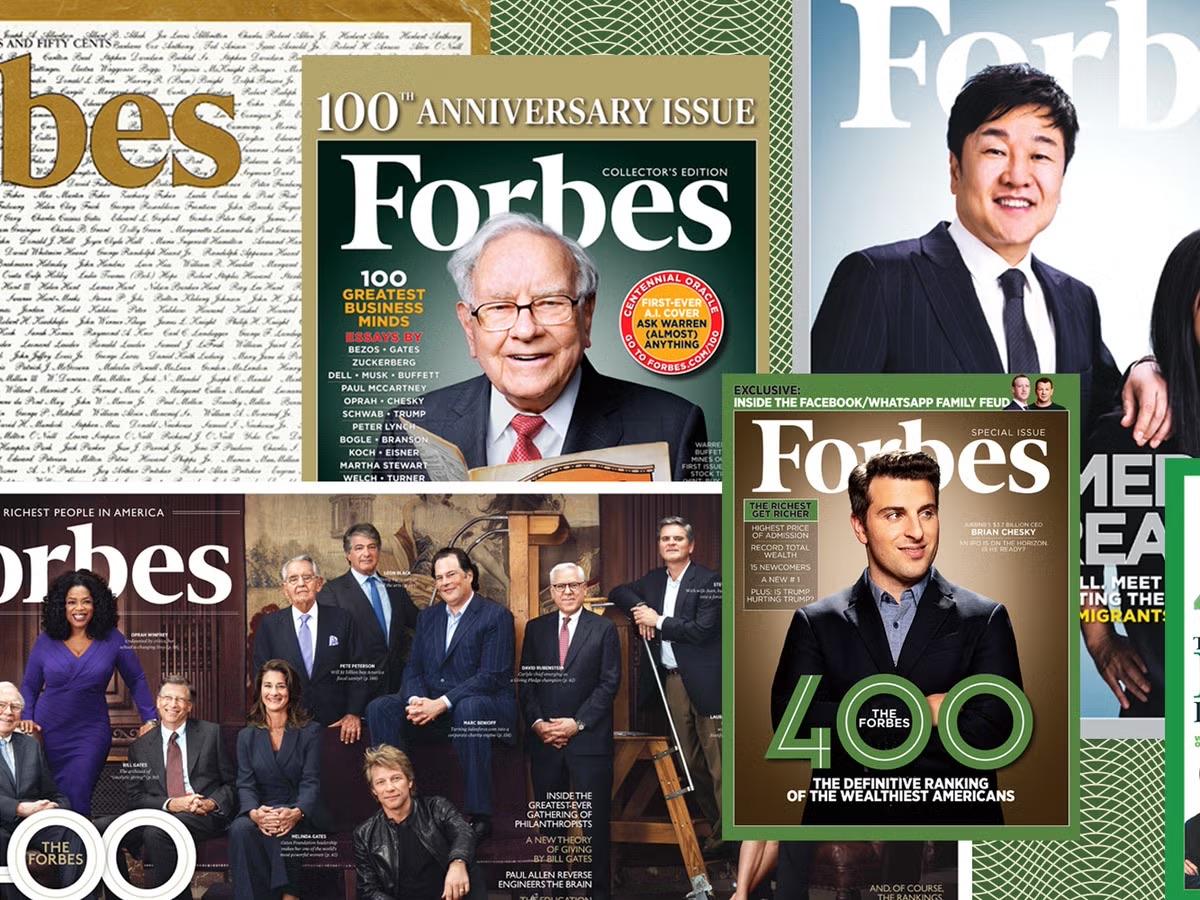
The richest people featured on Forbes are no longer simply accumulating wealth. Despite their considerable resources, they are still actively investing and reshaping industries through artificial intelligence (AI), infrastructure, private equity, energy, biotechnology, and space exploration. While global financial markets continue navigating inflation, elevated interest rates, and geopolitical uncertainty, the world's wealthiest individuals are deploying hundreds of billions of dollars into long-term investments they believe will define the next decade of economic growth.
The latest Forbes World’s Billionaires list shows 3,428 billionaires with a combined $20.1 trillion in wealth as of March 1, 2026. In other words, the richest people are not behaving like investors preparing for a deep freeze. They are behaving like owners looking for the next leg up. According to the latest Forbes billionaire rankings, global billionaire wealth has climbed to record levels, with many of the world's largest fortunes tied to technology, luxury goods, finance, retail, and industrial businesses.
For investors, tracking where billionaires are allocating capital often provides valuable insight into long-term economic trends. From AI data centers and semiconductor manufacturing to renewable energy projects and private credit, the investment priorities of the ultra-wealthy increasingly offer a roadmap for where global capital is headed.
Forbes Billionaires Are Putting Their Money Into AI, Infrastructure, And Long-Term Growth
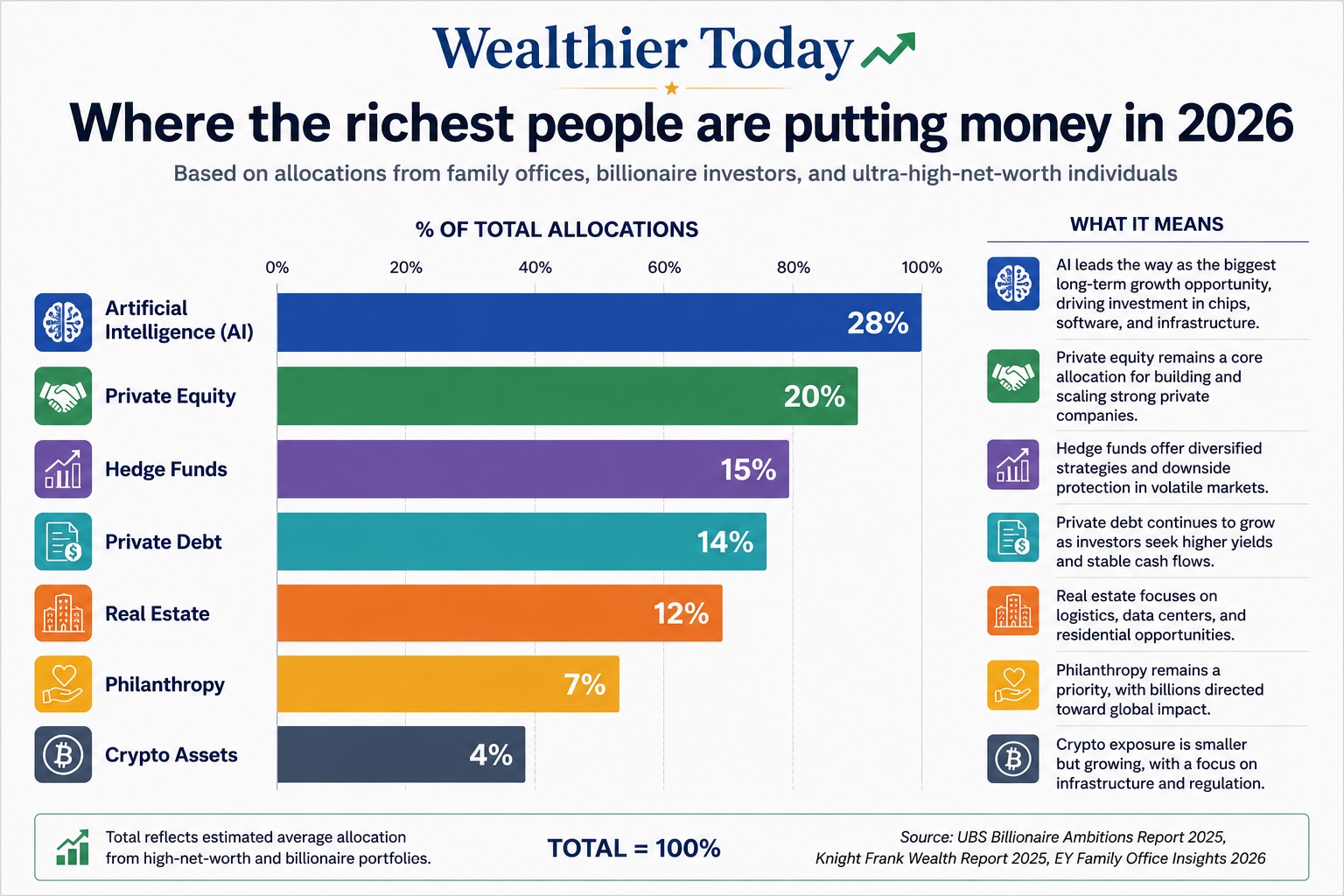
One of the clearest themes emerging from the latest Forbes rankings is that the richest people continue to double down on artificial intelligence. Technology leaders have committed hundreds of billions of dollars to AI infrastructure, including advanced chips, hyperscale data centers, cloud computing networks, and large language models, and they’re still not done. So far, industry analysts estimate global AI investment could exceed $1 trillion over the coming decade, making it one of the largest capital investment cycles in modern history.
Not surprisingly, several members of the Forbes billionaire list have dramatically increased spending on semiconductor manufacturing and computing infrastructure as demand for AI accelerates. In addition to this, space exploration has become another major focus. Private aerospace companies continue attracting substantial billionaire capital through reusable rockets, satellite internet networks, lunar exploration, and national security contracts, and one example is Elon Musk’s SpaceX. Due to this, the commercial space economy is expected to surpass $1.8 trillion by the 2030s.
In addition to technology spending, energy remains another priority, and this is a no-brainer, as technology requires energy to power it. Although renewable technologies continue expanding, many billionaire investors maintain exposure to oil, natural gas, nuclear energy, and electricity infrastructure. Growing AI adoption is expected to significantly increase electricity demand, creating new investment opportunities across power generation, grid modernization, battery storage, and transmission networks, and these world’s richest people are taking advantage of this.
Healthcare is also playing a major role in these billion-dollar portfolios. Biotechnology companies developing groundbreaking treatments such as cancer therapies, obesity treatments, gene editing technologies, and personalized medicine continue attracting billions of dollars in funding. With the aging population rising rapidly, healthcare spending is expected to rise for decades.
Naturally, real estate remains an important component of billionaire portfolios despite higher borrowing costs. But this goes beyond just having real estate as a primary residence. Publicly available data shows that many of the richest people continue acquiring logistics facilities, industrial warehouses, luxury residential properties, and data-center real estate rather than traditional office buildings. Digital infrastructure has become especially attractive as cloud computing and artificial intelligence expand globally, and the demand for real estate needed to house these units is rising.
One asset class that is also gaining popularity rapidly among the Forbes richest people is private credit. These large family offices and billionaire investors are increasingly providing the financing needed directly to businesses instead of relying solely on traditional banks. As a result, the private credit market has grown into an industry worth well over $2 trillion, offering higher yields than many conventional fixed-income investments.
Richest People On Forbes Are Diversifying Beyond Public Stocks
The richest people named by Forbes are also increasingly emphasizing diversification, moving beyond public equities. Many billionaire portfolios now combine publicly traded stocks with private companies, venture capital, infrastructure assets, farmland, commercial real estate, private equity, commodities, and alternative investments. This seems to be paying off as companies such as Anthropic are reaching trillion-dollar valuations before even going public.
The reason behind this diversification is that it helps reduce portfolio volatility while providing access to industries that may never become publicly listed. Several billionaire investors continue allocating capital to technology startups developing robotics, cybersecurity, autonomous vehicles, quantum computing, fintech, and artificial intelligence software. These investments are helping them to take risks but also offer a wide reward margin when it goes right. While these investments involve higher risk, they also offer the potential for extraordinary long-term returns if successful.
After the historic rally that saw it hit all-time highs above $4,300 in 2026, gold has quietly returned to favor among many wealthy investors. Following renewed demand across the board, bullion has delivered impressive gains over the past year. As a result, some family offices have increased allocations to precious metals as portfolio insurance against inflation and financial market volatility.
Digital assets are receiving selective attention as well, despite their less-than-optimal performance over the last year. But rather than making speculative cryptocurrency bets, many billionaire investors are choosing to focus on blockchain infrastructure. They often go the digital payment systems route, adding in regulated Bitcoin investment vehicles and tokenization technologies supporting institutional finance.
What The Richest People Also Do With Their Money
Besides just investing for returns, philanthropy remains another defining characteristic among members of the Forbes billionaire rankings. Many of the world's wealthiest individuals continue donating billions of dollars toward education, healthcare, climate initiatives, scientific research, poverty reduction, and global public health programs. Large charitable foundations now collectively manage hundreds of billions of dollars, making philanthropy an increasingly influential source of global investment capital. Some sometimes argue that the reason for this is for tax-relief, but it doesn’t undercut the spending that they do for philanthropy.
Outside of investing, Forbes billionaires also focus heavily on cash management. They do this through family offices by utilizing short-duration Treasury securities, money market funds, and high-yield cash-management products instead of letting the money sit. This way, they always have dry powder (cash) to deploy when a promising business or investing opportunity comes up.
Ultimately, the latest Forbes rankings reveal that billionaire wealth is not simply being preserved or sitting somewhere. It is being actively reinvested into industries expected to shape the global economy for years to come. This simply means that the world's richest people continue positioning their capital where they believe tomorrow's largest opportunities will emerge.
For everyday investors, following these capital-allocation trends does not guarantee investment success because they are for high-net-worth individuals with a lot of firepower. However, understanding where the world's wealthiest individuals are placing their money can provide a valuable perspective on the industries, technologies, and business models that many of today's most successful investors believe will define the next generation of global wealth creation.