
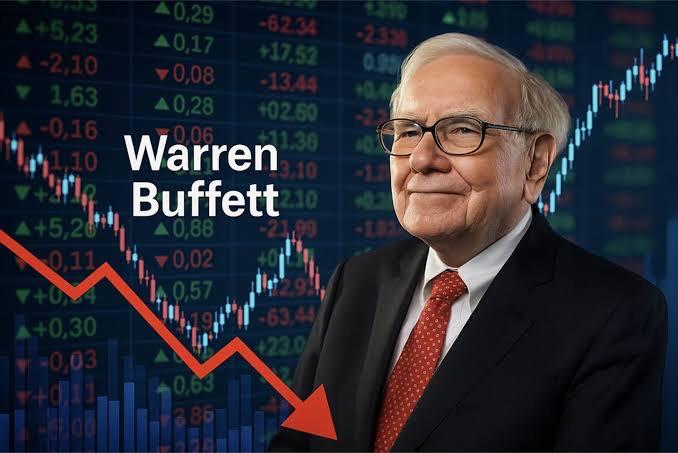
Warren Buffett has once again captured Wall Street's attention after a brief but powerful warning about market speculation reignited debate over the direction of the stock market. The Berkshire Hathaway chairman's comments come at a time when U.S. equities are trading near record highs, artificial intelligence stocks continue commanding premium valuations, and investors are increasingly questioning whether the stock market has become too expensive.
While Buffett did not predict an imminent market crash, his cautionary statement has prompted analysts and portfolio managers to revisit Berkshire Hathaway's increasingly defensive positioning. This also includes its historically large cash reserve and selective investment strategy.
Warren Buffett Warns Speculation Is Drowning Out Discipline
In a CNBC interview during Berkshire’s annual meeting, Warren Buffett made a single statement, saying, “We’ve never had people in a more gambling mood than now.” Despite him saying this back in May, the line has quickly become one of the most quoted stock market comments of the year.
Buffett has long described the market as a church with a casino attached, and the church here represents patient investing in strong businesses. The casino, on the other hand, represents short-term bets, leverage, and trading behavior that looks more like gambling than ownership.
In the Berkshire meeting, Buffett noted that a major shift is happening, and that is the casino side has become more attractive. Taking the comments further, the Berkshire chairman added that buying or selling one-day options is “not investing” and “not speculating” but “gambling,” and they have become increasingly popular. Given this, he states that there are more people in a gambling mood now than at any point he can remember.
To put this into perspective, Warren Buffett is currently 95 years old and has reportedly been investing for over 80 years, starting at age 11. This means that he has never seen the stock market lean so much toward gambling in his over 8 decades of being active in the financial industry.
Unlike what some people might think, Buffett’s warning is not just rhetoric. It lines up with a broader market backdrop that has already drawn valuation concerns from analysts. Recent coverage of Buffett’s favorite valuation yardstick, the ratio of total U.S. stock market value to GDP, which has become popularized as the ‘Buffett Indicator,’ put the reading at 233%, a record high. Buffett had once told Fortune in 2001 that investors are “playing with fire” when the metric approaches 200%, and now the indicator has crossed the warning level by more than 15%.
In recent quarters, Berkshire has accumulated a cash position exceeding $350 billion, the largest in the company's history. Rather than aggressively purchasing new companies, Buffett has instead allowed cash reserves to build while trimming several long-held equity positions. Berkshire’s own first-quarter 2026 earnings release showed about $347.7 billion in cash and Treasury bills, reinforcing the view that Buffett is still being selective about where he wants to put money to work.
Berkshire’s Response To The Current Stock Market Conditions
The stock market has produced extraordinary returns over the past two years, driven largely by artificial intelligence (AI) enthusiasm. The benchmark S&P 500 has repeatedly reached fresh all-time highs, while the technology-heavy Nasdaq has significantly outperformed broader indexes. Several of the stock market's largest companies, including Nvidia, Microsoft, Apple, Amazon, Meta Platforms, and Alphabet, now collectively account for more than 30% of the S&P 500's total market capitalization. Seeing this concentration, Buffett's widely shared warning reminds investors that market optimism can quickly reverse.
However, this defensive position has not exactly kept Warren Buffett from the stock market, as he has not suggested investors should abandon equities altogether. Even as Berkshire reduced several positions, the company initiated or expanded investments in other businesses. These include Delta Air Lines, Alphabet, Lennar, and The New York Times Company during recent quarters, as Wealthier Today reported.
Over the years, Warren Buffett has outperformed in the stock market, making him one of the foremost thought leaders in the financial industry. From 1965 through 2025, his firm Berkshire Hathaway delivered a compounded annual gain of approximately 19.9%, compared with roughly 10.4% for the S&P 500, according to the company's historical shareholder reports. This means that a $1,000 investment in Berkshire three decades ago would now be worth millions of dollars, illustrating the power of disciplined long-term investing.