
A Tuesday earnings report shows that Athletic shoes and apparel company Nike has delivered stronger-than-expected quarterly results. But the NKE stock price fell sharply after the earnings release as investors looked beyond the headline numbers. This shows a focus on slowing global demand, cautious analyst commentary, and lingering concerns about the company's turnaround strategy.
The athletic apparel giant reported fiscal fourth-quarter earnings that beat Wall Street estimates, posting adjusted earnings of $0.20 per share on $10.97 billion in revenue. Expectations before the earnings reports rose as high as roughly $0.12 per share on $10.85 billion in sales, showing that Nike is doing better than expected. But despite the positive returns, NKE stock price slipped in after-hours trading as investors questioned whether the company's recovery is gaining enough momentum.
Nike Beats Earnings Expectations, But Investors Wanted More
Although North America remained a bright spot, Nike continued to struggle in Greater China and parts of Europe. At the same time, its direct-to-consumer business remained under major pressure. This is evident in the fact that Nike Direct sales declined 7%, offsetting modest growth in wholesale revenue amid rising concerns that the company's turnaround time may be too high.
Revenue from the flagship Nike brand was essentially flat and recorded a 3% decline on a constant-currency basis. Meanwhile, the Greater China area has remained a significant weakness for the apparel brand. Converse sales also fell by roughly one-third, showing rising weakness in some parts of the business as competitors grab larger shares.
In a bid to reverse this rising weakness, Nike CEO Elliott Hill has spent the past year implementing a wide-ranging turnaround strategy centered on restoring relationships with wholesale partners, improving inventory levels, accelerating product innovation, and rebuilding consumer demand after several disappointing quarters.
While those initiatives have begun producing encouraging signs in North America, international markets remain a challenge. For example, China, which was once viewed as one of Nike's biggest long-term growth drivers, continues to experience weaker consumer spending. This is coming amid heightened competition from local athletic brands in the region. At the same time, Europe, the Middle East, and Africa have also posted weaker results than expected.
NKE Stock Price Weakness Could Be The Real Deal
At first glance, the latest earnings report appears encouraging. However, the market's reaction shows that investors were looking for stronger evidence of sustained growth rather than simply beating earnings expectations. The earnings report comes after a difficult year for NKE stock, which has lost roughly 35% year-to-date.
It also remains about 75% below levels seen five years ago, making it one of the weakest-performing components of the Dow Jones Industrial Average. The sell-off in the NKE stock has actually been one of the steepest among blue-chip consumer companies over the past five years.
Following Tuesday's earnings release, Nike shares traded around $41.05, after falling roughly 1% during the regular session and dropping around 3% further in after-hours trading as investors focused on weak forward momentum. During Tuesday's session, the stock swung between an intraday high of $43.75 and a low of $37.12, highlighting heightened volatility around the earnings announcement.
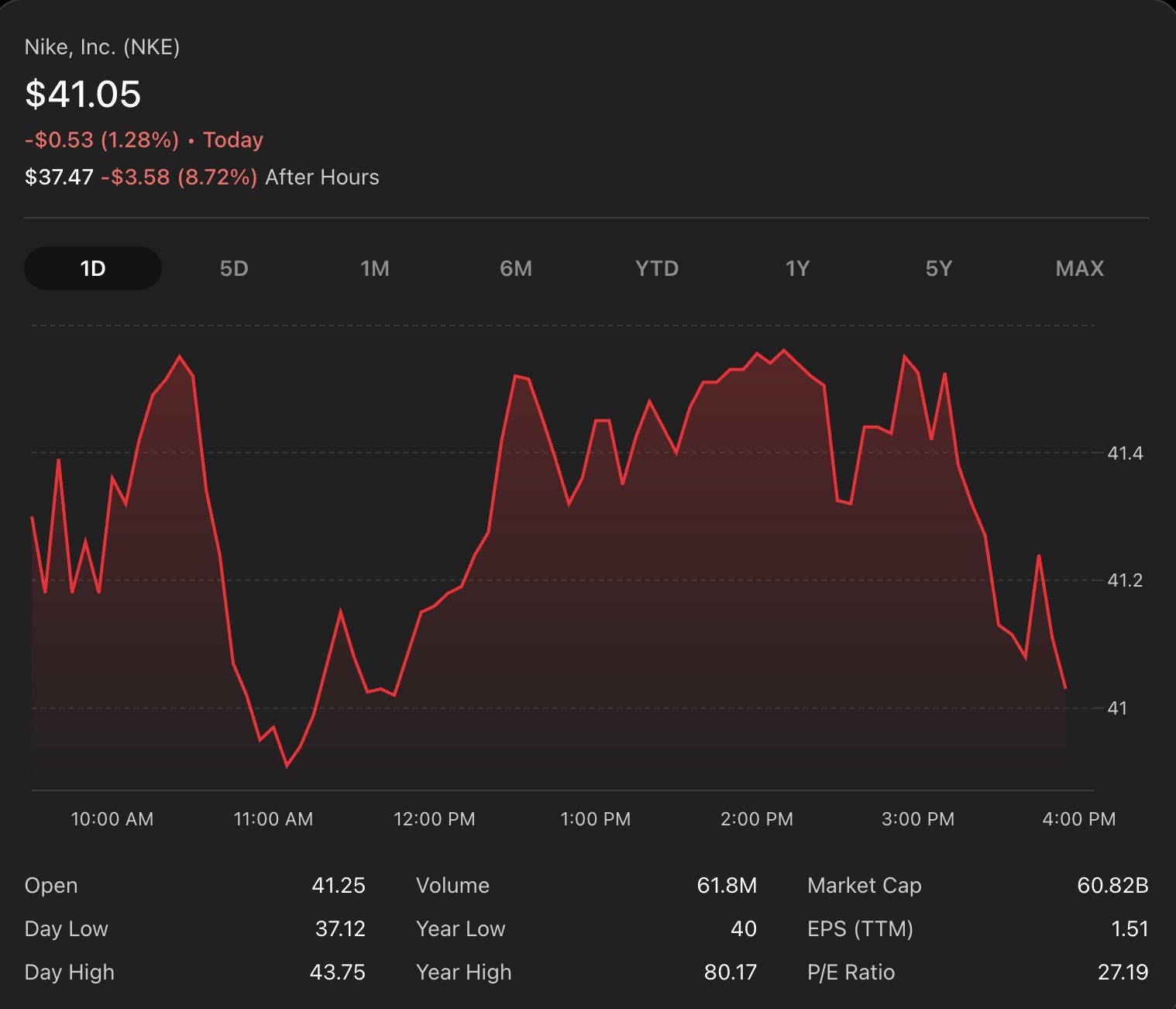
The current NKE stock price is well below Nike's all-time high of $179.10, which was recorded back in November 2021 during the pandemic-era boom in athletic apparel demand. At today's price, NKE stock is down approximately 77% from its record high, which means that the apparel brand has lost well over $190 billion in market value from its peak valuation.
The decline has been a persistent, drawn-out downtrend rather than a sudden crash. Over the past year, NKE stock has fallen about 42%. The NKE stock price is also trading near its lowest level in 12 years, suggesting that Nike may be succumbing to pressures from competitor demand.