
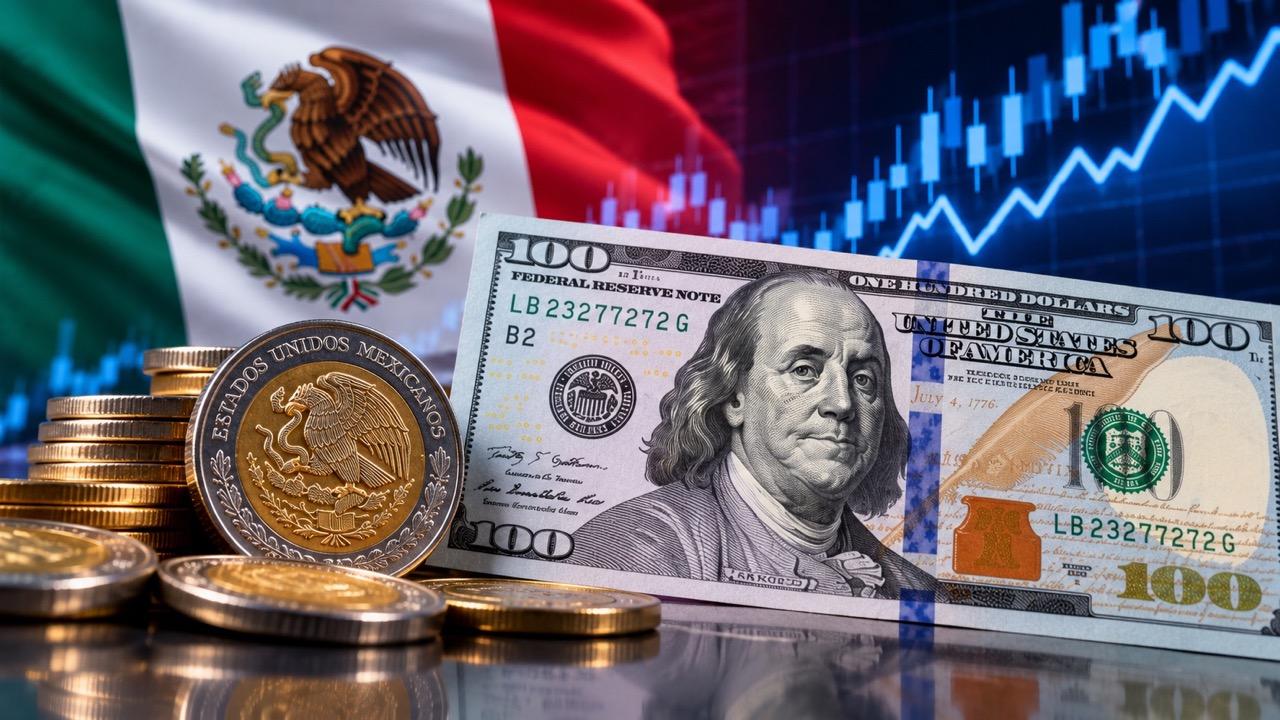
- The Mexican peso fell sharply against the US dollar on Monday, closing near 18 pesos per dollar as higher US Treasury yields, stronger demand for the greenback, and renewed tensions involving Iran pressured the currency.
The Mexican peso weakened 1.34% on Sept. 28 to 17.9445 per dollar, according to Banco de México data reported in the latest market coverage. The move left the currency near its weakest level since March and followed a period of increasing pressure on emerging-market assets.
The peso had traded near 16.85 per dollar earlier in September, making the move toward 18 a notable reversal over a relatively short period. Banco Base data cited in Mexican financial-market reports put the currency's September decline at roughly 5.9% through Monday.
The pressure came as global investors responded to higher US yields, a firmer dollar and renewed uncertainty over the conflict involving the US and Iran. Recent pressure in the US Treasury market has increased the appeal of dollar-denominated assets while raising the cost of carrying positions in emerging-market currencies.
Higher Treasury Yields Reduce the Peso's Rate Advantage
Interest-rate differentials are a major factor in demand for the Mexican peso. Banco de México kept its benchmark interest rate at 6.50% on Sept. 24, while the Federal Reserve raised its federal funds target range to 3.75%-4% on Sept. 16. The Fed's latest projections also showed a median federal funds rate of 4.1% at the end of 2026.
The difference between the two policy rates remains substantial, but it has narrowed after the Federal Reserve's September increase. This matters for currency traders because the peso has historically attracted international capital partly through its relatively high interest rates. When the US offers higher yields and the expected gap between Mexican and US rates narrows, the incentive to hold peso-denominated assets can change.
US Treasury yields have also moved sharply higher. El Financiero reported the US 10-year Treasury yield at 5.27% on Monday, compared with approximately 9.51% for Mexico's 10-year government bond.
Higher US yields can support the dollar because investors can receive greater returns on US fixed-income assets. The effect can be particularly relevant for emerging-market currencies when global risk appetite weakens.
Banco Base has described the changing rate differential as one factor reducing the attractiveness of carry-trade positions involving the peso.
Oil Prices and Iran Tensions Add to Currency Volatility
The peso's decline also coincided with another jump in crude prices. Brent crude rose above $107 a barrel during Monday's trading after President Donald Trump rejected an Iranian proposal linked to reopening the Strait of Hormuz. Higher oil prices have increased concerns about inflation and the possibility that major central banks could keep interest rates elevated for longer.
The latest move in oil prices therefore became part of the same market chain affecting the peso: geopolitical uncertainty pushed crude higher, bond yields rose, and demand for the US dollar increased. The peso also briefly traded above 18 per dollar during Monday's session before finishing that level below. El Financiero reported an intraday high near 17.95 at the time of its market update, while later market data showed the exchange rate briefly moving through 18 in electronic trading.
For Mexican households and companies that buy goods or services priced in dollars, a weaker peso raises the local-currency cost of those purchases. The effect can be particularly relevant for imported products and businesses with dollar-denominated expenses.
For financial markets, the immediate focus is likely to remain on US interest-rate expectations, Treasury yields and developments around Middle East oil supplies. The US economic calendar also becomes more important this week. Investors are awaiting inflation and employment data that could influence expectations for the Federal Reserve's next policy decisions.
As of Monday's close, the Mexican peso had lost 23.73 centavos against the dollar in a single session, taking the exchange rate to 17.9445. The currency's move toward 18 reflects a combination of a stronger dollar, higher US yields, reduced rate-differential support and heightened geopolitical risk.
The next major test for the peso will be whether those pressures persist as markets receive fresh US economic data and continue to assess oil supply risks.