
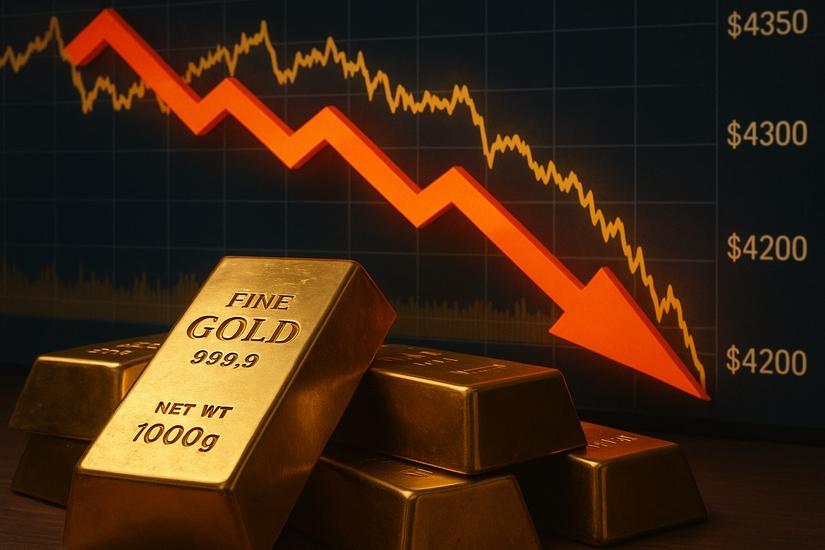
The gold market and the stock market are both flashing warning signs, leaving investors asking an unusual question: if money is flowing out of two of the world's most popular asset classes, where is all the liquidity headed to? Normally, periods of equity weakness benefit gold as investors seek traditional safe-haven assets. However, recent trading behavior has defied that historical relationship. So far, gold prices have retreated sharply even as major US equity indices struggle to regain momentum.
Gold Selloff Suggests Investors Are Choosing To Protect Liquidity
The recent decline in gold has surprised many market participants because the metal typically benefits during periods of heightened uncertainty. However, this could suggest that investors are rotating into alternative assets such as cash, short-term Treasuries, and stocking up on the US dollar instead of piling into precious metals.
According to analysts, several factors are weighing on gold simultaneously. A stronger US dollar has made bullion more expensive for overseas buyers. At the same time, elevated Treasury yields have increased the opportunity cost of holding a non-yielding asset. All of these come amid expectations that the Federal Reserve could keep interest rates higher for longer, and this has led to reduced demand for precious metals.
Rather than rotating heavily into gold, many institutional investors appear to be moving into cash equivalents and short-duration government bonds due to better yields with relatively low risk. Meanwhile, money market funds continue attracting billions of dollars as investors prioritize liquidity while waiting for greater clarity on inflation and monetary policy.
There is also the subject of profit-taking after gold's strong performance earlier this year. Following a sustained rally to new record levels above $4,300, it is no surprise some investors have chosen to lock in gains, contributing to the recent pullback despite ongoing geopolitical uncertainty. The gold price correction, however, has not fundamentally changed the long-term investment case for the precious metal, which many portfolio managers still view as an effective hedge against inflation and financial instability.
Stock Market Faces Rising Bearish Pressures
Gold is not the only asset that has weakened, as data shows that the q. According to Citi strategists, bearish positioning is also building across the stock market, adding to concerns that investors are becoming increasingly defensive. Usually, the reverse would be the case, and the stock market would rise as the gold price struggled.
However, this unusual divergence emerged, coming off the back of persistent inflation concerns, uncertainty over interest-rate policy, geopolitical risks, and slowing global economic growth. Together, these factors have created a difficult environment in which investors are picking neither gold nor the stock market. Instead, they are focusing on accumulating liquidity.
Citi explains that the weakness is already beginning to build across both the Nasdaq 100 and the S&P 500, indicating that investors are reducing exposure to risk assets. Naturally, this has extended to the crypto market, as the likes of Bitcoin have seen their prices crash as investors shy away from risk assets.
Technology shares, which have driven much of the stock market's gains over the past two years, have become particularly vulnerable to profit-taking. High valuations, combined with concerns about slowing artificial intelligence (AI) spending and tighter financial conditions, have triggered selling across these assets. But instead of moving directly from the stock market into gold, capital appears to be spreading across several lower-risk destinations.
Presently, the gold price is trending slightly above the $4,000 level, representing an almost 10% decline from its all-time high price hit earlier in the year. The S&P 500 is up 0.79% on the day, reaching 7,499.36 at the time of writing. Meanwhile, the Nasdaq Composite rose 1.52% to 26,213.72, and the Dow Jones rose 0.26% to 52,319.20 in the same time period.
Market activity
Gold Spot / U.S. Dollar
Market data and charting provided by TradingView. Data may be delayed depending on exchange availability.