
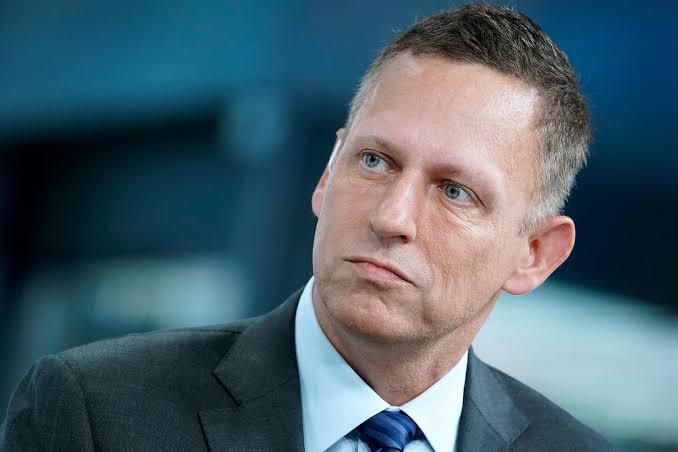
Peter Thiel is one of the hardest billionaires to pin down, and not by accident. When the paperwork landed in early 2026, the most interesting thing about Peter Thiel's portfolio was what wasn't in it.
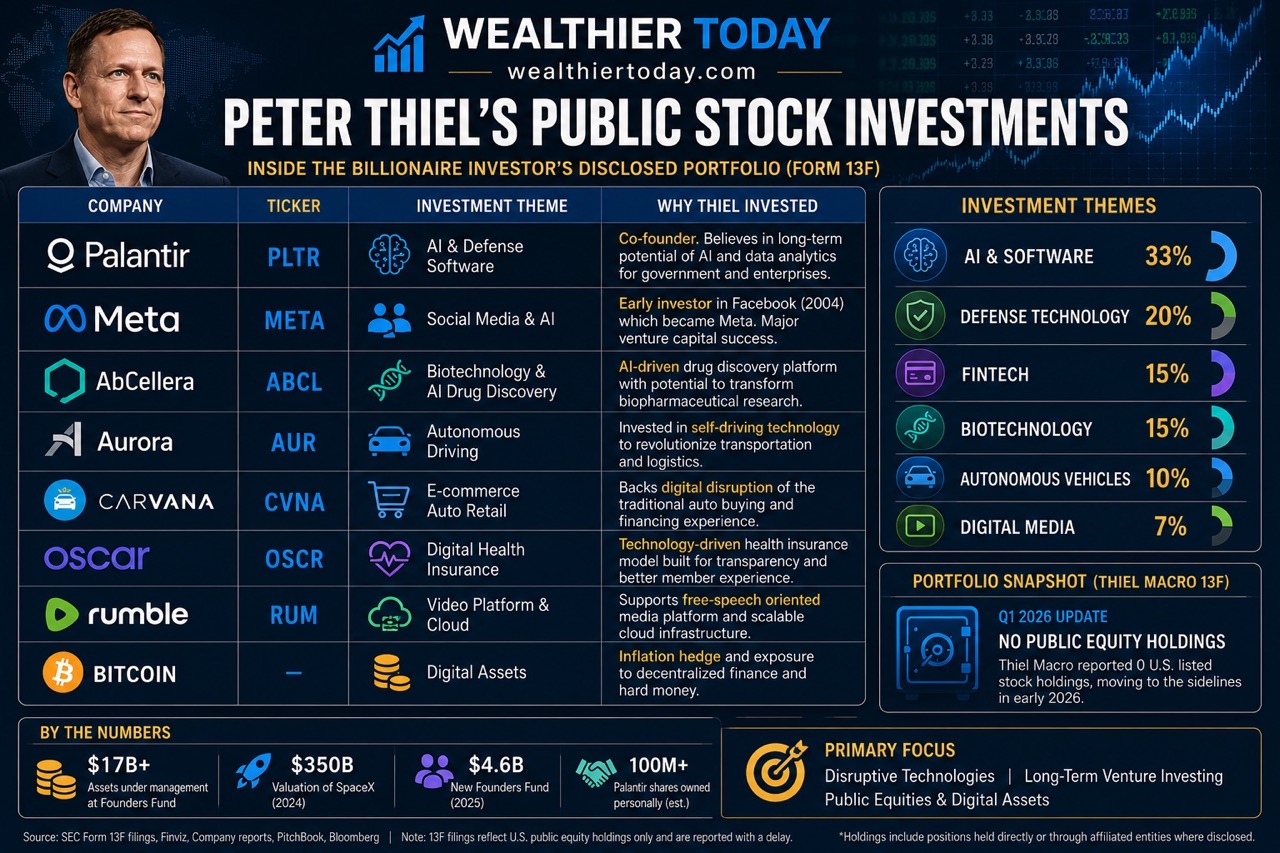
Every quarter, any investor running more than $100 million has to tell regulators which stocks they own. The disclosure is called a Form 13F, and for years, Thiel's had been a compact, closely watched document, but recently it was basically blank. The hedge fund he runs, Thiel Macro, had sold its last remaining stocks and moved to the sidelines. The man who helped write the opening chapters of the modern technology boom had, on paper, stopped betting on it.
To understand why that turned heads, you have to understand why anyone watches Thiel at all. He was the first person to put outside money into Facebook, writing a $500,000 check in 2004 that eventually came back as more than a billion dollars. Before that, he co-founded PayPal and ran it until eBay bought it, scattering a generation of founders (the so-called PayPal Mafia) across Silicon Valley.
Then he co-founded Palantir, the secretive data-analytics company that would one day be worth hundreds of billions. With his record, it's no surprise that everyone is curious about what he's seeing or can't see.
The Public Book: From AI Bull To All Cash
Thiel's exit unfolded over four quarters. Through the middle of 2025, Thiel Macro looked like a fairly ordinary AI-era portfolio. It held a large stake in Nvidia, a position in Tesla, and shares of the power producer Vistra, a wager that the electricity-hungry data centers behind artificial intelligence would soon need far more energy. He had bought Vistra early in 2025 and rode it to a gain of roughly 42 percent.
Then, in the third quarter, he began stepping away from the very trade that had made the market roar. He sold his entire Nvidia stake, around 537,000 shares worth close to $100 million. He cut his Tesla position by more than three-quarters. He exited Vistra. For a moment, it looked like a reshuffle rather than a retreat, because he also opened fresh positions in Microsoft and Apple.
By the end of the year, those were gone too. The final filing of 2025 showed Thiel Macro selling out of Microsoft, Apple, and the last of its Tesla stock and buying nothing to replace them. His next filing, covering the start of 2026, confirmed that the public stock portfolio was effectively empty.
Where did all the money go? The thing is, the 13F only captures U.S.-listed stocks. It says nothing about cash, bonds, foreign shares, or private companies, and it does not reveal bets that a stock will fall. Theil's exit really means his public American stock book went quiet, not that his fortune now sits in a checking account. Still, the signal was loud, and the timing demanded attention. When he was selling, the S&P 500 was trading at valuations last seen around the dot-com peak.
The One Stock Peter Thiel Can't Quit
There was a glaring omission from all of this: Palantir does not appear on Thiel Macro's filings because he holds it through personal investment vehicles rather than the fund. He co-founded the company in the early 2000s and has served as its chairman ever since, and he still owns something on the order of 100 million shares, a stake worth well over ten billion dollars. Here, too, he has been a steady seller, though a patient one. Using pre-scheduled trading plans, the legal mechanism that lets insiders sell without accusations of trading on secrets, he has parted with tens of millions of shares since 2023. Early in 2026, he filed to sell up to two million more, worth around $280 million. Analysts mostly shrugged, reading it as a founder taking profits after a long run rather than a loss of faith. He still owns far more than he has sold.
Beyond Palantir, a handful of Thiel's earliest bets are now stocks anyone can buy, each a small monument to a moment he saw before the rest of the world did. Facebook became Meta. LinkedIn, another early investment, was swallowed by Microsoft for $26 billion in 2016. PayPal trades on its own again. The review site Yelp, the lender SoFi, and the message board Reddit all reached the public market after early backing tied to Thiel or his funds.
The Empire You Can't Buy
For all the attention the public trial gets, it is the smaller part of the story. Most of Thiel's real exposure sits in companies you cannot buy at any price, at least not without an invitation.
His venture firm, Founders Fund, manages roughly $17 billion and closed a fresh $4.6 billion fund in the spring of 2025. Its portfolio reads like a map of the private market's crown jewels. It was an early backer of SpaceX, valued at around $350 billion in late 2024. It holds Stripe, the payments giant. It led a billion-dollar round in the defense-technology company Anduril that pushed its value past $30 billion in mid-2025. Thiel-linked money is threaded all through the AI boom he seemed to be abandoning in public, with positions connected to OpenAI and newer names like Ramp, Crusoe, and Cognition. To own any of these, you need access to private markets that ordinary investors simply do not have.
Is Peter Thiel Early, Or Wrong?
By the middle of 2026, the answer started to look less like fear and more like foresight. The AI trade that had carried the market began to wobble. Memory-chip makers, the new "neocloud" providers, and the semiconductor stocks that had led the charge sold off hard, and money began rotating out of the crowded winners.
It would be a mistake to read too much certainty into any of it. A 13F is a snapshot already weeks old by the time the public sees it. Thiel has been wrong before, and a similar move to cash he made years earlier spared him some losses while also costing him some gains. He is not infallible. He is unusually willing to sit out a party.
So what's the real list? The through-line isn't any single stock; it's about his temperament. Thiel buys contrarian, concentrates aggressively, and isn't afraid to hold nothing at all. For a fuller picture of where the ultra-wealthy are placing their chips right now, see the stocks billionaires own most.