
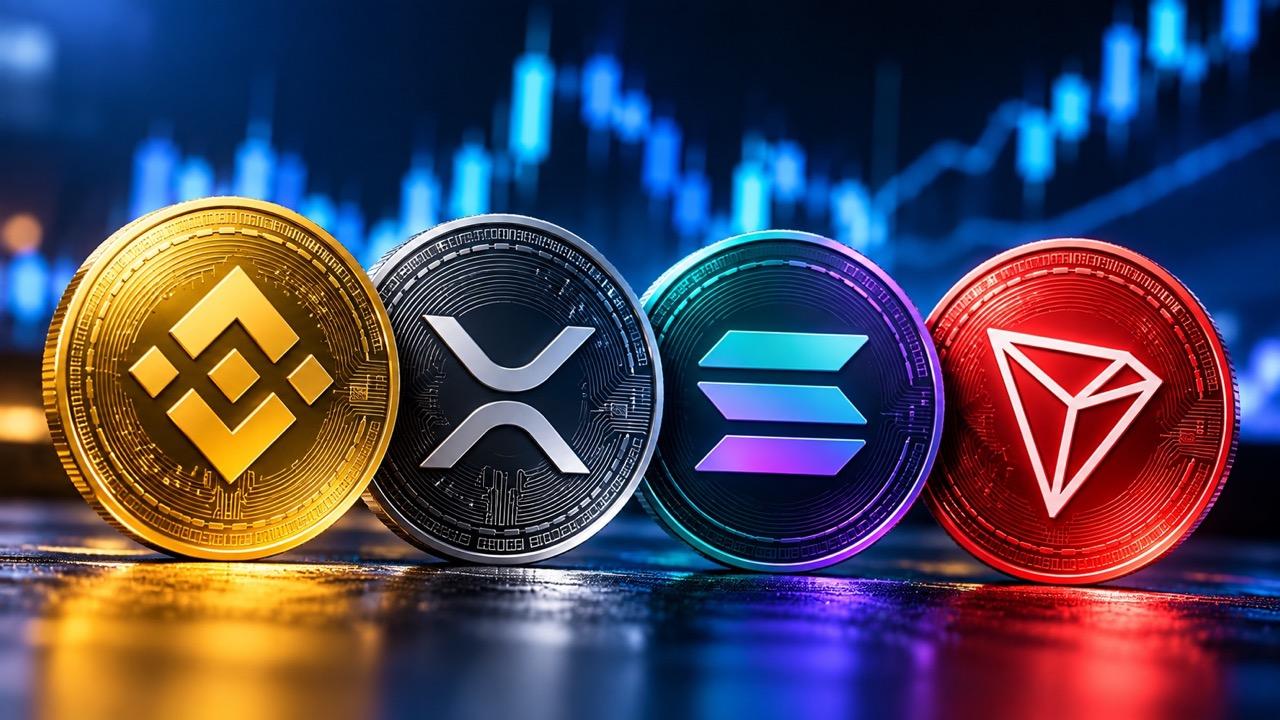
- Bitcoin and Ethereum remain the two largest cryptocurrencies by market value, but several large-cap networks offer investors exposure to different parts of the digital-asset market.
Investors who feel they missed the major moves in Bitcoin (BTC) and Ethereum (ETH) still have a wide range of cryptocurrencies to consider. The market now includes established networks focused on payments, decentralized finance, stablecoins, tokenized assets, and other blockchain applications.
Current market data places BNB, XRP, Solana and TRON among the largest crypto assets outside Bitcoin and Ethereum, although their market values and prices can change rapidly. CoinMarketCap's latest data puts BNB at roughly $102 billion in market capitalization, XRP at about $95 billion, and Solana at around $70 billion.
That does not mean these assets are guaranteed to repeat Bitcoin or Ethereum's historical performance. Each has a different network, token model, and use case.
BNB, XRP and Solana Bring Different Crypto Use Cases
BNB (BNB)
BNB (BNB) is the native token of the BNB Chain ecosystem and is used for transaction fees and applications across the network. BNB Chain says BNB also supports activity across decentralized finance, payments, and other applications.
BNB Chain has continued expanding its infrastructure in 2026. Its roadmap targets higher transaction capacity and lower latency, while the network has also expanded into areas including tokenized assets. The BNB Chain team said in June that more than 709 tokenized stocks and ETFs were available across its ecosystem, with cumulative volume exceeding $5 billion at the time.
XRP (XRP)
XRP (XRP) has a different focus. The XRP Ledger is designed around payments and financial transactions, with XRP serving as its native digital asset. The ledger supports direct XRP transfers as well as cross-currency transactions through its decentralized exchange.
The network is also being developed for tokenization. XRP Ledger documentation describes functionality for issuing and managing real-world assets, including its Multi-Purpose Token standard and built-in trading infrastructure.
Solana (SOL)
Solana (SOL) is another large-cap alternative, with a network geared toward high-throughput applications, payments, and decentralized finance.
The Solana ecosystem has expanded its focus on payments in 2026. The Solana Foundation recently highlighted payment channels designed to handle large numbers of small transactions, while its September ecosystem updates also pointed to tokenized funds, stablecoin payments and tokenized stocks.
TRON (TRX)
TRON (TRX) provides another way to gain exposure to blockchain activity without relying primarily on the smart-contract or payments narratives surrounding Ethereum, Solana and XRP. TRON has become particularly significant for stablecoin transfers. According to TRON's own network data, USDT circulating on the blockchain surpassed $90 billion in July 2026.
The network describes itself as a blockchain supporting stablecoin payments, decentralized finance, and Web3 applications. Its TRC-20 version of USDT is used for cross-border transfers, payments, and other financial activity.
That stablecoin concentration is an important difference between TRON and the other three networks. Rather than relying on a single narrative, TRON's activity is closely connected to the movement of dollar-pegged digital assets.
For investors researching crypto investing and digital-asset markets, the four networks therefore represent different areas of the broader blockchain economy: BNB through its application ecosystem, XRP through payments and tokenization, Solana through high-throughput applications and payments, and TRON through stablecoin activity.
None of these characteristics establishes that any one token will outperform Bitcoin or Ethereum. Crypto assets remain volatile, and market capitalization, network usage, and token prices can change substantially over time.
For investors who believe they missed earlier Bitcoin and Ethereum moves, the relevant question is therefore not simply which cryptocurrency has the lowest price. It is how each network is being used, where its activity is coming from, and whether the token's market value reflects those fundamentals.