

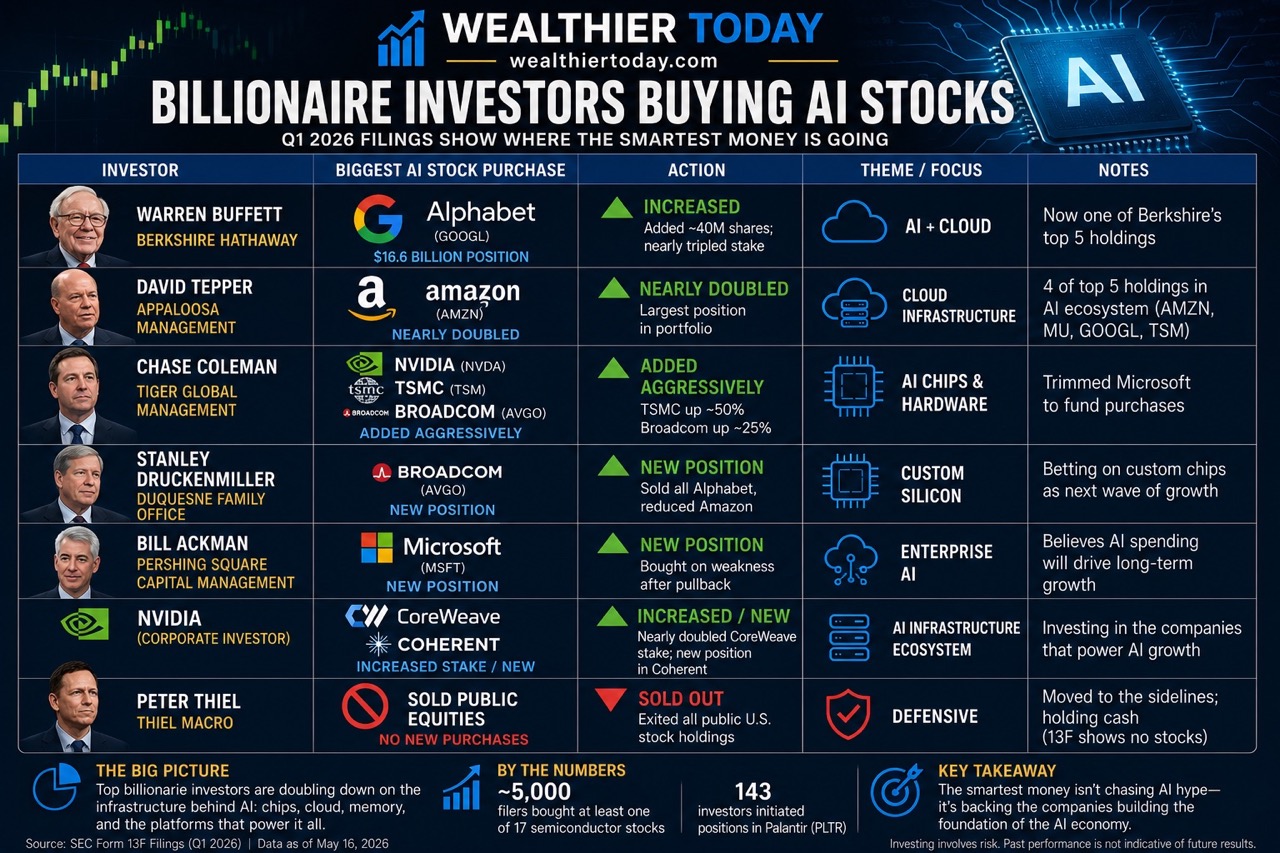
Not every heavyweight is running from AI stocks. While some famous names have pulled back, such as Peter Thiel emptying his public stock holdings heading into 2026, there has been a distinct cohort of billionaire investors who used the most recent filing season to do the opposite: buy more AI stocks.
Every ninety days, the largest money managers must disclose their stock holdings to regulators. When the filings for the first quarter of 2026 arrived in the middle of May, they revealed two very different strategies among billionaire investors.
The interesting part was not just who was buying. It was what they were buying, because the pattern across these AI stocks turned out to be remarkably consistent.
Billionaire Investors Turn To AI Stocks Despite High Valuations
The most surprising buyer on the list was also one of the market's most cautious investors.
For most of the AI boom, Warren Buffett's Berkshire Hathaway had watched from the sidelines, remaining disciplined as many AI stocks surged to record valuations. Then, in its first full quarter under new chief executive Greg Abel, Berkshire nearly tripled its stake in Alphabet, buying roughly 40 million additional shares to build a position worth about $16.6 billion.
For a firm famous for patience, placing Google's parent company among its five largest holdings was the clearest signal yet that one of the world's most respected billionaire investors now viewed AI stocks as long-term investments rather than speculative trades.
The move also reinforced Alphabet's growing importance in artificial intelligence. Beyond Search, Google owns one of the world's largest cloud platforms while developing its own AI chips and Gemini models, making it one of the foundational AI stocks in the market.
Billionaire Investors Are Betting On The AI Infrastructure Boom
Two hedge-fund billionaire investors went even further, targeting the infrastructure powering artificial intelligence rather than the software itself.
David Tepper's Appaloosa Management nearly doubled its Amazon position, making the cloud giant its largest investment. Four of his five biggest holdings now sit at the center of today's AI stocks ecosystem: Amazon, Micron Technology, Alphabet, and Taiwan Semiconductor Manufacturing.
Chase Coleman's Tiger Global made an even bigger commitment to semiconductor AI stocks. The fund added to Nvidia, increased its Taiwan Semiconductor position by roughly 50%, and expanded its Broadcom stake by approximately 25%.
The investment thesis is straightforward. Nvidia designs the processors training AI models. Broadcom develops custom networking chips. Taiwan Semiconductor manufactures the overwhelming majority of advanced processors powering artificial intelligence worldwide.
Interestingly, Coleman financed much of the buying by trimming Microsoft, illustrating that even committed believers in AI stocks continue rotating between industry leaders.
Stanley Druckenmiller pursued another strategy. He exited Alphabet entirely and sharply reduced Amazon before initiating a sizable Broadcom position, effectively betting that custom AI silicon would generate stronger returns than cloud computing over the next phase of the AI investment cycle.
Bill Ackman, meanwhile, viewed Microsoft's pullback as an opportunity. His new position reflected confidence that Wall Street had become overly concerned about AI spending while underestimating Microsoft's long-term earnings potential.
Perhaps the most revealing filing came from Nvidia itself.
The semiconductor giant nearly doubled its investment in CoreWeave, the fast-growing cloud company renting Nvidia GPUs to AI developers, while initiating a new stake in optical networking specialist Coherent. Rather than simply selling chips, Nvidia was investing directly in businesses supporting the broader AI stocks ecosystem.
Below the headline names, institutional demand remained remarkably broad.
Nearly 5,000 investment managers purchased at least one of 17 major semiconductor AI stocks, with Micron emerging as one of the biggest beneficiaries amid booming demand for high-bandwidth memory chips. Another 143 institutional investors initiated positions in Palantir, including Abu Dhabi sovereign wealth fund Mubadala.
Why AI Stocks Continue To Attract Billionaire Investors
Stepping back from the individual filings reveals the broader trend.
In every gold rush, the largest fortunes often belong to those selling picks and shovels. For today's billionaire investors, those "picks and shovels" are AI stocks tied to infrastructure rather than consumer applications.
That includes chip designers like Nvidia and Broadcom, semiconductor manufacturers like Taiwan Semiconductor, memory suppliers such as Micron, cloud providers including Amazon and Alphabet, and networking companies building tomorrow's AI data centers.
Even Buffett's Alphabet investment fits neatly into this theme, given Google's dominant cloud platform and heavy investment in proprietary AI hardware.
Wall Street analysts largely supported the strategy.
Wedbush analyst Dan Ives continued highlighting many leading AI stocks, maintaining bullish outlooks on Microsoft, Palantir, Nvidia, Amazon, and Broadcom while arguing that enterprise AI adoption remains in its early innings. Price targets across Micron, Amazon, and several semiconductor companies also moved higher as earnings expectations improved.
For much of 2026, billionaire investors, institutional analysts, and market momentum all pointed in the same direction.
Then sentiment shifted.
By mid-2026, many of the highest-flying AI stocks began correcting sharply. Semiconductor companies, memory manufacturers, and AI infrastructure providers gave back portions of their earlier gains as investors rotated toward financials, healthcare, and biotechnology.
Microsoft, despite continuing to post robust AI-driven revenue growth, also traded well below earlier highs.
That shift may ultimately define the next chapter for AI stocks.
History shows that market leadership rarely remains permanent. Capital leaving semiconductor leaders doesn't necessarily leave technology altogether; it simply looks for the next area offering attractive risk-adjusted returns.
For investors, the bigger question isn't whether AI stocks remain an important long-term theme. It's where billionaire investors decide to deploy their next wave of capital as the artificial intelligence boom enters its next phase.