
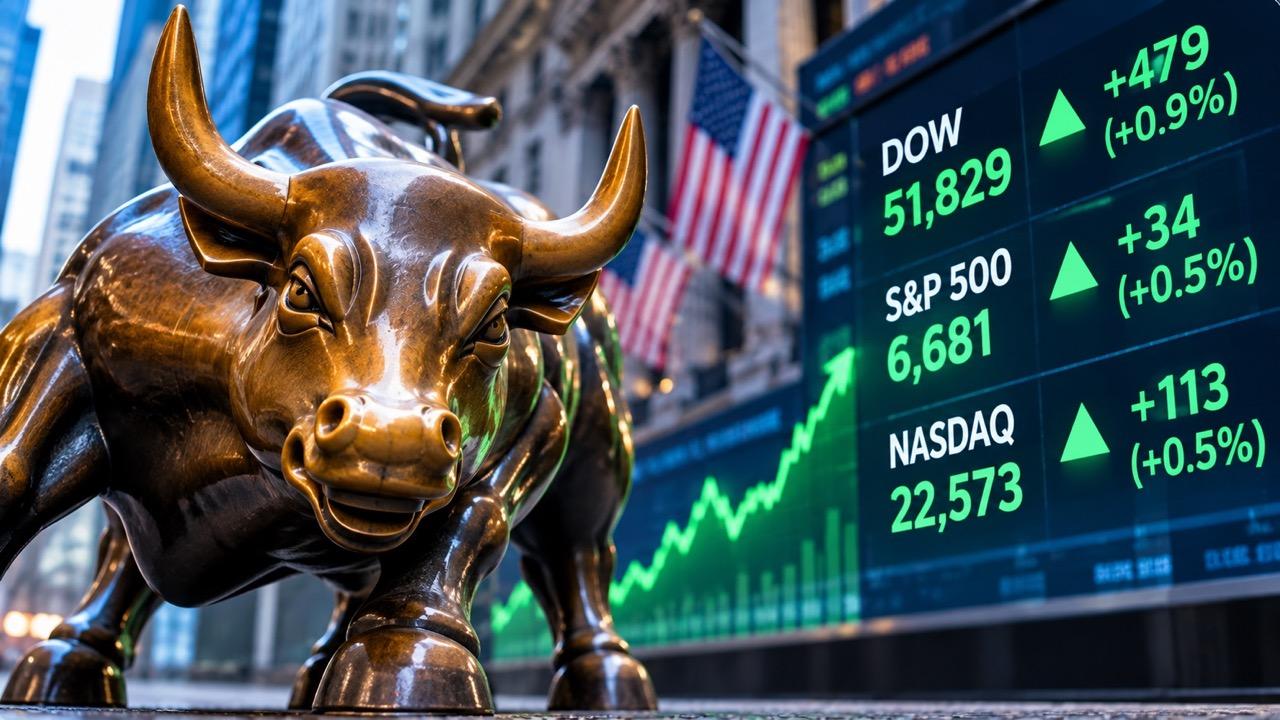
- US stocks finished higher Friday as Microsoft and other AI-related shares lifted the major indexes, helping Wall Street close a volatile week marked by rising Treasury yields, elevated oil prices and Middle East uncertainty.
The Dow Jones Industrial Average rose 479 points, or 0.9%, to 51,829, snapping a three-session losing streak. The S&P 500 gained 0.5%, while the Nasdaq Composite advanced 0.5%, according to The Wall Street Journal.
The gains came despite a difficult backdrop for financial markets. Oil prices remained elevated because of the conflict involving the US and Iran, while Treasury yields had climbed sharply during the week, increasing pressure on equity valuations and borrowing costs.
Investors also continued to assess the possibility of another Federal Reserve rate increase after the central bank raised its benchmark rate by 25 basis points on Sept. 16. The result was a market pulled in different directions: AI optimism supported technology stocks, while oil and bond yields continued to create inflation and interest-rate concerns.
Why Did Stocks Rise Despite Higher Treasury Yields and Oil Prices?
AI stocks provided much of Friday's support. Microsoft Corporation (NASDAQ: MSFT) gained about 3.7%, according to market data, after the software company unveiled new Copilot capabilities, including coding and agentic AI tools. The move made Microsoft one of the biggest contributors to the S&P 500's advance.
Akamai Technologies, Inc. (NASDAQ: AKAM) also attracted investors after announcing an $11.6 billion, seven-year agreement with Anthropic for cloud infrastructure and software. The arrangement can potentially expand by another $9 billion, bringing the total potential commitment to roughly $20 billion.
Akamai's deal is significant because it shows that the AI infrastructure trade is extending beyond the biggest semiconductor companies. Anthropic's agreement is focused on CPU workloads and distributed cloud infrastructure, highlighting demand for computing capacity outside traditional AI accelerators.
That helped reinforce the broader AI investment theme at a time when investors have been questioning how long the sector's spending boom can continue.
The other side of the market remained more difficult. US Treasury yields reached multi-year highs during the week as investors assessed inflation risks, government borrowing and expectations for additional Federal Reserve tightening. The 10-year Treasury yield had climbed above 5% earlier in the week, while the 30-year yield moved to its highest level since 2004.
Oil prices added another source of inflation pressure. Brent crude remained above $100 a barrel as traders monitored the Middle East conflict and potential disruptions to energy supplies. That combination means higher oil prices can feed into inflation while higher Treasury yields raise the return investors can obtain from relatively low-risk assets. Both can make the valuation of equities, particularly higher-growth stocks, more difficult to justify.
What Is Driving the Stock Market Outlook Into Next Week?
Friday's rally did not erase the underlying market tensions. The S&P 500 and Nasdaq were able to finish higher for the week despite several sessions in which rising yields and oil prices pressured stocks. Reuters reported that the S&P 500's forward price-to-earnings ratio had fallen to its lowest level since 2023, providing one indication that valuations had adjusted during the recent volatility.
At the same time, investors remain focused on Federal Reserve policy. Federal Reserve Chair Kevin Warsh has emphasized broader financial conditions, including Treasury yields, credit markets, asset prices, the dollar and commodities, when discussing monetary policy. Markets were pricing a significant possibility of another rate increase in October, according to CNBC reporting summarized by Wealthier Today.
That makes the next moves in bond yields particularly important for stocks. If Treasury yields continue rising alongside oil prices, investors could face renewed pressure from both higher discount rates and concerns about persistent inflation. If oil prices retreat and yields stabilize, some of that pressure could ease.
AI spending is providing a counterweight. Recent developments involving Microsoft, Akamai and Anthropic show that corporate demand for AI infrastructure and software remains strong, even as investors debate valuations and the sustainability of the investment cycle.