
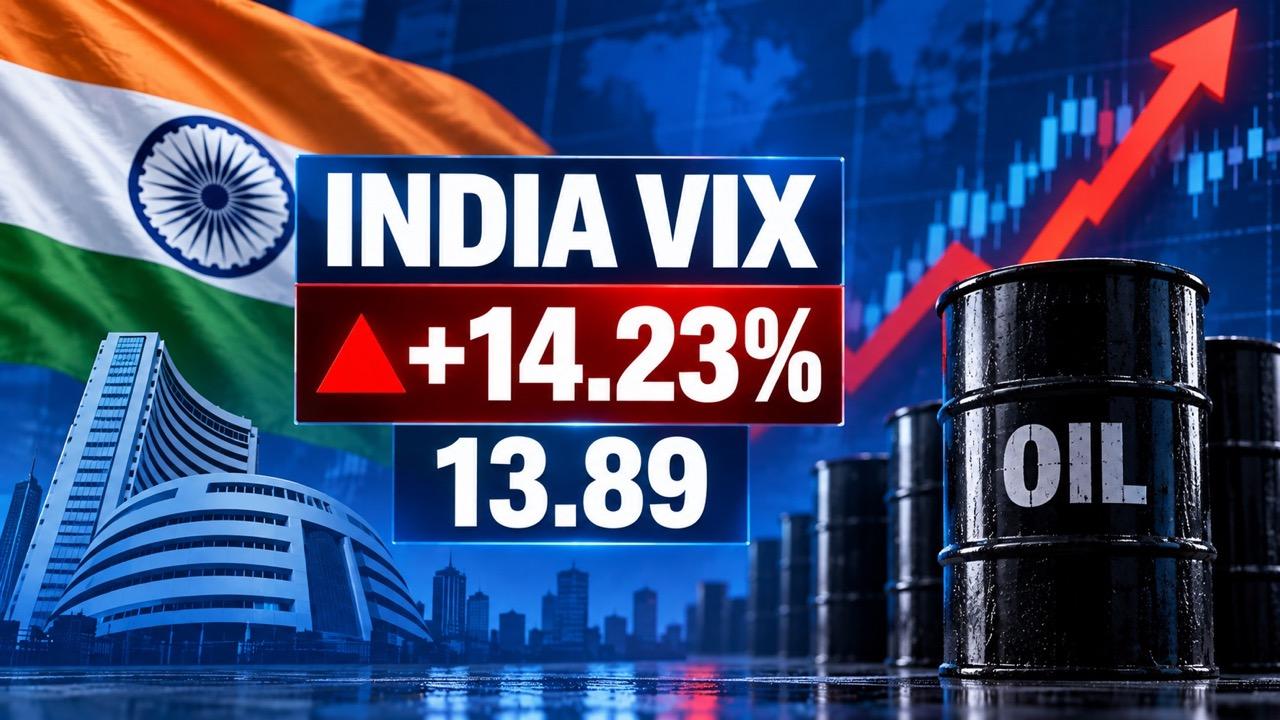
- India VIX surged more than 14% in early trading on Monday as higher crude prices, rising US Treasury yields and renewed geopolitical uncertainty pushed Indian equities lower.
India's volatility gauge jumped sharply on Sept. 28 as investors returned to the market facing renewed uncertainty around oil supplies and global markets. The India VIX, which measures the market's expected volatility for the Nifty 50 over the following 30 days, climbed to 13.89 by 10:15 a.m. IST, up 14.23% from the previous close of 12.16, according to HDFC Sky. The index reached an intraday high of 14.14 after opening at 12.16.
The move came as the Nifty 50 fell below 23,000 and the Sensex also declined in early trading. Brent crude rose above $106 a barrel, while higher US Treasury yields added to pressure on emerging-market equities.
Oil and Geopolitical Risks Drive Volatility Higher
The latest jump in India VIX follows an unusually volatile week for the Indian stock market. India VIX had fallen 4.18% to 12.16 on Sept. 25 after surging 22.64% to 12.69 on Sept. 24. The Sept. 24 increase came as crude prices moved above $100 a barrel, US Treasury yields climbed and global equity markets weakened. The latest increase therefore represents another sharp reversal in volatility expectations after Friday's brief easing.
Monday's market weakness was linked to renewed uncertainty surrounding the conflict involving the US and Iran. Reuters reported that Indian shares opened lower as oil prices rose following a stalemate in US-Iran peace talks, with Brent crude futures gaining about 2% to roughly $106.50 a barrel.
That oil move is particularly significant for India because the country is heavily dependent on imported crude. Higher energy costs can increase the import bill and add pressure to inflation and corporate margins.
Business Standard reported that the Nifty 50 fell as much as 1.10% to 22,887 in early trading, while the Sensex declined as much as 788 points. The report also pointed to higher crude prices, rising global bond yields and renewed foreign portfolio selling as factors weighing on sentiment.
The US 10-year Treasury yield climbed to around 5.20%, according to market coverage, while the two-year yield also moved higher. Rising US yields can make emerging-market assets relatively less attractive and increase pressure on currencies such as the Indian rupee.
The combination of higher oil prices, elevated bond yields and geopolitical uncertainty has therefore created a broader risk backdrop for Indian equities rather than a single-market catalyst.
India VIX Remains Below Its 2026 High
Despite Monday's increase, India VIX remains well below its 52-week high. The index reached 28.90 earlier in 2026, compared with a 52-week low of about 8.72. At around 13.89 in Monday's morning session, the VIX remained substantially below its annual peak even after the latest increase.
The recent trading pattern also shows how quickly volatility expectations have changed. India VIX closed at 10.34 on Sept. 23 after falling 5.93%, before jumping 22.64% the following day. It then declined 4.16% on Sept. 25 before rising again on Monday.
The NSE's India VIX data defines the index as a measure of expected market volatility based on Nifty 50 options. Unlike the Nifty 50 itself, India VIX does not indicate whether stocks are expected to rise or fall. A higher reading indicates that options markets are pricing in larger potential price movements.
Foreign investor flows are another factor being watched. Business Standard reported that foreign portfolio investors had resumed selling Indian equities in September after being net buyers in July and August. The selling has added another source of pressure while domestic investors have provided some offsetting demand.
For investors tracking the Indian stock market, the latest VIX move provides a real-time measure of how quickly risk expectations can change when several global factors move simultaneously.
The immediate focus remains on crude oil, US bond yields, developments in the Middle East and foreign portfolio flows. A sustained increase in India VIX would indicate that options markets continue to price greater near-term swings, while a reversal would suggest that some of the recent uncertainty is easing.
For now, Monday's jump places India VIX back in focus after a sharp sequence of moves over the past several sessions, with oil prices and geopolitical developments remaining central to the market's near-term risk outlook.