
Ethereum and Ripple are back in the spotlight after a major RLUSD burn. This comes after the move of the stablecoin to the Ethereum blockchain, expanding Ripple’s reach onto the blockchain that is currently powering the largest stablecoins in the market. Ripple’s move seems to have paid off as its RLUSD token has risen, with burns exceeding $500 million in a single month.
Ethereum And Ripple: What The RLUSD Burn Data Is Showing
On-chain data shows that Ripple burned about $544 million worth of RLUSD over the past 30 days, but the part of this catching attention is where the majority of the burn took place. Unlike what is expected, the XRP Ledger did not facilitate most of the burn. Instead, roughly 74.8% of the $555 million worth of RLUSD burned were destroyed on Ethereum, according to a community RLUSD tracker.
According to the report, Ripple burned the $544 million in RLUSD between May 23 and June 22, 2026. Of that total burn volume, $403.7 million occurred on Ethereum, which represented 74.8% of the 30-day figure. During this time, minting fell behind burns by more than $129 million, suggesting that there is a lower supply right now.
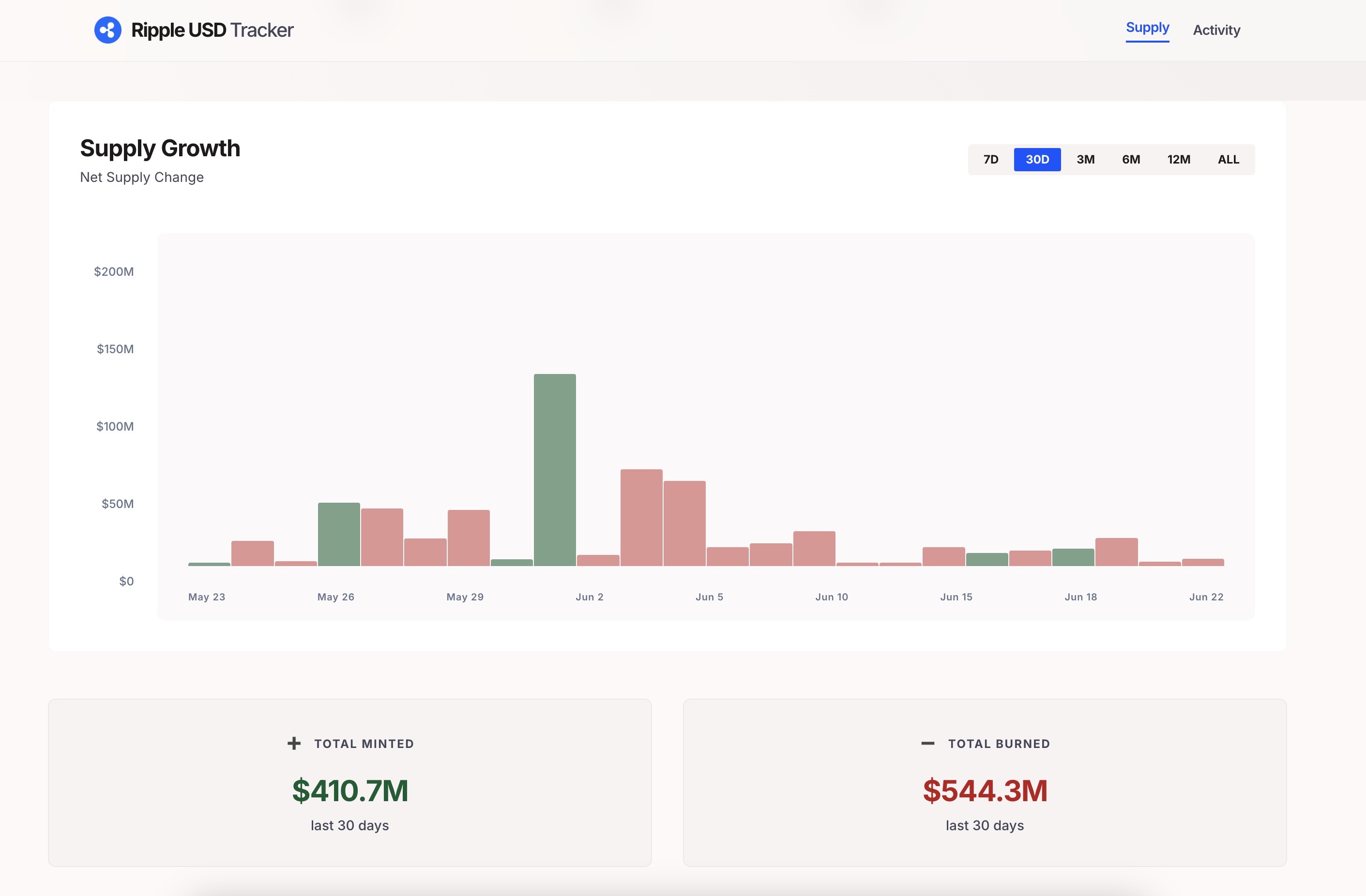
The figures matter because they show more than just token movement, but how the RLUSD stablecoin has grown since it debuted on the Ethereum network. Ripple has been managing its supply across two networks, showing what redemptions may look like in practice and why Ethereum still plays a major role in RLUSD’s growth, even as Ripple continues to build around the XRP Ledger.
However, while the burns are notable, they do not automatically mean weakness or even strength. Instead, in a stablecoin system, burns often reflect redemptions, treasury rebalancing, or supply adjustments tied to institutional demand. The only major difference is when burns outpace mints on one chain, which signifies that its usage is shifting elsewhere.
Why The Network Mix Matters For Ripple’s Stablecoin Strategy
That split between both networks is notable because RLUSD is issued on both Ethereum and the XRP Ledger, and Ripple’s own product page says the stablecoin is designed for near-real-time settlement across both networks. It describes RLUSD as “fully backed by a segregated reserve of cash and cash equivalents” and redeemable 1:1 for U.S. dollars, with issuance support on both chains.
However, the Ethereum-heavy burn pattern suggests that a large share of RLUSD liquidity has been cycling through the chain that already dominates much of the stablecoin market. Ethereum remains the deepest venue for ERC-20 stablecoin activity. Thus, it is no surprise that Ripple moved toward the Ethereum blockchain as it aims to expand RLUSD usage.
That does not prove Ripple is abandoning Ethereum. Although RLUSD’s token design on Ethereum uses standard ERC-20 mechanics, burn and mint permissions are still completely controlled by Ripple. In fact, the opposite may be true as Ripple seems to be using Ethereum and the XRP Ledger for different roles.
Ethereum remains useful for broad distribution, exchange liquidity, and DeFi compatibility, while the XRP Ledger may be better suited for Ripple’s own payments and settlement infrastructure. If RLUSD supply is being reduced more quickly on Ethereum than on the XRP Ledger, it may indicate that Ripple is allowing circulation to compress where there is less strategic need for excess liquidity, while preserving or expanding supply on the network it controls more directly.
Despite being less than two years old in the market, Ripple’s RLUSD has seen significant success. At the time of this report, its market cap is sitting above $1.62 billion, making it the 8th-largest stablecoin in the market. Its 24-hour volume has risen above $112 million, surpassing the likes of its largest competitors, such as PayPal’s PYUSD at $79 million and USDe at $73 million daily trading volume, according to data from CoinMarketCap.
Market activity
Ripple USD
Market data and charting provided by TradingView. Data may be delayed depending on exchange availability.